
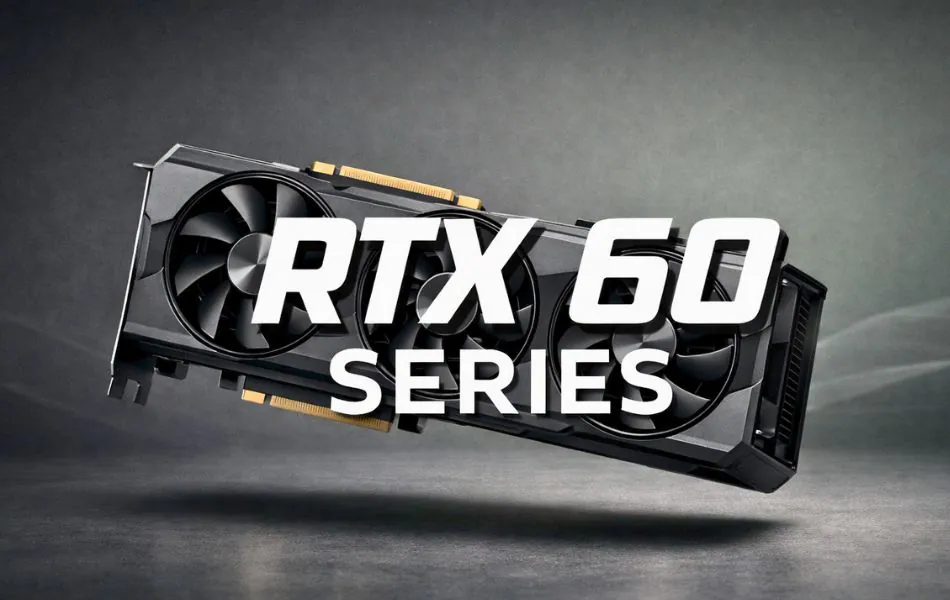
NVIDIA is unlikely to launch its next-generation RTX 6000 series gaming GPUs before 2028, signaling what could become the longest pause between GeForce generations in the company’s history. The delay reflects NVIDIA’s deepening focus on AI accelerators and data-center hardware, where demand, margins, and long-term contracts continue to outweigh consumer gaming products far.
For PC gamers and system builders, the implications are significant. There is no near-term successor to the current RTX 5000 lineup, supply conditions are expected to remain tight, and pricing pressure may persist well into 2027.
Industry reporting suggests NVIDIA had previously targeted late 2027 for mass production of RTX 6000 gaming GPUs, but those plans have slipped due to severe memory constraints tied to the global AI boom. High-bandwidth memory, a critical component for Nvidia’s data-center accelerators, is being prioritized for enterprise and hyperscale customers racing to build AI infrastructure. As a result, consumer gaming GPUs are competing for manufacturing capacity with products that deliver substantially higher revenue per unit.
This shift represents more than a short-term adjustment. NVIDIA’s data-center business has become its primary growth engine, while gaming now accounts for a smaller and less predictable share of overall revenue. With AI customers willing to sign multi-year contracts at premium pricing, NVIDIA has little financial incentive to accelerate a new GeForce generation on the traditional cadence.
Also Read: NVIDIA N1X ARM Windows Laptops Delayed to Mid-2026
Historically, NVIDIA refreshed its gaming GPUs roughly every two years, with occasional mid-cycle updates. If RTX 6000 gaming cards do not arrive until 2028, the RTX 5000 series introduced in early 2025 would remain the company’s flagship consumer architecture for at least three years, marking the longest gap between major GeForce launches in more than a decade.
The extended delay also carries broader market consequences. Retail availability for high-end graphics cards remains uneven, and prices are unlikely to normalize if production capacity stays constrained through 2027. Without a new generation to reset performance tiers and pricing expectations, many gamers may hold onto older RTX 3000 or RTX 4000 cards longer, turn to the used GPU market, or focus on mid-range options where price-to-performance ratios are easier to justify. Rather than a sudden supply collapse, the more likely outcome is market stagnation, where innovation slows and pricing remains elevated due to limited competitive pressure.
NVIDIA has not publicly confirmed any launch timeline for RTX 6000 gaming GPUs. In response to similar reports, the company has emphasized that demand for GeForce products remains strong and that it continues to ship GPUs while working closely with suppliers to manage memory availability. However, NVIDIA has stopped short of offering assurances about a next-generation gaming release, reinforcing the view that AI workloads will continue to take precedence in the near to medium term.
The prolonged gap may create an opening for rivals. AMD could strengthen its position in mid-range and upper-mainstream segments, where buyers are most price-sensitive, while Intel may benefit marginally as expectations for rapid generational leaps soften. Even so, neither competitor appears positioned to challenge NVIDIA at the ultra-high end, and the absence of RTX 6000 cards is unlikely to dent NVIDIA’s overall dominance.
For consumers, the takeaway is caution rather than alarm. There is no indication that existing RTX cards are nearing end-of-life or that driver and software support will be reduced. Still, for buyers waiting specifically for a next-generation leap in gaming performance, expectations may need to be reset. If current signals hold, 2028 is the earliest realistic window for NVIDIA’s next major GeForce architecture, underscoring how profoundly AI has reshaped the company’s priorities and turned what was once a predictable gaming roadmap into an open-ended timeline.
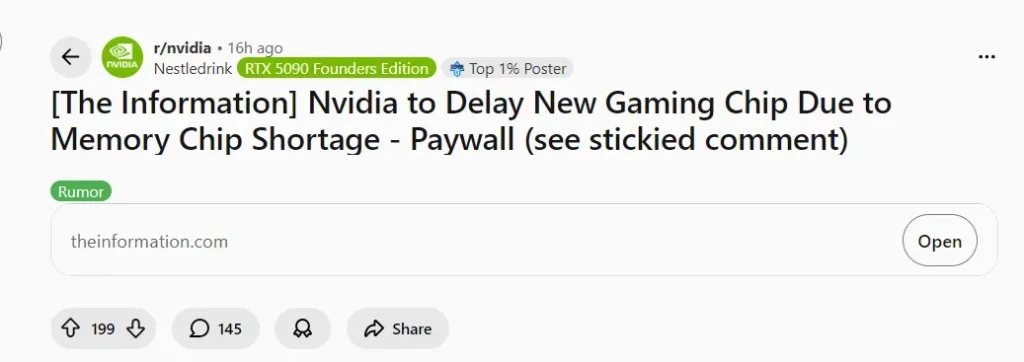
Source: Reddit