
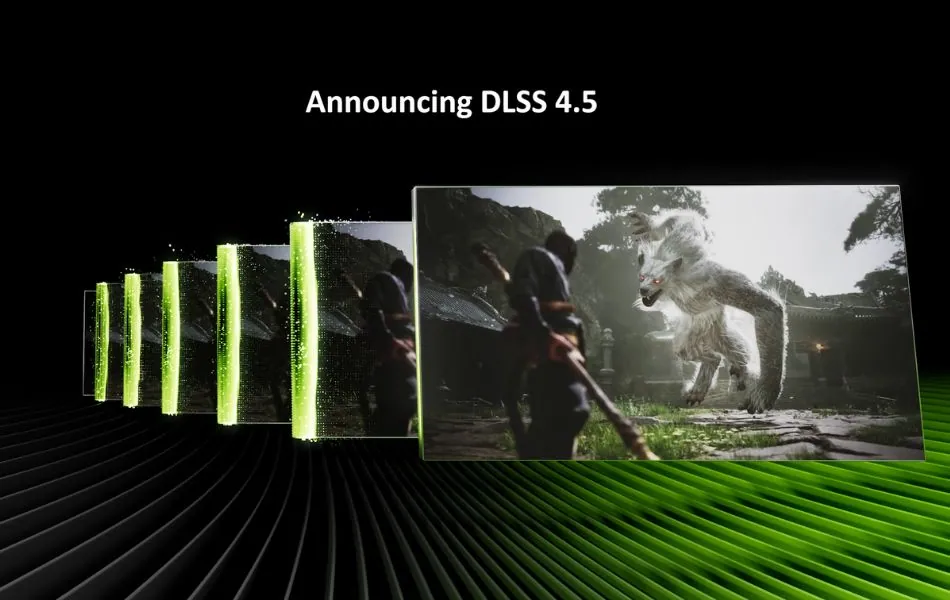
NVIDIA has confirmed that DLSS 4.5 will roll out publicly in April, introducing its most significant architectural update to DLSS since the transition to transformers. The release combines a second-generation transformer model for DLSS Super Resolution with Dynamic Multi-Frame Generation, a new system that allows the GPU to generate up to five additional frames for every traditionally rendered frame. Both features were first shown at CES 2026 and later reaffirmed during company briefings attended by European press, with NVIDIA now tying the launch to a concrete April window.
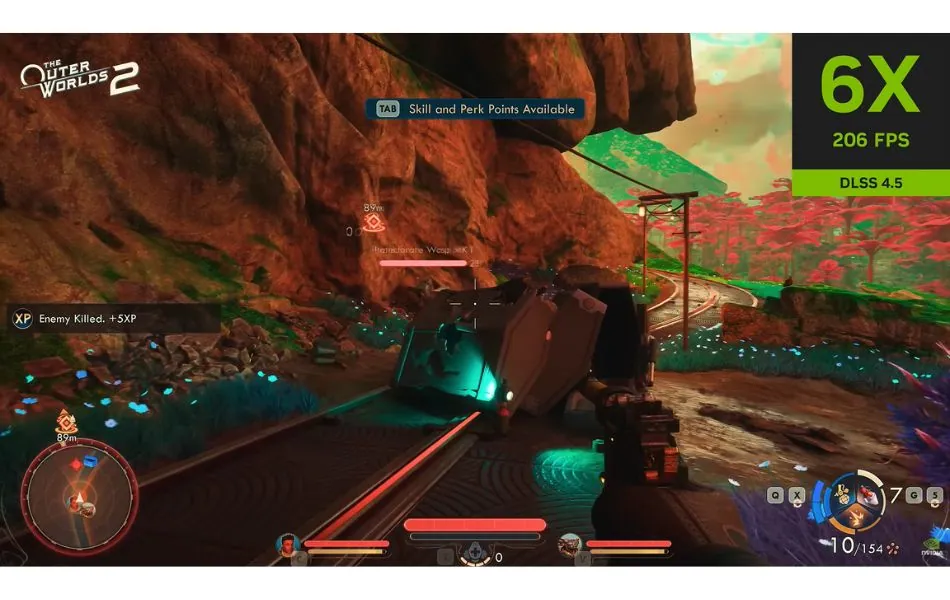
It is important to separate what is already available from what is coming later. DLSS 4.5 Super Resolution is live today and can be enabled across more than 400 supported games and applications through the NVIDIA App. Dynamic Multi-Frame Generation and the new 6x mode, however, will arrive in April and will be limited to GeForce RTX 50-series “Blackwell” GPUs.
Unlike earlier DLSS updates that focused primarily on incremental image-quality improvements, DLSS 4.5 represents a structural shift. NVIDIA is no longer treating DLSS solely as an upscaler, but as a temporal rendering system designed to support increasingly aggressive frame generation. That shift reflects the reality that modern games are often constrained by CPU throughput, power limits, and engine complexity rather than raw GPU raster performance.
At the core of DLSS 4.5 is a redesigned Super Resolution model built on a second-generation transformer architecture. Unlike earlier convolutional neural network–based models, the new transformer is trained to reason across motion vectors and longer temporal sequences, allowing it to maintain stability as more AI-generated frames are inserted between real frames. NVIDIA says the model required roughly five times more training compute than its predecessor and was trained using motion data rather than static frames alone, with inference performed in linear color space to preserve lighting accuracy.
Also Read: Apple Studio Display 2 May Launch With 90Hz Refresh Rate, Not 120Hz
The new transformer applies only to Super Resolution. NVIDIA explicitly notes that Ray Reconstruction continues to use the previous model, making DLSS 4.5 a targeted upgrade rather than a wholesale replacement of the entire DLSS pipeline.
According to NVIDIA, the most visible improvements appear in DLSS Performance and Ultra Performance modes, where edge stability, anti-aliasing, and fine detail reconstruction approach, or in some scenes exceed, native rendering. The company also claims reduced ghosting and improved temporal stability, which becomes increasingly important as DLSS scales beyond one-to-one frame interpolation.
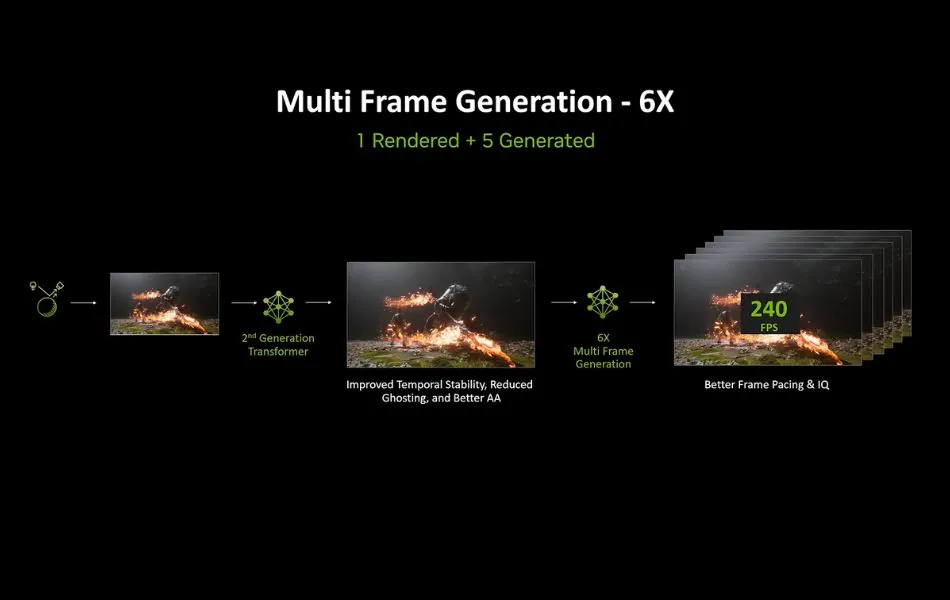
Dynamic Multi-Frame Generation expands on NVIDIA’s existing frame generation technology, which can already synthesize up to three additional frames. The new system allows the driver to adjust the frame-generation multiplier dynamically based on workload and target refresh rate rather than locking users into a fixed ratio. NVIDIA compares the behavior to an automatic transmission: demanding scenes can trigger higher multipliers, including 6x, while lighter scenes or menus fall back to lower ratios to avoid unnecessary latency and overhead.
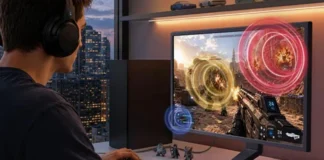
During live demonstrations shown to the press, NVIDIA displayed Dynamic Multi-Frame Generation adjusting frame-generation multipliers in real time based on scene complexity. Transitions between multipliers occurred rapidly and without visible instability, even when changes happened frequently. These observations reflect demonstrated behavior rather than a purely theoretical claim, supporting NVIDIA’s position that the system can sustain a stable output frame rate aligned with high-refresh displays without overshooting them.
As with all frame generation techniques, it is critical to distinguish between output frame rate and simulation rate. Multi-Frame Generation increases the number of displayed frames but does not advance game logic, physics, or input sampling. Generated frames are predictive interpolations designed to improve motion smoothness, not responsiveness. To mitigate added latency, NVIDIA requires Reflex to be enabled whenever Multi-Frame Generation is active.
The scope of DLSS 4.5 is therefore split cleanly by hardware generation:
| Feature | Availability |
|---|---|
| DLSS 4.5 Super Resolution (2nd-gen transformer) | Available now on RTX 20/30/40/50 |
| Dynamic Multi-Frame Generation | April, RTX 50 only |
| 6x Multi-Frame Generation | April, RTX 50 only |
| Ray Reconstruction transformer update | Not included |
NVIDIA also notes that DLSS 4.5 is backward-compatible with existing DLSS integrations. Through the NVIDIA App, users can enable the new Super Resolution model using the “DLSS Override – Recommended” preset, which automatically selects updated transformer models optimized for Performance and Ultra Performance modes. This mechanism allows DLSS 4.5 Super Resolution to be deployed broadly without requiring game-side updates.
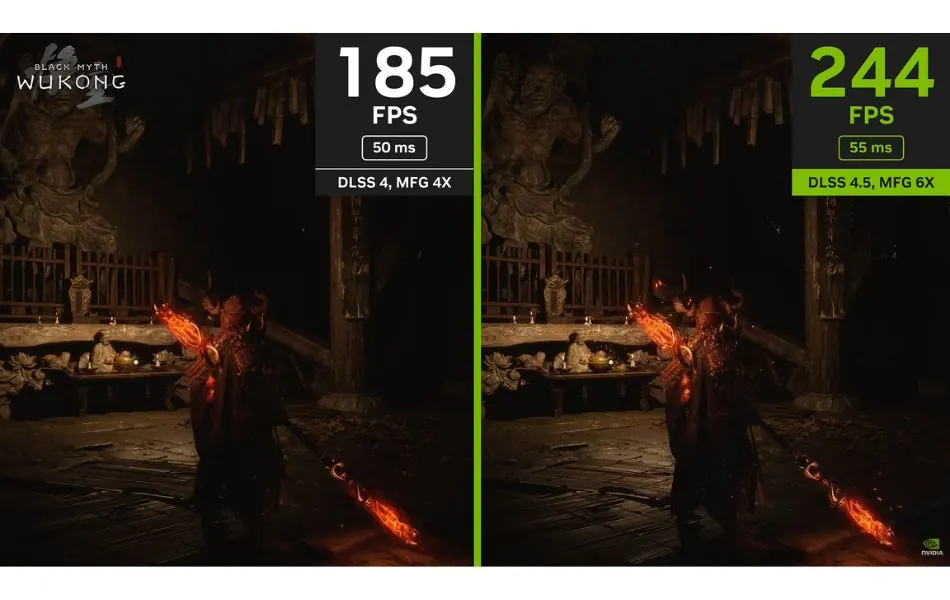
NVIDIA claims that moving from 4x to 6x frame generation can improve output frame rates by up to 35 percent in some path-traced workloads on RTX 50-series GPUs. These figures are vendor-provided and depend heavily on resolution, CPU limits, and engine behavior. Independent testing will be required to evaluate latency, artifact accumulation, and consistency across different titles.
The benefits of DLSS 4.5 will vary by use case. GPU-bound and CPU-limited games stand to gain the most, particularly cinematic and single-player titles where perceived smoothness is prioritized over simulation accuracy. Competitive and latency-sensitive games are less likely to benefit, as higher output frame rates do not reduce the time between real input samples.
With an April launch window now confirmed, DLSS 4.5 represents one of NVIDIA’s most consequential updates to its AI rendering pipeline. Whether Dynamic Multi-Frame Generation becomes a widely adopted solution or remains a niche feature will depend on how developers expose it in shipped games, and how well NVIDIA’s latency mitigation holds up outside controlled demonstrations.
Source: NVIDIA