
ASUS IoT has expanded its industrial computing lineup with the launch of the PE1000U, a compact, fanless edge PC designed for environments where local AI processing, deterministic control, and long-term reliability are more critical than raw cloud connectivity.
The system arrives as manufacturers increasingly shift vision processing, motion control, and inference workloads to the edge to reduce latency, bandwidth dependency, and operational costs.
Targeted at factory automation, autonomous mobile robots (AMRs), industrial vision systems, and vehicle-mounted controllers, the PE1000U combines Intel’s latest Core Ultra processors with a rugged, sealed design, positioning it as a deployment-focused platform rather than a general-purpose mini PC.
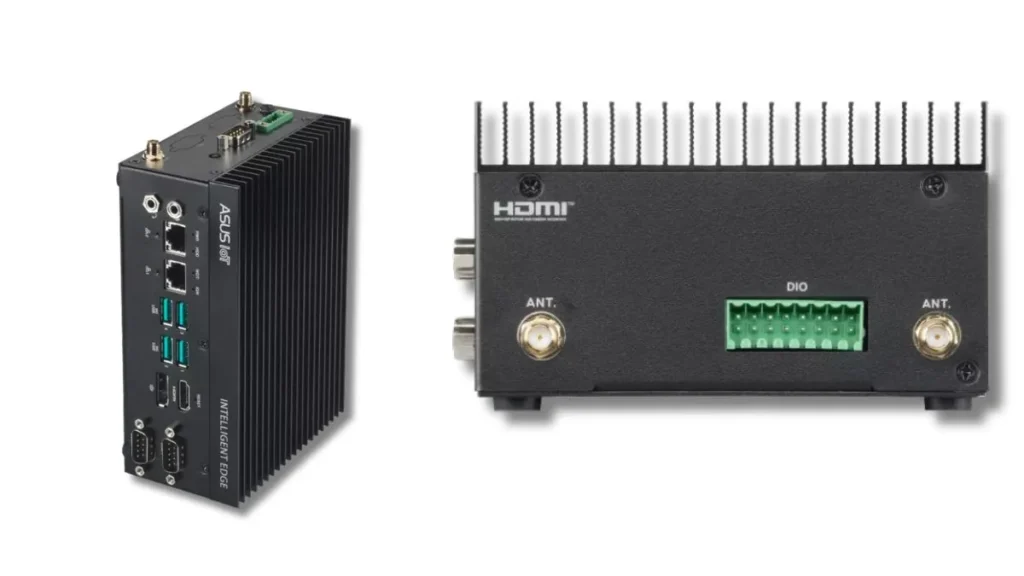
Despite its small footprint, the PE1000U is engineered for harsh conditions. Measuring 63 × 110 × 160 mm, the system is housed in an IP40-rated enclosure capable of operating across a wide temperature range from -25°C to 70°C. A 9–36V DC wide-range power input, paired with built-in ignition control, enables stable operation in mobile and vehicle-based installations such as automated guided vehicles, industrial transport systems, and on-machine controllers.
At the core of the PE1000U are Intel Core Ultra Series 2 processors, with configuration options including the Core Ultra 7 265U and Core Ultra 5 235U. Notably, ASUS IoT offers a clear architectural choice: the higher-end 265U is based on Arrow Lake-U, while the 235U uses Meteor Lake-U silicon.
This distinction allows system integrators to tune deployments based on workload requirements. Arrow Lake-U provides higher IPC and stronger AI throughput for compute-heavy vision and inference tasks, while Meteor Lake-U prioritizes efficiency and thermal balance for sustained, low-power operation. Both processors integrate CPU, GPU, and NPU resources on a single platform, enabling real-time analytics, motion control, and AI inference to run locally without relying on external accelerators.
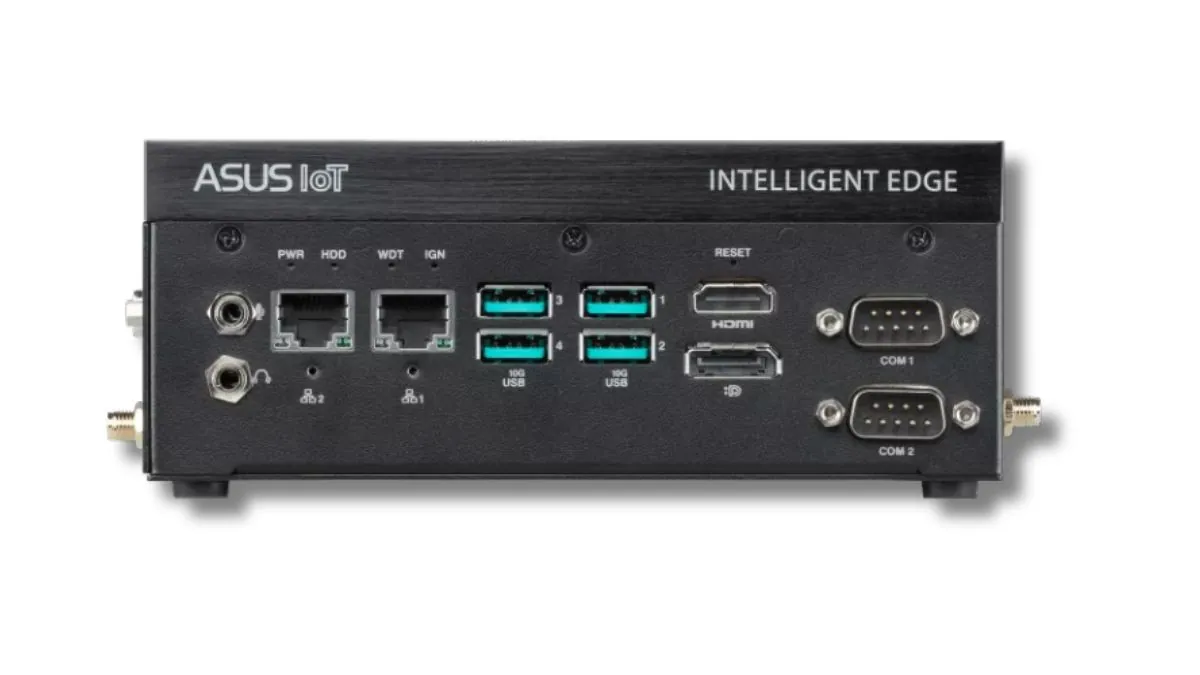
Connectivity is a defining feature of the PE1000U. The system supports up to four Ethernet ports, with dual 2.5GbE available by default, enabling high-bandwidth sensor, camera, and network aggregation. Multiple USB ports and up to four serial COM interfaces ensure compatibility with both modern peripherals and legacy industrial equipment.
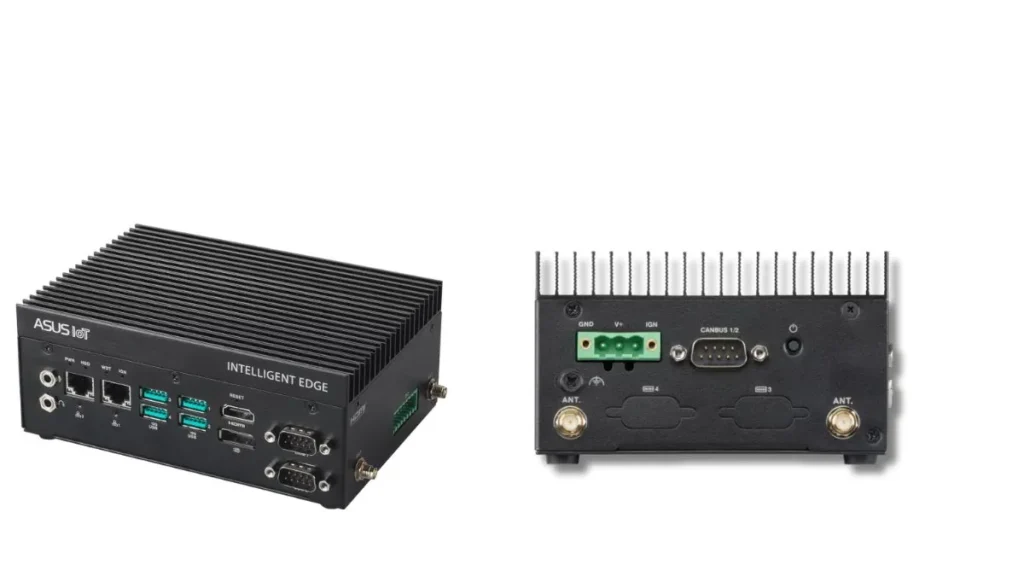
For robotics and mobile platforms, ASUS IoT has included dual CAN bus support alongside isolated digital I/O, allowing deterministic communication with motor controllers, LiDAR modules, and safety systems. Electrical isolation and predictable timing are essential in these environments, particularly where precision motion control and synchronized triggering are required.
To maximize reliability and minimize maintenance, the PE1000U employs a fully passive cooling architecture. Heat is transferred directly from internal components to the exterior chassis through a large aluminum heatsink, eliminating fans and vents that are vulnerable to dust ingress, vibration, and mechanical failure.
This sealed, fanless design enables silent operation and extended service life, especially in installations where airflow is limited or routine maintenance is impractical. The system has also undergone MIL-STD-810H vibration testing, reinforcing its suitability for mobile, vehicle-mounted, and continuously operating industrial deployments.
The PE1000U supports up to 64 GB of DDR5 memory, providing ample headroom for data-intensive vision and analytics workloads. Storage options include PCIe Gen 4 NVMe SSDs alongside a 2.5-inch drive bay, allowing flexible configuration for applications that require both speed and capacity.
Display output is handled via HDMI and DisplayPort, with support for dual 4K displays. This makes the system suitable for human-machine interfaces (HMIs), inspection stations, and machine-vision monitoring setups where multiple high-resolution outputs are required.
From a broader industry perspective, the PE1000U reflects the accelerating shift toward compact, AI-capable edge hardware that can be mounted inside control cabinets or deployed directly alongside machines. As automation systems scale and vision-based inspection becomes more widespread, platforms that combine modern AI acceleration, flexible I/O, and low-maintenance fanless designs are becoming increasingly attractive to system integrators and industrial operators.
ASUS IoT has not disclosed pricing or detailed availability, with sales expected to follow the quote-based model typical of industrial computing products. Even so, the PE1000U signals a clear strategy: aligning Intel’s latest AI-ready mobile processors with rugged, deployment-focused hardware to strengthen ASUS IoT’s presence in the industrial edge computing market.
Key Specifications: ASUS PE1000U
| Specification | Details |
|---|---|
| Processor Options | Intel Core Ultra 7 265U (Arrow Lake-U) Intel Core Ultra 5 235U (Meteor Lake-U) |
| AI Performance | Up to 22.5 TOPS (CPU + GPU + NPU) |
| Memory Support | Up to 64GB DDR5 |
| Storage | PCIe Gen 4 NVMe SSD + 2.5-inch SATA bay |
| Networking | Up to 4× Ethernet, dual 2.5GbE |
| Industrial I/O | USB, COM ports, isolated DIO, dual CAN bus |
| Cooling Design | Fully fanless, passive cooling |
| Operating Temperature | -25°C to 70°C |
| Power Input | 9–36V DC with ignition control |
| Mounting | DIN-rail |
| Dimensions | 63 × 110 × 160 mm |
| Rugged Standards | IP4X, MIL-STD-810H vibration tested |
Source: ASUS