

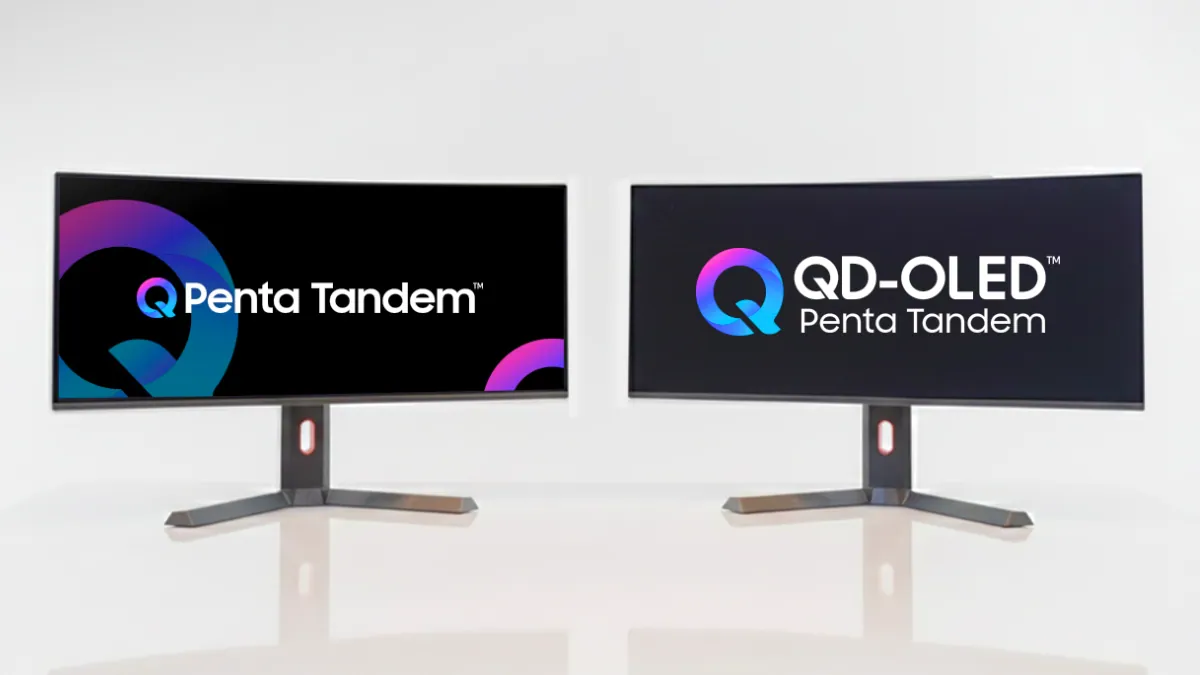
Samsung Display has formally introduced QD-OLED Penta Tandem, a new premium branding initiative built around its latest five-layer organic light-emitting structure, as the company sharpens its competitive edge in the high-end TV and gaming monitor market.
The five-layer architecture delivers up to 4,500 nits peak brightness in televisions and around 1,300 nits in monitors, improves luminous efficiency by approximately 1.3 times, and extends panel lifespan by up to two times compared to previous four-layer QD-OLED designs. The move positions Samsung more directly against LG Display’s Tandem WOLED strategy in the premium segment.
QD-OLED Penta Tandem refers to Samsung Display’s new five-layer blue OLED stack architecture that redistributes electrical load across five emitting layers, rather than four.
By spreading current and energy across an additional emitting layer, the structure reduces per-layer stress, improves energy dispersion, enhances durability, and enables higher peak brightness without proportionally increasing degradation risk. “Penta” derives from the Greek word for five, reflecting the five stacked organic emitting layers that power the updated QD-OLED panels.
The redesign replaces the previous four-layer configuration used in earlier QD-OLED generations. Blue OLED materials degrade faster than red and green in conventional structures because they operate at higher energy levels within the visible spectrum. In Samsung’s QD-OLED design, blue OLED acts as the primary light source, with quantum dots converting portions of that light into red and green without relying on traditional color filters.
4-Layer vs 5-Layer QD-OLED: Comparison
| Feature | 4-Layer QD-OLED | 5-Layer QD-OLED Penta Tandem |
|---|---|---|
| Blue OLED Stack | 4 emitting layers | 5 emitting layers |
| Efficiency | Baseline | ~1.3x higher |
| Lifespan | Standard | Up to 2x longer |
| TV Peak Brightness | ~3,000–3,500 nits typical | Up to 4,500 nits (3% OPR) |
| Monitor Peak Brightness | ~1,000 nits | Up to 1,300 nits |
| Energy Stress | Higher per-layer load | Reduced per-layer stress |
| Power Efficiency | Moderate | Improved energy dispersion |
Adding a fifth emitting layer allows Samsung to reduce stress on individual organic materials, improve energy efficiency, and either increase brightness at similar power levels or maintain brightness at lower power consumption.
Samsung reports peak brightness figures of up to 4,500 nits for televisions and around 1,300 nits for monitors under specific testing conditions measured at a 3 percent On Pixel Ratio. This means only a small portion of the screen is illuminated at maximum intensity. Sustained full-screen brightness and long-duration HDR performance remain dependent on thermal management and firmware tuning by individual manufacturers.
Stack engineering has become increasingly critical as resolutions and pixel densities rise. In high-resolution 4K monitors and ultrawide 5,120 × 1,440 panels, shrinking pixel apertures reduce the light-emitting area of each subpixel. Under these constraints, sustaining brightness without accelerating material degradation becomes more technically challenging. A five-layer structure enables higher peak luminance or improved durability under similar operating conditions.
Samsung’s approach differs structurally from LG Display’s Tandem WOLED architecture. LG’s solution uses a white OLED stack combined with color filters, while Samsung’s QD-OLED uses blue OLED light with quantum dot color conversion. Because QD-OLED avoids color filters, it can retain more light output and potentially achieve stronger color luminance at high brightness levels. This difference may translate into improved color volume performance in HDR scenes where both brightness and saturation are pushed simultaneously.
Samsung Display began QD-OLED mass production in 2021 and has gradually refined materials and stack composition. The five-layer configuration represents the most substantial structural update since launch. The company has confirmed a 49-inch QD-OLED panel with 5,120 × 1,440 resolution, commonly referred to as Dual QHD, which is expected to target premium gaming monitors. Refresh rates of 240 Hz or higher are likely in this segment. Additional sizes include 27-inch UHD, 31.5-inch UHD, and 34-inch ultrawide formats.
Existing QD-OLED gaming monitors such as the ASUS ROG Swift OLED PG32UCDM, ASUS ROG Swift OLED PG27UCDM, MSI MPG 272URX, and MSI MPG 341CQPX demonstrate how manufacturers have leveraged Samsung’s QD-OLED technology in high-end displays. Future revisions of these and similar models could adopt the five-layer Penta Tandem structure as 2026 product cycles begin.
Samsung states that panels built on the new structure can meet VESA DisplayHDR True Black 500 certification requirements. Because QD-OLED panels operate without backlights, they maintain per-pixel dimming and near-zero black performance. However, independent validation of long-term aging behavior, static image retention resistance, sustained HDR output, and power consumption under extended gaming workloads will ultimately determine the real-world impact of the structural improvements.
From a manufacturing perspective, adding an extra emitting layer increases material complexity and may influence production yields and costs. Samsung has not disclosed pricing implications, though improved durability could offset higher material costs by reducing warranty risks and enhancing long-term reliability for partner brands.
Also Read: Best Laptops for Multiple Monitors
The broader timing is strategically significant. Premium TV average selling prices remain elevated, while OLED gaming monitors continue to expand as one of the fastest-growing segments in the display market. As refresh rates climb and HDR expectations intensify, panel makers are competing not only on brightness but also on durability, efficiency, and color performance.

Despite Samsung’s internal metrics suggesting measurable gains, several questions remain unresolved. Sustained full-screen brightness levels, long-term burn-in resistance under static content scenarios, real-world power draw during 240 Hz HDR gaming sessions, and thermal behavior in ultrathin monitor designs will require third-party testing once commercial products ship.
The introduction of QD-OLED Penta Tandem underscores how central stack architecture has become in the race for premium OLED leadership. With global monitor launches expected throughout 2026 and broader TV integration underway, Samsung Display is positioning its five-layer QD-OLED technology as a foundational step in the next phase of OLED evolution.
Source: Samsung Display