
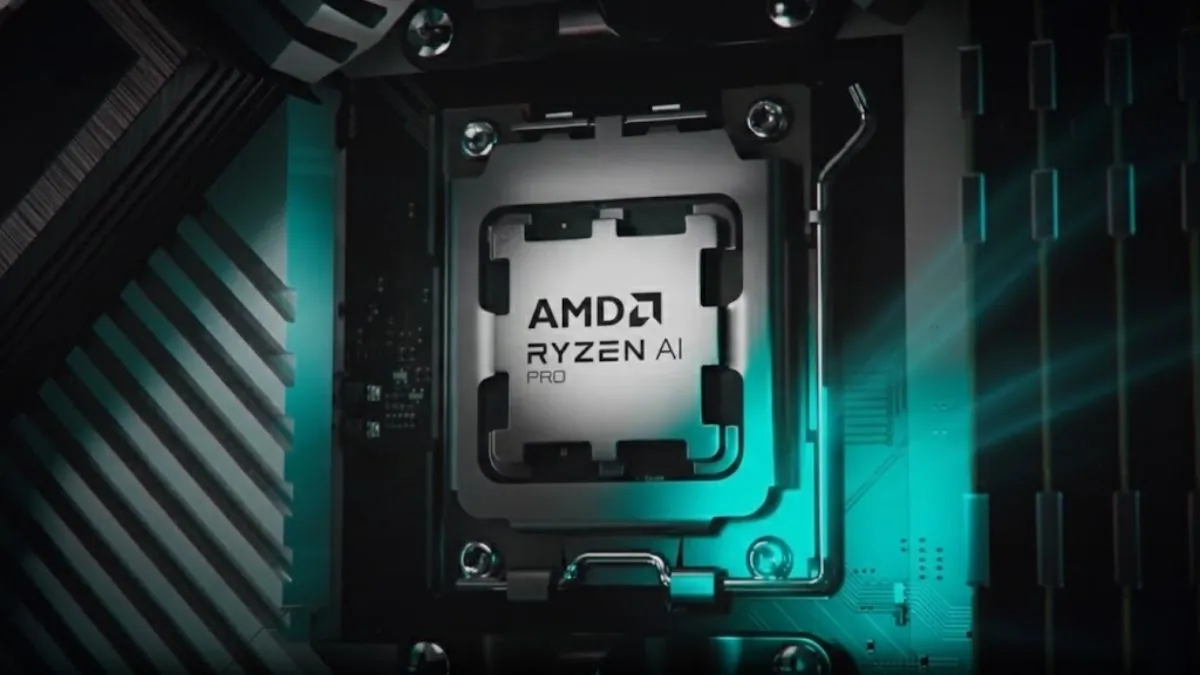
AMD’s Ryzen AI 400 “Gorgon Point” desktop processors for the AM5 platform are reportedly targeting a first-half 2026 release, with a possible Q1 launch window, according to a new claim from Moore’s Law Is Dead on X. The leaker also shared what is described as a short promotional clip showing a Ryzen AI 400 Pro processor installed in an AM5 socket. AMD has not officially confirmed launch timing, but the company did preview AM5-based Ryzen AI 400 desktop parts alongside its mobile announcement at CES 2026.
At CES, AMD introduced the Ryzen AI 400 series for laptops built on a hybrid mix of Zen 5 and Zen 5c CPU cores, paired with RDNA 3.5 graphics and a significantly upgraded neural processing unit. Desktop-branded Ryzen AI 400 parts were shown at the same event, though without firm availability details. The new report suggests those desktop chips are now moving toward commercial release in early 2026.
If the desktop variants mirror their mobile counterparts, they are widely expected to reuse the same underlying Strix Point silicon, adapted for socketed AM5 systems. That would likely mean AMD is tuning power management and sustained clock behavior for desktop thermals rather than introducing an entirely new die.
Based on current information, the top configuration is expected to include up to 12 CPU cores in a 4x Zen 5 and 8x Zen 5c hybrid layout, a 16 Compute Unit RDNA 3.5 integrated GPU, and an NPU rated at up to 60 TOPS. However, these details remain unconfirmed for the desktop models.
Expected Ryzen AI 400 Desktop Configuration (Unconfirmed)
| Specification | Expected Details |
|---|---|
| CPU Architecture | Zen 5 + Zen 5c hybrid |
| Maximum Cores | 12 (4 Zen 5 + 8 Zen 5c) |
| Integrated Graphics | 16 CU RDNA 3.5 |
| NPU Performance | Up to 60 TOPS |
| Platform | AM5 |
| Launch Window | H1 2026 (Q1 reportedly possible) |
Zen 5 brings IPC improvements and front-end refinements over Zen 4, while Zen 5c focuses on efficiency and density. In a desktop scenario, the full Zen 5 cores would likely prioritize foreground and latency-sensitive workloads, while Zen 5c cores handle background tasks and parallel processing. Hybrid scheduling support in modern operating systems will be critical to ensure optimal thread distribution.
If Gorgon Point is indeed a derivative of the monolithic Strix Point die, that has platform implications. Mobile-derived silicon typically provides fewer PCIe lanes than chiplet-based desktop Ryzen CPUs. That could limit expansion flexibility compared to Ryzen 9000-series processors. As a result, Ryzen AI 400 would be positioned primarily for mainstream, compact, and OEM-focused systems rather than enthusiast builds with heavy PCIe demands.
The graphics upgrade from RDNA 3 to RDNA 3.5 could deliver better efficiency and feature support, though performance will remain dependent on system memory bandwidth. Memory support specifications have not yet been disclosed and will be critical for real-world gaming results.
The NPU upgrade is significant. At up to 60 TOPS, Ryzen AI 400 would dramatically exceed the AI capability of previous desktop APUs. This aligns with the broader industry push toward AI-accelerated PCs and Copilot-class features. Intel’s recent Core Ultra architectures have also emphasized integrated NPUs, placing direct competitive pressure on AMD in AI performance metrics.
Ryzen 8000G vs Ryzen AI 400 (Expected)
| Feature | Ryzen 8000G | Ryzen AI 400 (Expected) |
|---|---|---|
| CPU Architecture | Zen 4 | Zen 5 + Zen 5c |
| Maximum Cores | 8 | 12 |
| Graphics | RDNA 3 | RDNA 3.5 |
| NPU | ~16 TOPS | Up to 60 TOPS |
| Platform | AM5 | AM5 |
The increase in CPU cores and AI performance suggests AMD is using Gorgon Point to extend AM5’s lifespan while introducing stronger AI branding into the desktop space.
The appearance of a Ryzen AI 400 Pro processor in the leaked promotional clip may indicate initial targeting of OEM and commercial systems. Pro-branded AMD processors traditionally focus on business desktops with extended validation and enterprise support cycles.
Pricing, SKU segmentation, cache sizes, clock speeds, PCIe lane allocation, and official memory support remain undisclosed. AMD is unlikely to release only a single 12-core SKU, so lower-tier models are expected. Final product positioning will depend heavily on pricing relative to both Intel’s AI-focused desktop offerings and AMD’s own higher-end chiplet CPUs.
Also Read: 5 Best Affordable AI Laptops in 2026
With Zen 6 expected in a future generation, a Gorgon Point launch in early 2026 would provide AM5 users a transitional upgrade without requiring a socket change. Assuming BIOS compatibility, it could offer a straightforward drop-in upgrade for existing systems.
For now, H1 2026 timing remains based on a leak and has not been officially confirmed. Buyers should watch for motherboard BIOS updates, official product listings, and benchmark database appearances as stronger launch indicators.
If the reported specifications hold, Ryzen AI 400 “Gorgon Point” could become AMD’s most capable integrated desktop APU on AM5 to date, combining hybrid Zen 5 CPU cores, RDNA 3.5 graphics, and substantial AI acceleration in a single socketed package. Final details will determine whether it reshapes the mainstream desktop market or serves primarily as a stepping stone toward Zen 6.
Source: Moore’s Law is Dead on X