

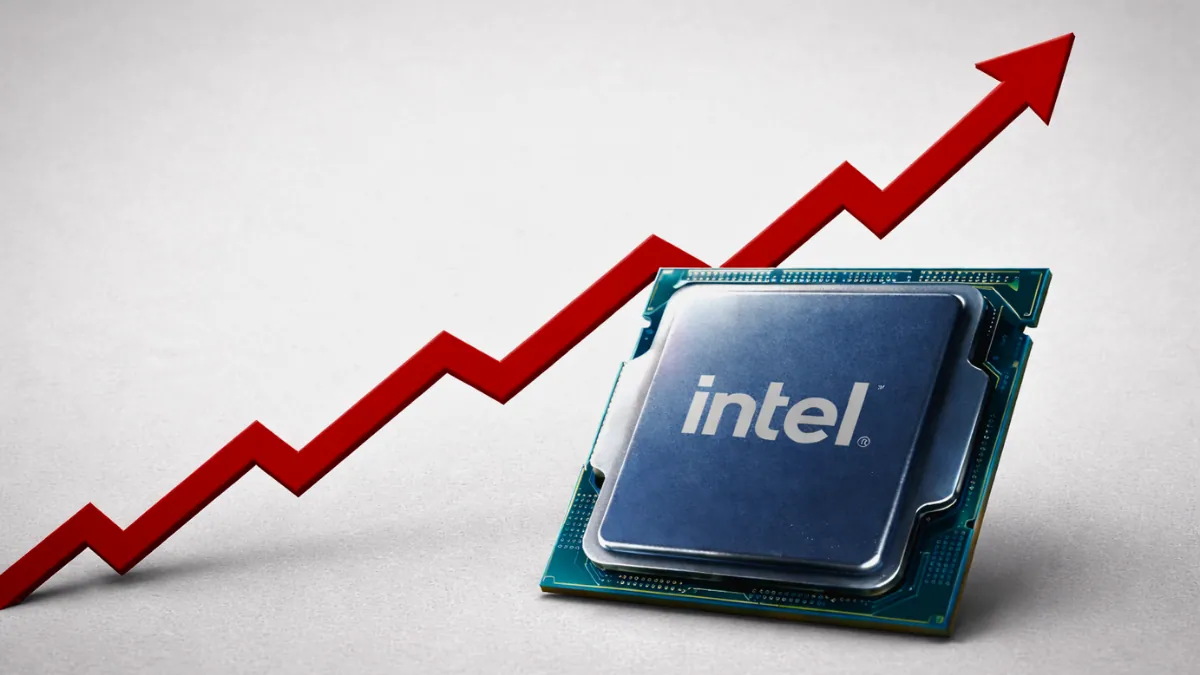
Intel CPU price increases in 2026 may not be over yet. New supply-chain data suggests another price hike could arrive as early as May, potentially pushing total CPU price growth close to 30% year-over-year. The move reflects surging AI-driven demand, tightening supply, and rising pressure across the global semiconductor market, a trend also seen in PC price hikes, power GPU SSD memory.
Intel is reportedly preparing another CPU price increase as early as May, adding to the hikes already introduced earlier this year. The move follows growing pressure from AI-driven demand and ongoing supply constraints, based on recent channel checks and industry research.
The company has already increased prices twice in 2026, first in February and then in March, with hikes of around 10% to 15% across different segments, including Intel Core and Xeon chips, similar to trends discussed in the Intel Core Ultra 200S Plus desktop CPUs launch. If another increase happens in May as expected, total CPU prices could end up about 30% higher than they were in 2025.
The main driver behind these price increases is the growing gap between demand and supply. Industry estimates suggest global demand for server CPUs could rise by around 50% to 60% in 2026, largely fueled by hyperscale cloud providers and major US tech firms expanding their AI infrastructure, similar to developments in the NVIDIA RTX 50 GPU supply cut 2026 memory constraints. At the same time, Intel’s production capacity is already running at close to 95% utilization, making it difficult to ramp up output quickly.
There is also a noticeable shift in how AI systems are being designed, a transition also reflected in the AMD Zen 6 Medusa Point leak. While GPUs used to dominate most AI workloads, CPUs are now taking on a bigger role in tasks like data orchestration, memory management, and overall system coordination. Earlier setups typically relied on one CPU to support multiple GPUs, but that balance is starting to change. As workloads become more complex, data centers need more CPUs than before, which is further driving up demand.
Supply challenges are becoming more complex due to advanced manufacturing processes. Many of Intel’s latest processors use multi-chip packaging, where different components are made on separate nodes and sometimes by external partners like TSMC before final assembly. This adds pressure to the supply chain, as a delay in even one component can slow down overall shipments.
Why are Intel CPU prices rising?
The current price pressure comes down to three factors:
- AI data center demand is accelerating faster than expected.
- Production capacity is already near maximum utilization.
- Complex multi-node chip manufacturing is slowing deliveries.
This combination is tightening supply across both enterprise and consumer markets.
This imbalance is already showing up in the market. Big enterprise clients and hyperscale cloud companies are getting priority, while smaller markets are dealing with limited stock and longer wait times. Intel’s strategy makes sense from a business point of view, but it’s also putting extra strain on the broader PC and server market.
Competition in the CPU market is heating up, especially in the server space, where AMD and ARM-based players are pushing better performance at competitive prices, as also seen in Snapdragon X2 Elite. But they’re running into many of the same supply challenges, so overall industry capacity is still tight.
For everyday consumers in the US market, the impact will be noticeable but relatively moderate. High-end desktop processors and premium laptop chips may see slight price increases, while the most significant changes are expected in enterprise and data center products. Over time, rising infrastructure costs could also translate into higher prices for cloud services from providers like AWS, Microsoft Azure, and Google Cloud.
Source: Minutes Logic Society