
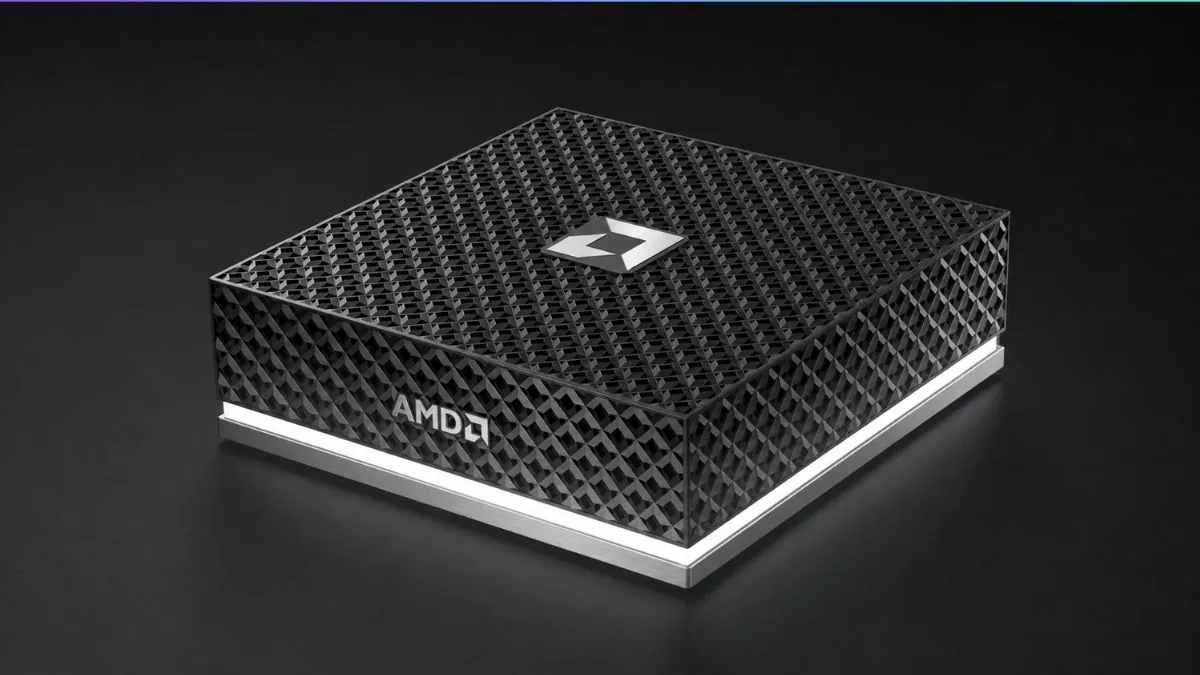
AMD introduced the Ryzen AI Halo Developer Platform with Ryzen AI Max+ 395 processors, 128GB LPDDR5x unified memory, and support for AI models carrying up to 200 billion parameters. The compact desktop starts at $3,999 and supports both Windows and Linux environments.
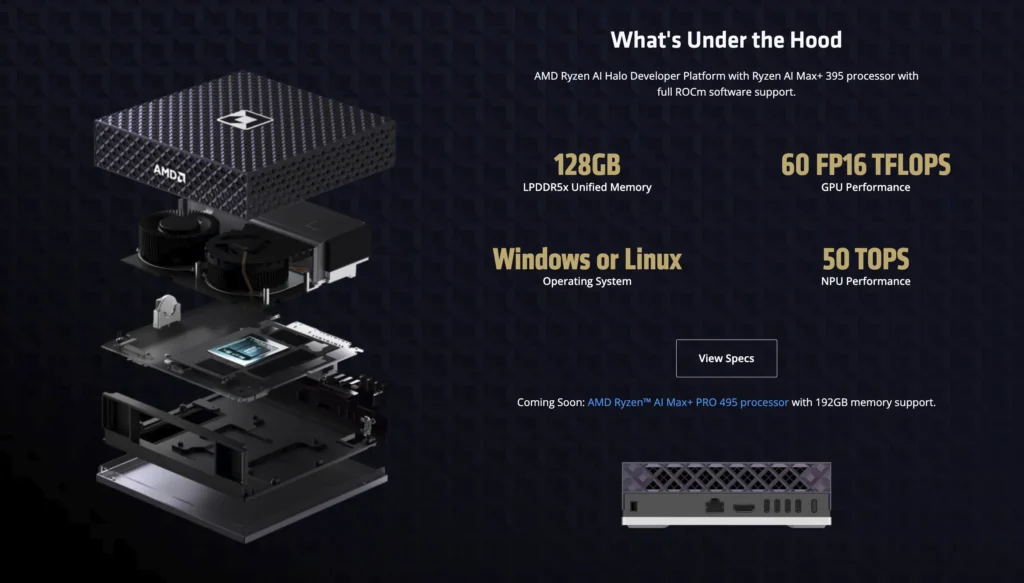
Powering the platform is AMD’s Ryzen AI Max+ 395 processor built on the Strix Halo architecture, the same architecture referenced in Thermalright AI Hydronous R1 Ryzen AI Max+ 395 cooling test. The chip features 16 Zen 5 CPU cores, RDNA 3.5 integrated graphics, and an XDNA 2 NPU capable of delivering up to 50 TOPS of AI performance.
AMD offers the desktop with 128GB LPDDR5x unified memory alongside a 2TB NVMe SSD. The hardware is aimed at developers running larger AI workloads that normally require workstation GPUs or cloud-based infrastructure.
AMD stated that the Ryzen AI Halo platform can locally run AI models carrying up to 200 billion parameters with suitable quantization methods. The company positions the desktop for image generation, large language model inference, coding assistants, automation pipelines, and generative media workloads without depending entirely on remote cloud services, targeting workloads covered in best laptops for deep learning guide.
Graphics performance can give up to 60 FP16 TFLOPS according to AMD’s published specifications. The desktop supports both Windows and Linux workflows while offering compatibility with PyTorch, vLLM, llama.cpp, Ollama, LM Studio, ComfyUI, and ROCm acceleration.
AMD is shipping the platform with a new Ryzen AI Developer Center application acting as a hub for deployment tools, software updates, workflow setup guides, and AI Playbooks. Several AI Playbooks arrive preinstalled, while additional workflow packages are planned as monthly downloads.
AMD’s benchmark slides compare Ryzen AI Halo against Nvidia’s DGX Spark and Apple’s M4 Pro Mac Mini across several AI workloads following recent comparisons involving Snapdragon X2 Elite versus Apple M5 performance. According to the company’s published figures, Ryzen AI Halo delivers stronger performance in tasks involving GPT OSS 120B, Qwen 3.5 122B, Stable Diffusion XL, Flux Schnell, Qwen Image, and Hunyuan 3D workflows.
The platform is designed to function either as a standalone AI workstation or as part of smaller compute clusters connected to larger development machines.
AMD has already confirmed a higher-end successor platform planned for the third quarter of 2026. The upcoming Ryzen AI Max PRO 400 Series developer platforms are expected to support up to 192GB unified memory and as much as 160GB VRAM allocation capability.
HP and Lenovo are preparing hardware based on Ryzen AI Max PRO 400 Series processors later in 2026.
AMD is opening preorders for the Ryzen AI Halo Developer Platform in June 2026 through Micro Center in the United States. Pricing starts at $3,999.
Source: AMD