
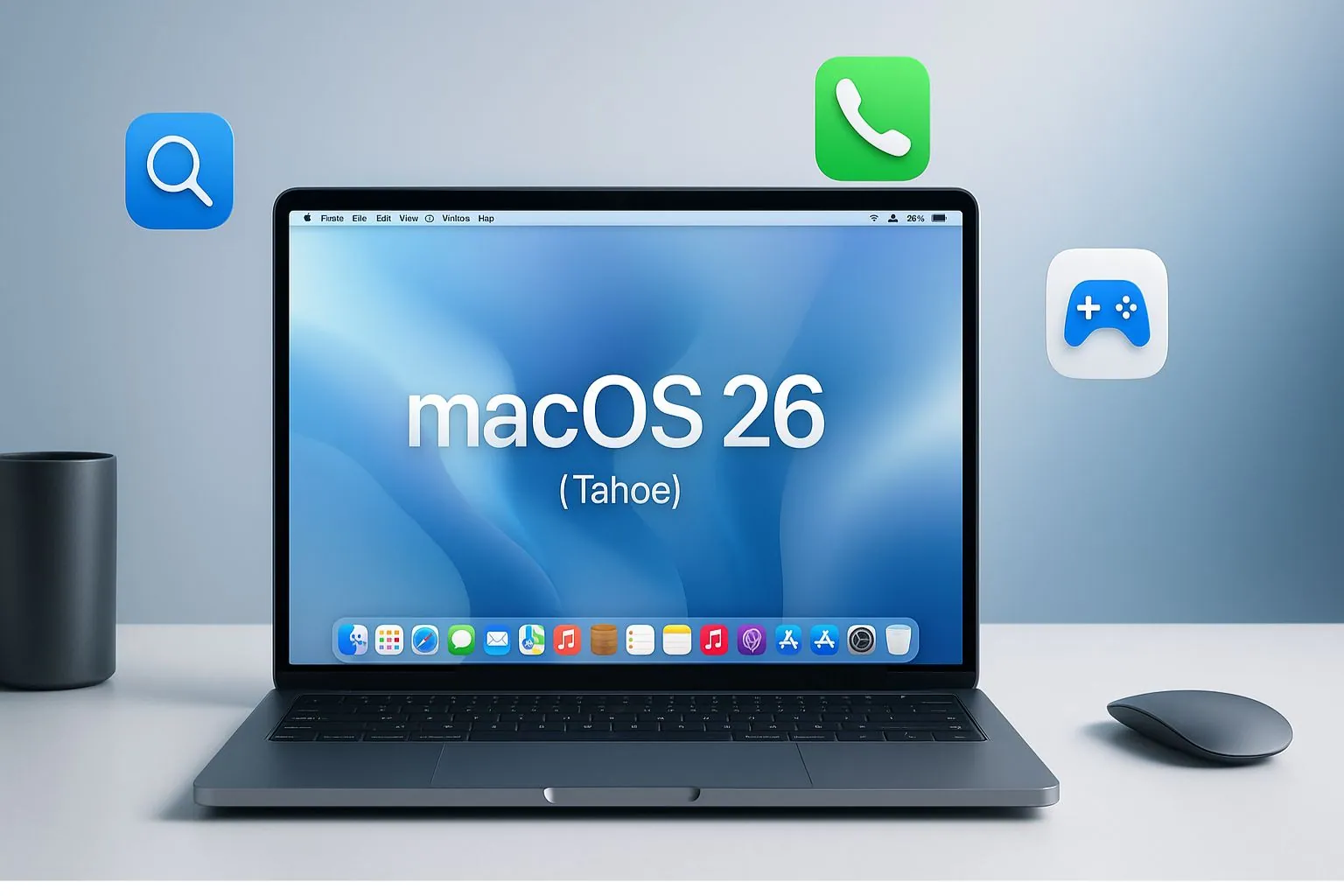
Apple has added a new battery health feature in the macOS Tahoe 26.4 beta that lets MacBook users set a fixed charging limit in System Settings. For the first time, Mac users can choose exactly how high their battery charges without using third-party apps. This gives more control over long-term battery health and removes the need for extra charging utilities.
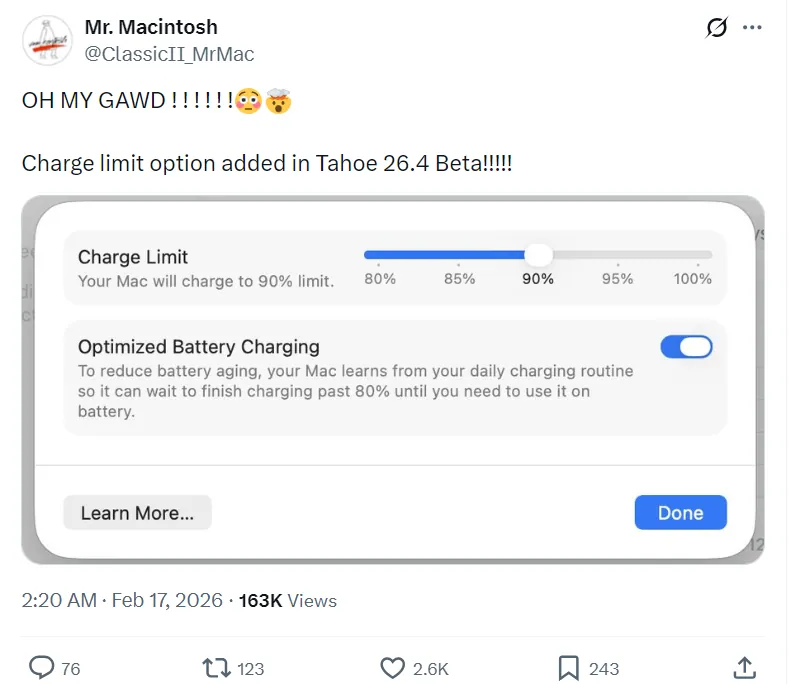
According to details emerging from the macOS 26.4 developer beta, Apple has added a manual charge limit slider that allows users to cap charging between 80 percent and 100 percent.
The option appears under System Settings > Battery > Charging Options, enabling a hard ceiling rather than the adaptive behavior seen in earlier versions. Once set, the MacBook will stop charging when it reaches the selected threshold, even if it remains plugged in.
Until now, MacBook users who wanted to prevent their batteries from sitting at 100 percent charge for extended periods often relied on third-party applications. Tools such as AlDente gained popularity for enforcing strict limits, particularly among users who keep their laptops connected to power for most of the day. With macOS Tahoe 26.4, Apple brings that core functionality natively to the operating system, eliminating the need for background charging-control apps for most users.
The shift significantly alters the landscape of battery utilities. A direct comparison highlights how Apple’s native implementation stacks up against popular third-party solutions:
MacOS Tahoe 26.4 vs AlDente: Feature Comparison for MacBook Charge Limits
| Feature | macOS Tahoe 26.4 | AlDente (Free) | AlDente Pro |
|---|---|---|---|
| Hard Charge Limit | Yes (80%–100%) | Yes | Yes |
| Limit Below 80% | No | Yes | Yes |
| Automatic Calibration | No | Limited | Yes |
| Smart Disconnect / Advanced Modes | No | No | Yes |
| System-Level Integration | Native | Third-party | Third-party |
| Cost | Free | Free | Paid |
While Apple now offers built-in charge limit control, it does not currently allow limits below 80 percent. Advanced features such as deep calibration tools, battery condition analytics, and adaptive charging profiles remain exclusive to paid third-party software. However, for the majority of MacBook Air and MacBook Pro users seeking a simple 80 percent cap, the new native control covers the primary use case.
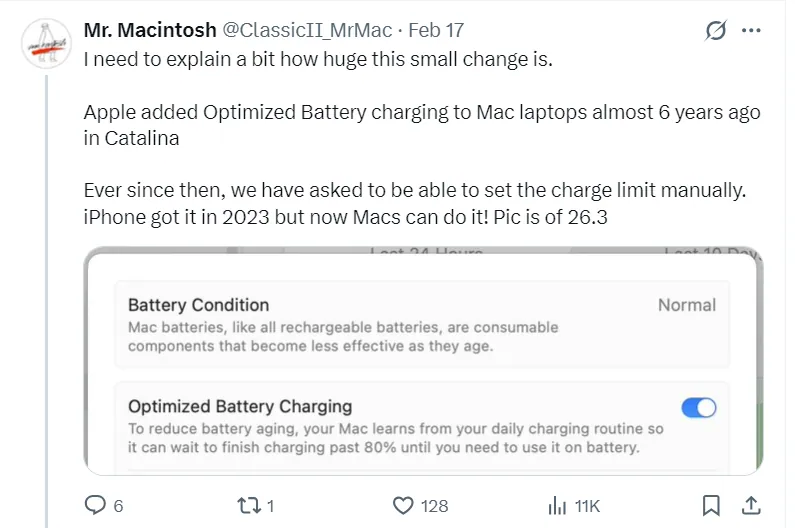
Previous macOS releases included an Optimized Battery Charging feature that delayed charging past 80 percent based on learned usage patterns. However, it did not offer a fixed cap. Systems could still charge to full capacity depending on daily routines, making the feature inconsistent for users who preferred a strict upper boundary. The new implementation introduces a predictable and permanent limit, aligning macOS more closely with battery health controls already available on the iPhone and iPad.
Lithium-ion battery research consistently shows that prolonged exposure to 100 percent charge accelerates chemical aging. Maintaining charge levels between roughly 20 percent and 80 percent can help reduce stress on battery cells and slow long-term capacity degradation. For professionals who use MacBook Air or MacBook Pro models as desktop replacements and keep them plugged in for extended periods, this update directly addresses a widely discussed longevity concern.
Early reports from the developer community suggest the charge limit feature works alongside Optimized Battery Charging rather than replacing it. Users can enable both settings, allowing macOS to manage charging behavior intelligently while still respecting a defined maximum threshold. The integration appears seamless, reinforcing Apple’s broader focus on battery health transparency.
The feature is currently available in the macOS Tahoe 26.4 beta and may evolve before the final public release. Apple has not yet confirmed whether the charge limit control will extend to all supported Intel-based MacBook models or remain focused on Apple Silicon devices, though broader compatibility is expected as the update moves toward stable rollout.
For third-party battery utility developers, the change represents a structural shift. Core charge-limiting functionality is now native to macOS, narrowing the need for basic charging control apps while preserving demand for advanced diagnostics, deeper calibration tools, and enterprise-level battery management features.
This update gives MacBook users real control over how their battery charges, especially for people who keep their laptops plugged in most of the day. Instead of relying on third-party apps, the charge limit is now built directly into macOS. That makes battery management simpler and more reliable. It also helps extend long-term battery health without needing extra software running in the background. For many users, this could become one of the most practical battery updates Apple has added to macOS in years.
Source: Mr. Macintosh(X)