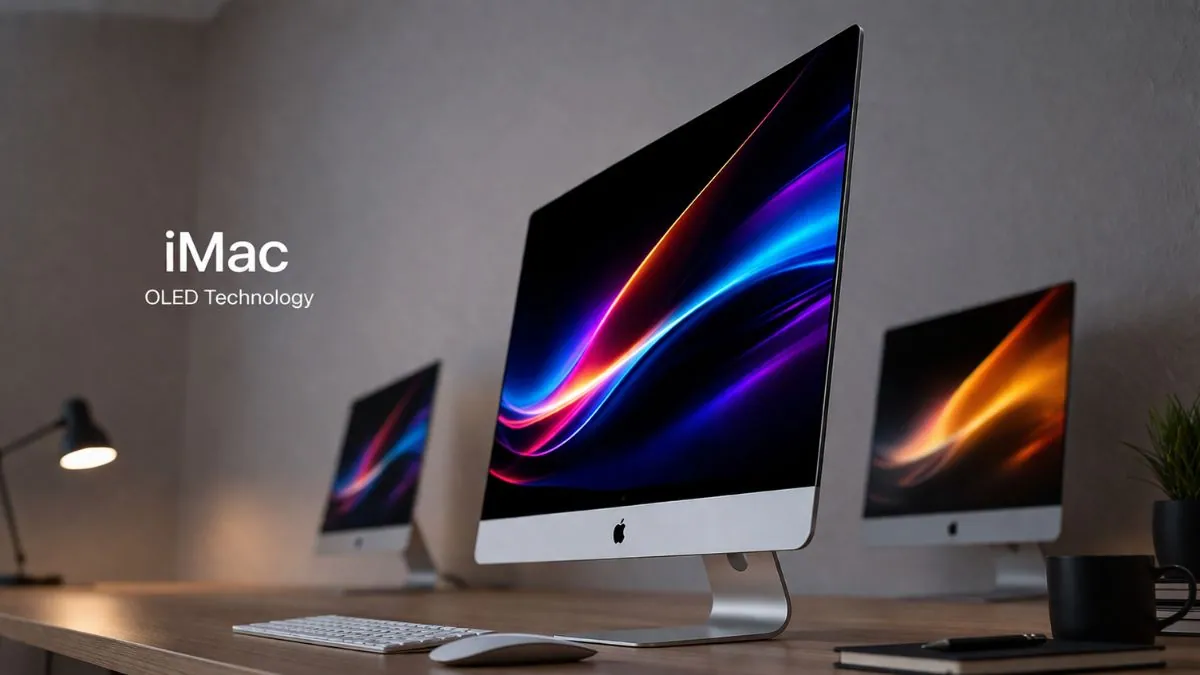
Apple is moving forward with its OLED iMac plans, requesting Samsung Display and LG Display to produce 24-inch panel samples on mass production lines, following similar OLED development trends seen in products like the Apple OLED MacBook Pro. This marks a shift from early-stage development to supplier-level testing, indicating that the project has entered a more advanced phase.
According to supply chain reports, Apple is targeting a 24-inch OLED panel with a pixel density of around 218 to 220 PPI and full-screen brightness of at least 600 nits. This would exceed the current 24-inch iMac’s 500-nit LCD panel while maintaining the same sharpness level.
Reaching 600 nits across the full screen remains a key challenge for OLED technology. Large OLED panels today typically deliver closer to 250–300 nits in sustained full-screen brightness, which places Apple’s requirement well above current mainstream capabilities .
Samsung Display is preparing 220 PPI samples using its QD-OLED production lines, a significant step up from the 160 PPI panels it currently mass-produces for monitors, building on advancements in QD-OLED panel technology. The company is also advancing multi-layer OLED structures, including penta-tandem designs that stack multiple emission layers. These panels are designed to reach peak HDR brightness levels of up to around 1300 nits while improving efficiency.
LG Display is taking a different approach with W-OLED technology, working on a five-layer structure that adds an additional green emission layer to increase brightness. Unlike Samsung’s quantum dot conversion method, W-OLED relies on color filters, which inherently reduce brightness output. LG is also developing its eLEAP manufacturing process, which removes the need for fine metal masks, though this technology has not yet reached production readiness.
Tandem OLED structures play a central role in both approaches. By stacking multiple emission layers, these panels can deliver around 30 percent higher brightness and significantly improved lifespan compared to conventional OLED designs .
The difference in panel technology directly affects performance, particularly when compared with existing Apple display products such as the Apple Studio Display. QD-OLED converts blue light through quantum dot layers, resulting in higher brightness and color efficiency, while W-OLED filters white light, leading to lower brightness under similar conditions. This places Samsung’s approach in a stronger position during early sample evaluation.
Despite this progress, the OLED iMac remains a long-term project. Current timelines point to a launch window between 2029 and 2030 as suppliers continue to scale brightness, efficiency, and large-format production.
The extended timeline reflects the difficulty of bringing high-brightness OLED panels to desktop-class sizes while maintaining uniformity, lifespan, and manufacturing yield at scale, a factor that continues to influence recommendations in best laptops for graphics design.
OLED iMac: Key Details (Expected)
| Specification | Details |
|---|---|
| Display Size | ~24-inch |
| Pixel Density | ~218–220 PPI |
| Brightness Target | ~600 nits (full screen) |
| Panel Types | QD-OLED (Samsung) / W-OLED (LG) |
| Panel Structure | Tandem / multi-layer OLED |
| Peak HDR (est.) | Up to 1300 nits |
| Current iMac | 500 nits LCD, 218 PPI |
| Timeline | 2029–2030 |
Source: ZDNET Korea