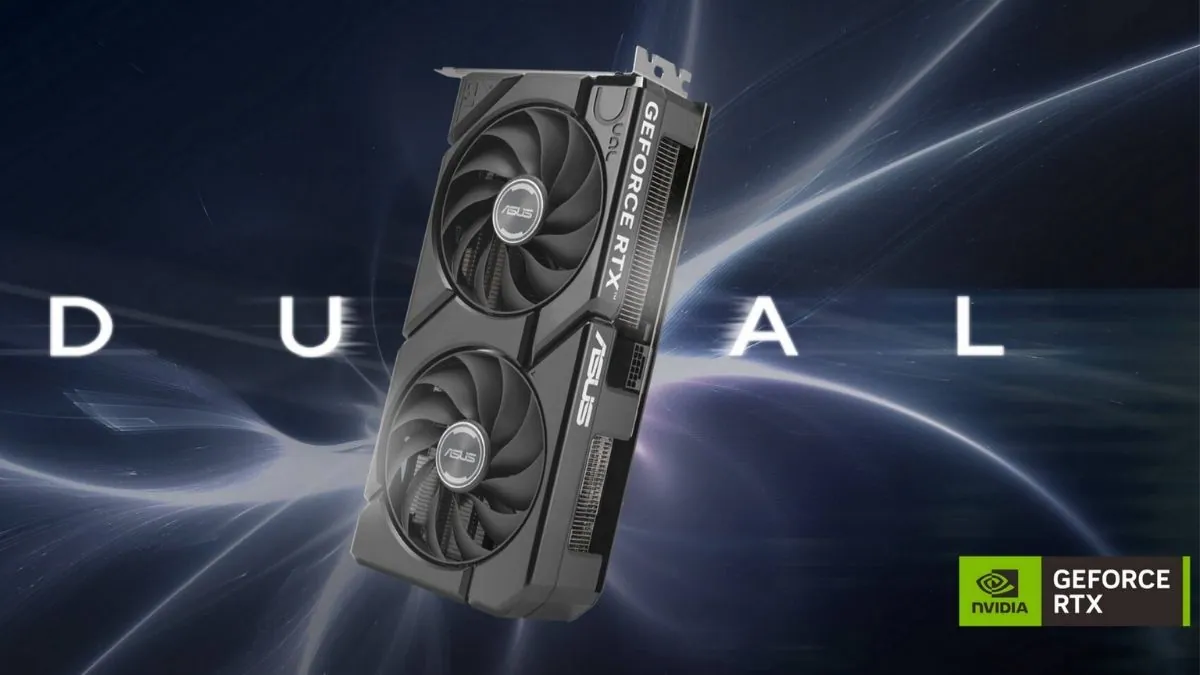
ASUS has quietly added the ASUS Dual GeForce RTX 5070 EVO to its official website, showing a shorter 2.5-slot design built for compact PC cases. While many early RTX 5070 partner cards launched with large triple-fan coolers close to 3 slots thick, this model focuses on better case compatibility without changing the core GPU specifications.
The card follows NVIDIA’s reference configuration for the GeForce RTX 5070 based on the Blackwell architecture. What makes this version different is not the silicon, but the size of the cooler and the overall footprint. For builders using Mini-ITX or smaller mid-tower cases, that change can make installation much easier.
Below is a structured look at the confirmed specifications:
| Specification | ASUS Dual RTX 5070 EVO O12G |
|---|---|
| GPU | NVIDIA GeForce RTX 5070 |
| Architecture | Blackwell |
| CUDA Cores | 6,144 |
| Memory | 12GB GDDR7 |
| Memory Bus | 192-bit |
| Interface | PCIe 5.0 x16 |
| Slot Size | 2.5-slot |
| Cooling | Dual Axial-tech fans |
| Fan Features | Dual-ball bearings, 0dB mode |
| Power Connector | 1× 16-pin 12V-2×6 |
| Recommended PSU | 650W |
| Display Outputs | 3× DisplayPort 2.1, 1× HDMI 2.1 |
| Backplate | Metal with rear vent |
Exact boost clock speeds depend on the selected BIOS mode and region, but ASUS confirms factory overclock support. Real-world speeds will depend on temperature and power limits.
The biggest change here is the cooler design. Many RTX 5070 cards from other brands are around 300 mm or longer and take up almost 3 slots. That can cause problems in smaller cases where GPU clearance is limited. A 2.5-slot card that is shorter in length improves compatibility in builds where every millimeter matters.
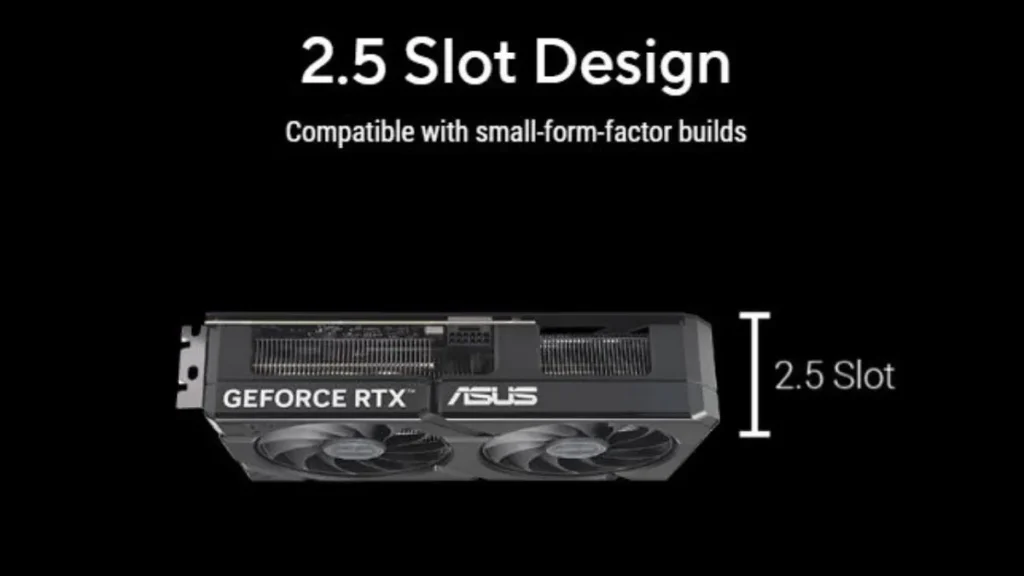
Below is a quick comparison between larger RTX 5070 partner cards and this Dual EVO model.
| Feature | Larger Triple-Fan RTX 5070 | ASUS Dual RTX 5070 EVO |
|---|---|---|
| Fan Count | Three | Two |
| Slot Thickness | 2.7 to 3 slots | 2.5 slots |
| Typical Length | 300 mm or more | Shorter design |
| Cooling Capacity | Higher | Balanced for size |
| Small Case Fit | Limited | Improved |
A bigger cooler usually runs a few degrees cooler and may be slightly quieter under heavy load. A smaller cooler can run a bit warmer, but the performance difference is usually small because NVIDIA’s boost system adjusts speeds automatically. For most gamers, the difference in frame rates between dual-fan and triple-fan versions of the same GPU tier is minor.
The RTX 5070 itself targets high refresh rate 1440p gaming and entry-level 4K gaming when using DLSS. Compared to RTX 4070 class cards, it introduces GDDR7 memory and improvements in AI processing and ray tracing efficiency. Raster performance gains over the previous generation are expected to be moderate rather than dramatic.
AMD competes in this price range with cards such as the Radeon RX 7800 XT. AMD often offers more VRAM, while NVIDIA focuses on DLSS, ray tracing performance, and creator software support. Final buying decisions will likely depend on street pricing.
Power delivery follows the new 12V-2×6 connector used in the RTX 50 series. Builders upgrading from older 8-pin GPUs should make sure their power supply supports this connector or includes the proper adapter. Cable clearance is also important in small cases, and a shorter card can help reduce strain on the power cable.
Also Read: ASUS TUF Gaming A14 Ryzen AI Max+ 392 Launches at $2,199 in the US
ASUS has listed the product but broad retail pricing and availability are still developing. Final value will depend heavily on how it is priced compared to larger RTX 5070 models. If ASUS keeps pricing close to standard dual-fan variants, this could become a strong choice for small-form-factor builds. If it carries a premium, its appeal will be mostly limited to users who specifically need the reduced size.
This card is best suited for builders using compact cases with limited GPU clearance, system integrators designing smaller prebuilt PCs, and gamers upgrading from RTX 3060 or RTX 3070 class hardware. Users who prioritize the quietest possible operation or heavy manual overclocking may prefer larger triple-fan designs.
The ASUS Dual RTX 5070 EVO does not change what the RTX 5070 can do. It changes where it can fit. In a market where many midrange GPUs are getting bigger, a shorter 2.5-slot option gives builders more flexibility without stepping down to a lower performance tier. We will update this coverage once full retail pricing and independent thermal testing become available.