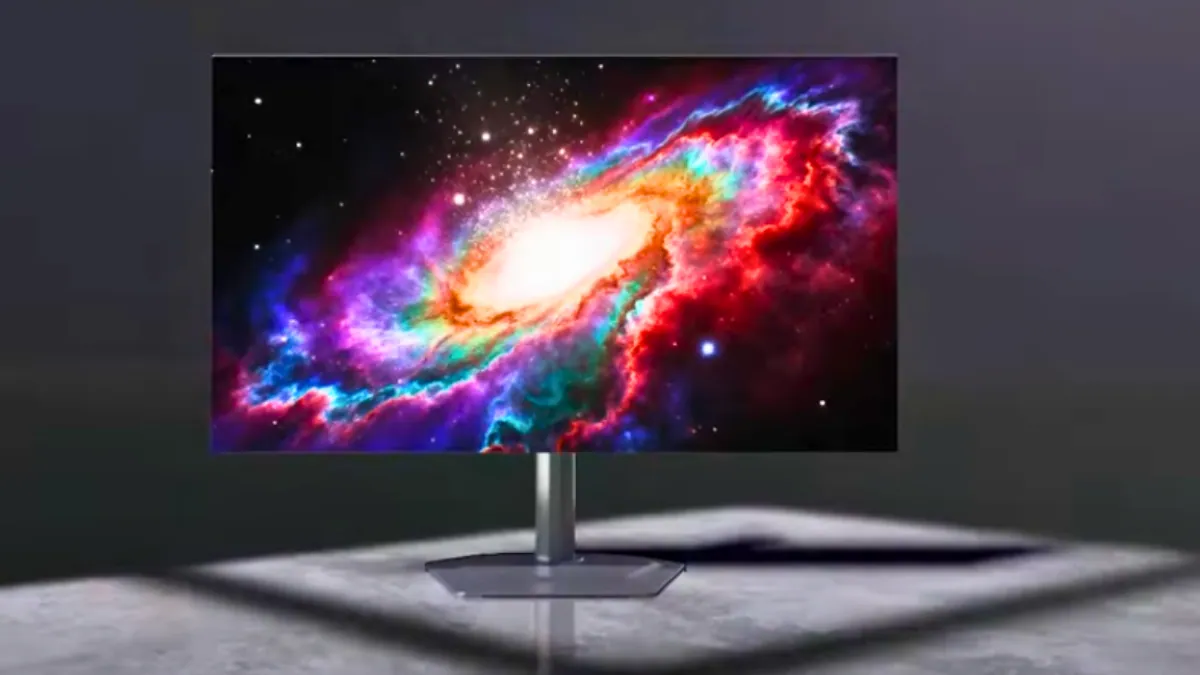
Gigabyte has officially released the MO27Q28GR in the United States following its showcase at CES 2026, introducing a 27-inch QHD gaming monitor that pairs a 280Hz refresh rate with a glossy fourth-generation Tandem OLED panel at a $599 price point.
Built around LG Display’s latest 4th Gen WOLED technology, the model is positioned as a more affordable alternative to other high-refresh OLED esports monitors while retaining flagship-level HDR brightness, improved panel efficiency, and competitive gaming performance.
The MO27Q28GR is based on LG Display’s fourth-generation WOLED stack, widely referred to as “Tandem OLED” due to its multi-layer light-emitting architecture designed to increase luminance efficiency and panel lifespan. Compared to third-generation WOLED implementations found in earlier 240Hz QHD OLED monitors, the updated stack improves brightness sustainability and reduces overall power draw by up to 20 percent under comparable workloads.
The panel retains the RWBG subpixel layout characteristic of LG’s WOLED technology and is engineered to manage Automatic Brightness Limiter (ABL) behavior more effectively during high-APL scenes, particularly in HDR gaming scenarios.
The display delivers up to 1,500 nits peak brightness in HDR (measured at 1.5% APL), 99.5 percent DCI-P3 color coverage, and approximately 84 percent BT.2020 support, alongside true 10-bit color depth. Gigabyte includes factory calibration with a claimed △E < 2, targeting color accuracy suitable not only for gaming but also for content creation workflows.
The monitor carries VESA DisplayHDR True Black 500 certification, ensuring deep black levels and controlled highlight performance consistent with OLED’s pixel-level dimming characteristics.
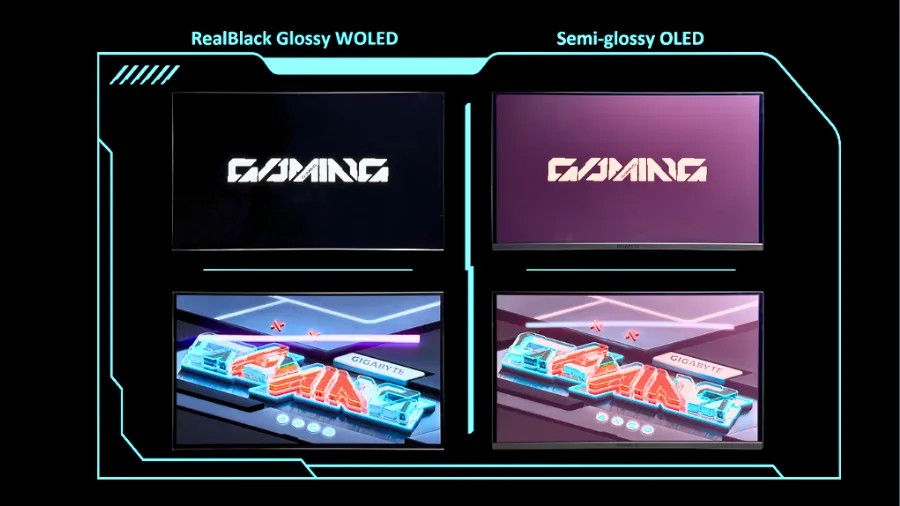
A defining visual element is the glossy RealBlack coating. Unlike matte or semi-gloss finishes commonly used to diffuse reflections, RealBlack integrates an anti-reflective, low-haze optical layer designed to preserve perceived contrast and color saturation. In controlled lighting environments, glossy OLED coatings typically produce deeper apparent blacks and higher contrast perception compared to matte-treated alternatives, though they may be more reflective in brightly lit rooms.
At 2560 x 1440 resolution with a pixel density of roughly 109 PPI, the monitor targets competitive PC gamers, prioritizing refresh rate and motion clarity over 4K pixel density. The 280Hz refresh rate, paired with a 0.03ms gray-to-gray response time, places it in direct competition with other QHD OLED esports displays such as the ASUS PG27AQDM, MSI MPG 271QRX, Alienware AW2725DF, and LG 27GS95QE.
Gigabyte also recently introduced the more affordable GO27Q24G 240Hz OLED, which targets the same 1440p esports segment at a significantly lower entry price.
The jump from 240Hz to 280Hz represents a measurable 16.7 percent increase in refresh ceiling, appealing to high-FPS players seeking marginal gains in motion resolution and latency consistency.
Pricing is where this monitor really starts to stand out. At $599.99 in the US, the MO27Q28GR comes in noticeably lower than many 240Hz and 280Hz QHD OLED rivals, which usually sit closer to the $649–$699 range.
That difference may not look huge on paper, but in this segment, it makes OLED far more approachable for serious gamers who were previously on the fence. With panel production improving and costs slowly coming down, Gigabyte appears to be pushing high-refresh QHD OLED into a more mainstream premium tier rather than keeping it limited to early adopters.
Connectivity includes two HDMI 2.1 ports and one DisplayPort 1.4 with Display Stream Compression (DSC), enabling full 280Hz operation at 1440p on modern GPUs. This HDMI bandwidth also supports 1440p at 120Hz with Variable Refresh Rate on PlayStation 5 and Xbox Series X consoles, broadening its appeal beyond PC-only setups.
The monitor includes a USB Type-C port with DisplayPort Alt Mode and up to 18W power delivery, making it easy to connect and power compatible laptops with a single cable. It also features a USB upstream port, two USB 3.2 downstream ports, and a built-in KVM switch. This allows users to control multiple devices, such as a PC and a laptop, using one keyboard and mouse on the same desk setup.
Gigabyte has added its AI-based OLED Care system to help reduce the risk of long-term image retention. The monitor automatically runs pixel refresh cycles and other protection features in the background. Users can adjust these settings through the on-screen menu.
Like all OLED displays, burn-in can still be a concern if static images are shown for long periods. However, newer panel technology and built-in protection features are designed to lower the risk over time.
The MO27Q28GR offers flexible ergonomics, including height adjustment up to 130mm, tilt from -5° to +21°, swivel of ±15°, and the ability to rotate 90 degrees into portrait mode. It supports standard 100 × 100 mm VESA mounting and includes dual 5W speakers for basic built-in audio. Typical SDR brightness is rated at 335 cd/m², and OLED’s strong contrast performance is reflected in a listed 1.5M:1 dynamic contrast ratio.
This release highlights how the gaming monitor market is evolving. Instead of focusing only on higher resolutions, brands are now pushing faster refresh rates, better HDR brightness, improved power efficiency, and stronger burn-in protection.
As fourth-generation WOLED panels become more common, 280Hz QHD OLED monitors are moving beyond early-adopter products and becoming more accessible options for competitive gamers who want both speed and image quality.
Key Specifications
| Model | Gigabyte MO27Q28GR |
| Panel Size | 27-inch 4th Gen WOLED (Tandem OLED, RWBG) |
| Screen Coating | Glossy RealBlack (anti-reflective, low-haze) |
| Resolution | 2560 x 1440 (QHD) |
| Pixel Density | ~109 PPI |
| Refresh Rate | 280Hz |
| Response Time | 0.03ms GTG |
| Peak Brightness | Up to 1,500 nits (HDR, 1.5% APL) |
| Typical SDR Brightness | 335 cd/m² |
| Contrast Ratio | 1.5M:1 (OLED) |
| Color Coverage | 99.5% DCI-P3, ~84% BT.2020 |
| Color Depth | True 10-bit (1.07 billion colors) |
| Factory Calibration | △E < 2 |
| HDR Certification | VESA DisplayHDR True Black 500 |
| Adaptive Sync | AMD FreeSync Premium Pro, G-SYNC Compatible |
| Ports | 2x HDMI 2.1, 1x DisplayPort 1.4 (DSC) |
| USB Connectivity | 1x USB-C (DP Alt Mode, up to 18W PD), 1x USB-B Upstream, 2x USB 3.2 Downstream |
| KVM | Integrated KVM switch |
| Speakers | 2x 5W |
| Ergonomics | Height (130mm), Tilt (-5°~+21°), Swivel (±15°), Pivot (90°) |
| VESA Mount | 100 x 100 mm |
| Launch Price (US) | $599.99 |