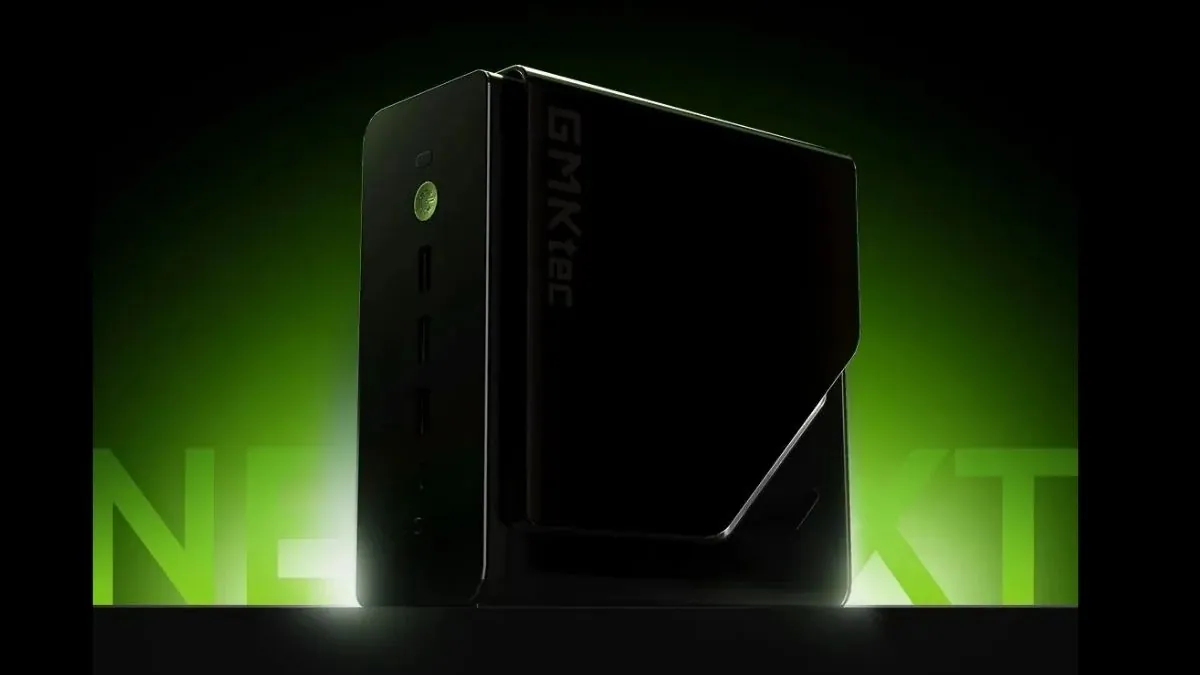
GMKtec is preparing to introduce its next-generation EVO-T2 mini PC on March 12, bringing Intel’s upcoming Panther Lake Core Ultra processors into the compact desktop segment. The new system will be available with processors including the Core Ultra X9 388H and Core Ultra X7 358H, positioning the EVO-T2 as one of the first mini PCs designed around Intel’s next wave of client AI processors. According to information shared ahead of the launch, the system was previously demonstrated during CES 2026 and is designed to deliver workstation-level compute capability in a compact chassis.
The EVO-T2 represents a shift in how mini PCs are being positioned in the market. Earlier compact systems were primarily designed for office workloads or media playback, but newer platforms are targeting AI workloads, high-speed networking, and GPU-accelerated computing. Intel’s Panther Lake architecture is part of that shift, combining CPU cores, integrated graphics, and dedicated AI acceleration in a single chip designed to power laptops and compact desktops. For manufacturers like GMKtec, this enables mini PCs that approach the capabilities of larger workstations while maintaining a small footprint.
The flagship configuration of the EVO-T2 is expected to use the Intel Core Ultra X9 388H processor, a high-end chip built on the Panther Lake architecture. The processor reportedly offers up to 16 cores and integrates Intel’s Arc B390 graphics based on the newer Xe3 graphics architecture. Alongside the CPU and GPU improvements, the platform also integrates dedicated AI acceleration hardware capable of delivering up to 180 TOPS of AI compute performance across the CPU, GPU, and neural processing blocks. This level of compute is designed to support local AI inference workloads, including the ability to run larger language models directly on the system without relying on cloud processing.
The memory and storage configuration of the EVO-T2 highlights its workstation ambitions. GMKtec says the system will support up to 128GB of LPDDR5X memory running at speeds up to 9600MT/s, which is significantly higher than what most mini PCs currently offer. Storage expansion is handled through two M.2 slots supporting PCIe Gen5 and PCIe Gen4 SSDs, allowing the system to scale up to 16TB of total storage capacity depending on the installed drives.
| Component | Specification |
|---|---|
| Processor Options | Intel Core Ultra X9 388H / Core Ultra X7 358H |
| CPU Architecture | Intel Panther Lake |
| CPU Configuration | Up to 16 cores / 16 threads |
| Integrated Graphics | Intel Arc B390 (Xe3 architecture) |
| AI Compute | Up to 180 TOPS |
| Memory Support | Up to 128GB LPDDR5X |
| Memory Speed | Up to 9600 MT/s |
| Storage | Dual M.2 SSD slots |
| Storage Interface | PCIe Gen5 + PCIe Gen4 |
| Maximum Storage | Up to 16TB |
The system includes dual Ethernet ports with both 10-gigabit and 2.5-gigabit networking, a feature typically found in workstation-class hardware rather than compact desktops. It also includes USB4 connectivity supporting up to 40Gbps data transfer and 100W Power Delivery, allowing high-speed external storage or docking solutions. GMKtec also includes an OCuLink interface, which allows users to connect external graphics cards through a high-bandwidth PCIe connection. This means the mini PC can operate as a compact standalone workstation for most tasks while still supporting a full desktop GPU when additional graphics power is required.
| Connectivity | Details |
|---|---|
| Ethernet | Dual LAN (10GbE + 2.5GbE) |
| USB | USB4 with 40Gbps bandwidth |
| Power Delivery | Up to 100W PD support |
| External GPU | OCuLink interface |
| Storage Expansion | Dual M.2 PCIe slots |
The EVO-T2 has a maximum power limit of 80W but operates in a default balanced mode of 45W. Users can switch between these modes depending on workload requirements. The higher power profile allows the CPU and integrated GPU to operate closer to their peak performance, while the balanced mode prioritizes lower power consumption and quieter operation. This approach is particularly important for mini PCs because thermal constraints can significantly affect sustained performance in compact systems.
| Power Mode | Power Limit | Intended Use |
|---|---|---|
| Balanced Mode | 45W | Everyday workloads and quieter operation |
| Performance Mode | Up to 80W | Maximum compute and GPU performance |
One notable feature mentioned in the source material is the inclusion of Phison’s aiDAPTIV+ technology. This solution allows SSD storage to be used as an extension of the AI memory pool, effectively increasing the amount of data available for local AI workloads. While SSD-based memory expansion cannot match the latency of system RAM, it can still enable larger AI models to run locally by extending available memory capacity through storage.
The design of the EVO-T2 follows a compact square layout typical of modern mini PCs, with a chassis designed to manage airflow and heat dissipation despite the higher-performance hardware inside. According to the source article, the system incorporates ventilation channels and airflow-optimized internal layout to ensure sustained performance while maintaining a clean desktop footprint.
Although GMKtec has confirmed the March 12 release timeline, several key details have not yet been disclosed. Pricing has not been announced, and independent performance benchmarks for the Core Ultra X9 388H processor and Arc B390 graphics have not yet been published. These factors will determine how competitive the EVO-T2 becomes against other high-end mini PCs entering the market in 2026.
Mini PCs are no longer just small office computers. Many new models are designed to work like compact workstations. The EVO-T2 is one example of how this category is evolving. It supports large amounts of memory, high-speed networking, AI processing hardware, and even optional external GPU expansion.
These features allow the EVO-T2 to deliver strong performance in a very small desktop system. Whether it becomes one of the most powerful mini PCs of the year will depend on its final price and real-world performance after the system launches on March 12.
Also Read: Intel Core Ultra 200S Plus CPUs Launch With Faster Gaming