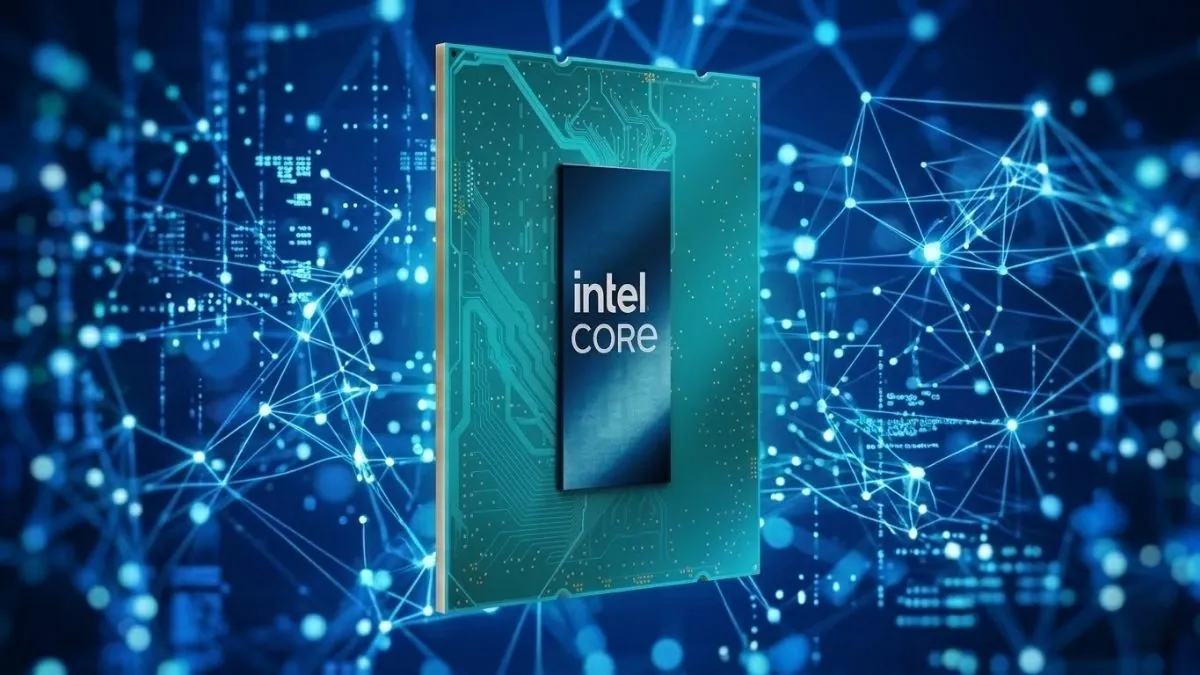
Intel has introduced a new family of processors called Bartlett Lake under the Core Series 2 branding at Embedded World 2026. These processors are designed mainly for edge computing and industrial systems rather than consumer desktop computers. The chips offer up to twelve performance cores and boost speeds reaching 5.9 GHz while continuing to use the LGA1700 socket platform.
The new processors follow a different design compared to many recent desktop CPUs. Modern processors often use a hybrid architecture that combines performance cores and efficiency cores. Bartlett Lake removes this hybrid approach and uses only performance cores. This design helps deliver more predictable and stable performance, which is important for industrial workloads.
Many edge systems run software that must respond at precise times. Examples include robotics controllers, machine vision systems, factory automation platforms, and smart infrastructure devices. In hybrid processors, the operating system must decide whether a task runs on a performance core or an efficiency core. This decision can sometimes cause delays or uneven timing. A processor that uses identical cores avoids this problem because every thread runs on a core with the same performance level.
The Bartlett Lake processors are built using the Intel 7 manufacturing process and use the Raptor Cove performance core architecture. These are the same high performance cores used in earlier desktop processors. However, this new design increases the number of performance cores to twelve while removing efficiency cores completely.
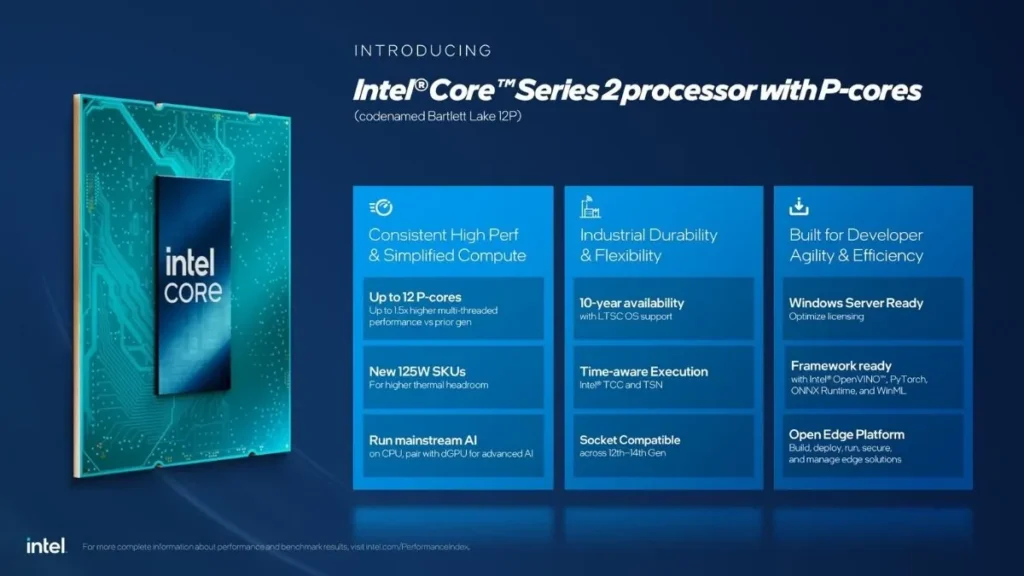
Intel is releasing the processors in three power levels. High performance industrial systems can use the 125 W versions. Compact systems and embedded edge devices can use the 65 W and 45 W models which consume less power.
Intel Bartlett Lake Core Series 2 Processor Lineup
| Processor | P-Cores | Threads | Base Clock | Boost Clock | All-Core Boost | L3 Cache | Power |
|---|---|---|---|---|---|---|---|
| Core 9 273PQE | 12 | 24 | 3.4 GHz | 5.9 GHz | 5.3 GHz | 36 MB | 125 W |
| Core 7 253PQE | 10 | 20 | 3.5 GHz | 5.7 GHz | 5.3 GHz | 33 MB | 125 W |
| Core 5 223PQE | 8 | 16 | 4.0 GHz | 5.5 GHz | 5.3 GHz | 24 MB | 125 W |
| Core 9 273PE | 12 | 24 | 2.3 GHz | 5.7 GHz | 5.2 GHz | 36 MB | 65 W |
| Core 7 253PE | 10 | 20 | 2.5 GHz | 5.5 GHz | 5.1 GHz | 33 MB | 65 W |
| Core 5 223PE | 8 | 16 | 2.9 GHz | 5.4 GHz | 4.8 GHz | 24 MB | 65 W |
| Core 5 213PE | 8 | 16 | 2.7 GHz | 5.2 GHz | 4.6 GHz | 24 MB | 65 W |
| Core 9 273PTE | 12 | 24 | 1.4 GHz | 5.5 GHz | 4.6 GHz | 36 MB | 45 W |
| Core 7 253PTE | 10 | 20 | 1.8 GHz | 5.4 GHz | 4.6 GHz | 33 MB | 45 W |
| Core 5 223PTE | 8 | 16 | 2.3 GHz | 5.4 GHz | 4.6 GHz | 24 MB | 45 W |
| Core 5 213PTE | 8 | 16 | 2.1 GHz | 5.2 GHz | 4.6 GHz | 24 MB | 45 W |
The top processor in the lineup is the Core 9 273PQE. It includes twelve performance cores and twenty four threads using Hyper-Threading technology. The chip runs at a base clock of 3.4 GHz and can boost up to 5.9 GHz for single threaded tasks. Under full workload conditions the processor can reach all core boost speeds around 5.3 GHz if cooling conditions allow it.
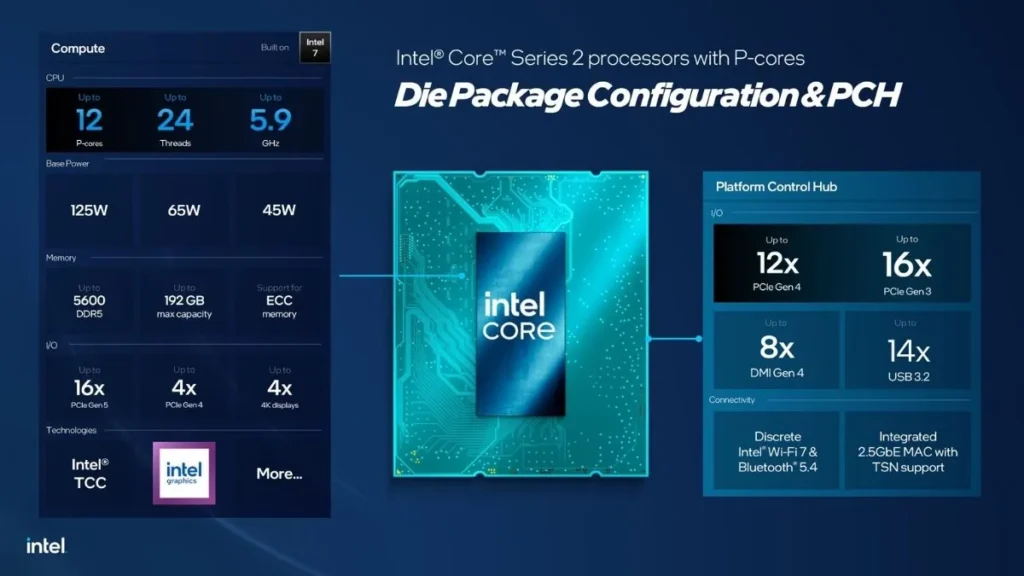
The processors continue to use the LGA1700 socket. This socket has already been used by several earlier processor generations. For companies building embedded hardware platforms, this compatibility allows easier upgrades without designing a completely new motherboard. Industrial boards using chipsets such as R680E, Q670E, and H610E can support these processors with updated firmware.
The platform offers a wide range of connectivity features similar to desktop systems. This includes modern memory support, PCIe expansion, integrated graphics, and ECC memory capability which is important for reliability in industrial environments.
Platform Specifications
| Feature | Specification |
|---|---|
| CPU Architecture | Raptor Cove performance cores |
| Manufacturing Process | Intel 7 |
| Socket | LGA1700 |
| Memory Support | DDR5-5600 and DDR4-3200 |
| Maximum Memory | Up to 192 GB |
| ECC Memory | Supported |
| CPU PCIe Lanes | 16 PCIe 5.0 + 4 PCIe 4.0 |
| Chipset PCIe Lanes | Up to 12 PCIe 4.0 + 16 PCIe 3.0 |
| DMI Interface | DMI 4 |
| Integrated Graphics | Xe-LP with 32 execution units |
| Display Support | Up to four displays |
Support for up to 192 GB of memory allows these processors to handle demanding workloads in industrial computing. ECC memory is also supported, which helps detect and correct memory errors. This feature is important in environments where systems must run continuously without failure.
Also Read: Lenovo ThinkPad X1 2-in-1 Gen 11 Aura Edition Launches With 2.8K 120Hz OLED
The processors include integrated Xe-LP graphics with thirty two execution units. This allows basic display output and light graphics processing for applications such as monitoring dashboards or industrial control systems.
Intel also focuses heavily on real time performance features in this processor family. Technologies such as Time Coordinated Computing and Time Sensitive Networking help improve timing accuracy between hardware components and network devices. This is useful in robotics systems, automated factories, transportation infrastructure, and other real time control environments.
According to internal testing shared by Intel, a 65 W Core 9 273PE processor can provide significant improvements in deterministic computing performance compared with other processors operating at similar power levels. The company reports up to 3.8 times higher deterministic compute performance, up to 2.5 times faster response time, and up to 4.4 times lower maximum PCIe latency. These results are based on internal measurements and independent benchmarks have not yet been published.
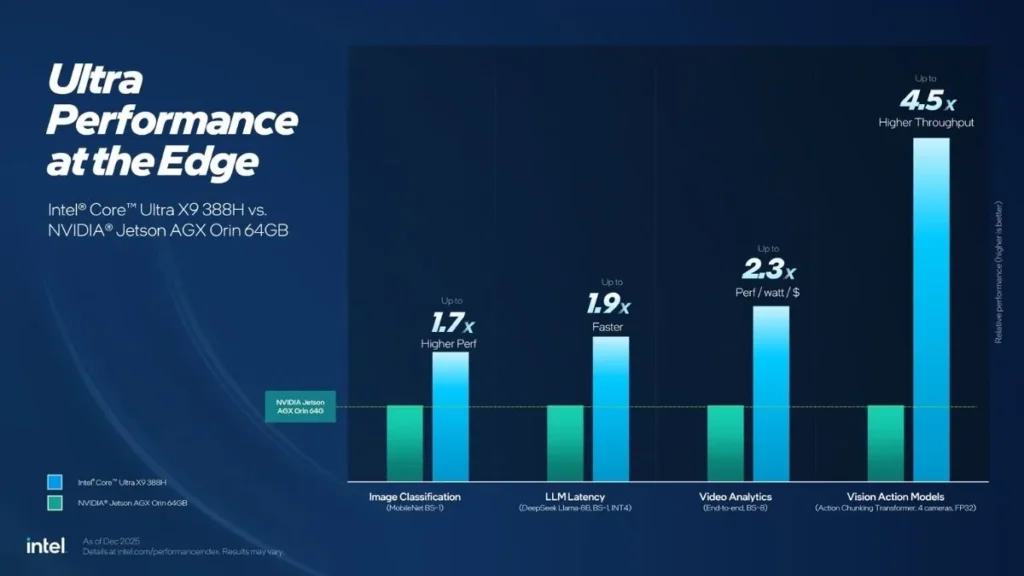
The processors also support software tools commonly used in edge artificial intelligence workloads. Developers can run machine learning models using frameworks such as OpenVINO, PyTorch, ONNX Runtime, and WinML. These frameworks allow AI inference to run directly on the CPU or together with additional accelerators.
Another important feature is long term availability. Many consumer processors stay on the market for only a few years before being replaced. Industrial systems often remain in use for much longer periods. Intel plans to keep Bartlett Lake processors available for up to ten years so companies can build hardware platforms without worrying about rapid component changes.
Bartlett Lake processors will not be sold through standard retail channels for desktop users. Instead, they will be supplied directly to hardware manufacturers and system integrators building industrial computers and specialized edge computing systems.
The launch reflects the growing demand for computing power outside traditional data centers and personal computers. As more industries deploy intelligent systems in factories, transportation networks, healthcare equipment, and smart infrastructure, processors designed for stable and predictable performance become increasingly important.
With its twelve performance cores, high boost speeds, long lifecycle support, and focus on deterministic workloads, the Bartlett Lake Core Series 2 processors are designed to provide reliable compute power for the next generation of edge and embedded computing platforms.
Source: Intel