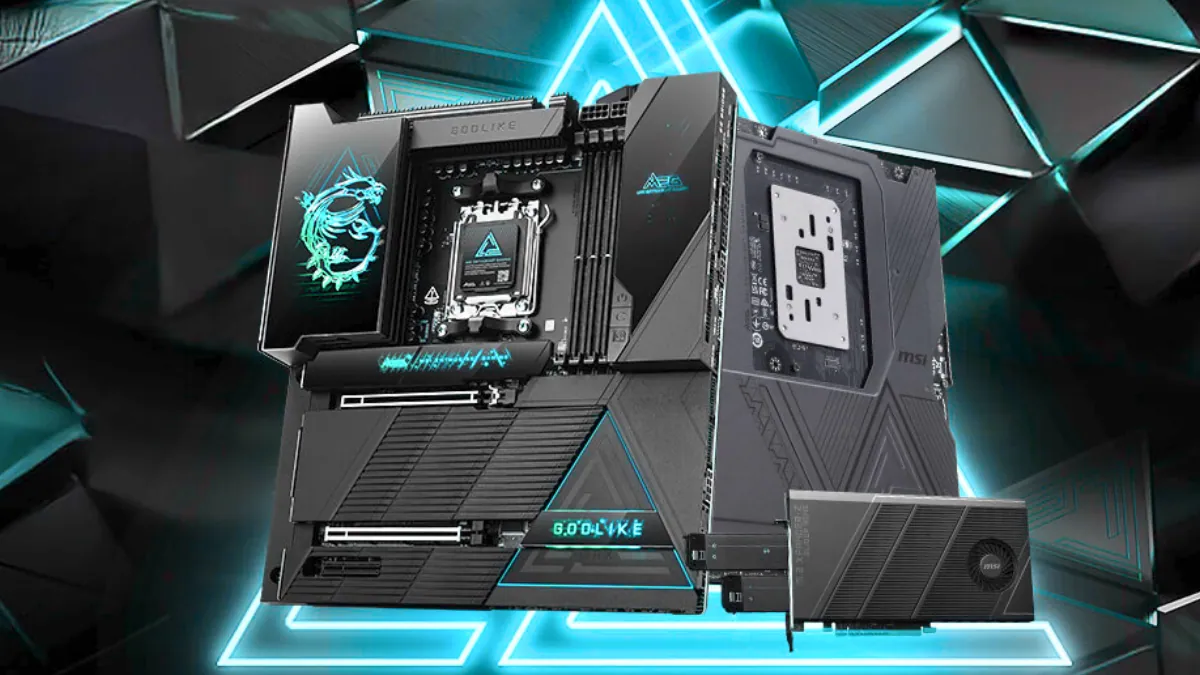
MSI has quietly launched the MEG X870E GODLIKE MAX, an updated version of its top-end AM5 motherboard. It is based on the earlier GODLIKE model but comes with a larger BIOS and improved tuning features.
Instead of changing the whole design, MSI focused on making the board better for long-term use and more accurate overclocking. This helps it stay strong in the high-end Ryzen 9000 market.
The biggest change in the MAX version is the new 64MB BIOS chip. It may seem like a small upgrade, but the extra space is important. It allows better support for future updates, more CPU compatibility, improved memory tuning, and continued AGESA improvements over time.
With AMD’s AM5 socket expected to support multiple processor generations, additional BIOS headroom ensures the board remains viable as Ryzen 9000 and subsequent releases evolve.
For builders planning extended upgrade cycles, this firmware expansion represents practical future-proofing rather than a marketing refresh.
The inclusion of an external clock generator, branded by MSI as its OC Engine, significantly enhances base clock tuning flexibility.
Unlike multiplier-only overclocking, a dedicated clock generator allows for finer frequency granularity and better stability when pushing high-core-count Ryzen CPUs.
This feature is particularly relevant for competitive overclockers and users experimenting with advanced memory and fabric tuning. To better understand where the MAX revision diverges from the standard GODLIKE model, the differences are outlined below.
Combined with MSI’s Click BIOS X interface and onboard diagnostic tools, the MAX variant strengthens its identity as a board engineered for manual optimization rather than automatic presets.
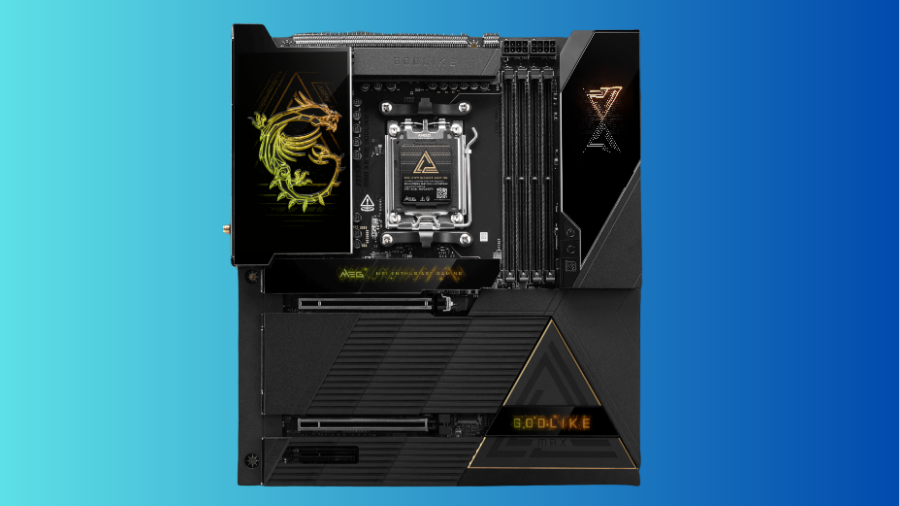
The MEG X870E GODLIKE MAX retains MSI’s 24+2+1 Duet Rail power delivery system rated at 110A SPS stages. The design is supported by dual 8-pin CPU power connectors and supplemental PCIe power, ensuring stable current delivery under sustained heavy workloads.
The board is built on a 10-layer PCB with 2oz thickened copper and server-grade materials.
This multilayer construction improves signal integrity for PCIe 5.0 and DDR5 overclocking while enhancing thermal efficiency and electrical stability.
For users running high-core-count Ryzen 9000 processors under load, this level of VRM and PCB engineering positions the GODLIKE MAX firmly in workstation-class territory.
Memory support continues to target high-frequency DDR5 tuning, with official overclocking support reaching up to DDR5-9200+ MT/s.
The board supports AMD EXPO profiles, dual-channel configuration, and up to 256GB capacity across four DIMM slots.
MSI’s enhanced memory trace layout and clock generator integration allow for tighter timing control. This is particularly important for latency-sensitive gaming, simulation, and AI inference workloads. Competitive benchmark users will appreciate the headroom available for fine-grained tuning.
The board offers dual PCIe 5.0 x16 mechanical slots sourced from the CPU. These support x16 or x8/x8 configurations depending on processor choice, alongside a third PCIe 4.0 x4 slot routed via the chipset.
The platform is fully ATX 3.1 and PCIe 5.1 ready, aligning with next-generation GPU power and bandwidth requirements. Reinforced Steel Armor II slots and supplemental PCIe power improve durability when housing large triple-slot graphics cards.
This configuration makes the board suitable for high-end gaming GPUs, AI accelerator cards, and multi-device workstation builds.
Storage is a defining feature of the GODLIKE MAX platform. The board provides two PCIe 5.0 x4 M.2 slots connected directly to the CPU and three PCIe 4.0 M.2 slots connected via the chipset.
Additionally, MSI bundles the M.2 XPANDER-Z SLIDER GEN5 expansion card. This adds two more PCIe 5.0 x4 slots in a single-slot-thickness design with active cooling.
This results in support for up to seven total M.2 NVMe drives. RAID support includes RAID 0, 1 and 10 for SATA, RAID 0, 1 and 10 for NVMe, and RAID 5 for NVMe when paired with Ryzen 9000 processors.
It should be noted that certain PCIe lane-sharing behaviors apply. The USB4 40Gbps ports and specific M.2 slots share bandwidth, meaning enabling full x4 operation on some storage slots may disable rear USB4 functionality.
Networking includes a Marvell AQC113CS 10GbE controller alongside a Realtek 8126 5GbE port. This enables flexible multi-gig wired configurations.
Wireless connectivity is handled by a Wi-Fi 7 solution supporting 320MHz channels and theoretical speeds up to 5.8Gbps, alongside Bluetooth 5.4. Dual USB4 Type-C ports provide 40Gbps throughput with DisplayPort passthrough support.
Key Specifications
| Chipset | AMD X870E |
| Socket | AM5 |
| CPU Support | Ryzen 9000 / 8000 / 7000 Series |
| Power Design | 24+2+1 Duet Rail, 110A SPS |
| PCB | 10-layer, 2oz copper, server-grade |
| Memory | 4x DDR5 up to 9200+ MT/s (OC), 256GB max |
| PCIe Slots | 2x PCIe 5.0 x16, 1x PCIe 4.0 x4 |
| Storage | 5x onboard M.2 + 2x via XPANDER (7 total) |
| SATA | 4x SATA 6Gbps |
| RAID | 0/1/10 (SATA & NVMe), RAID 5 (Ryzen 9000 NVMe) |
| LAN | 10GbE (Marvell AQC113CS) + 5GbE (Realtek 8126) |
| Wireless | Wi-Fi 7 (320MHz, up to 5.8Gbps), Bluetooth 5.4 |
| USB | Dual USB4 40Gbps, USB 20Gbps Type-C, multiple 10Gbps |
| Audio | Realtek ALC4082 + ESS9219Q DAC |
| Form Factor | E-ATX (304.8mm x 277mm) |
| BIOS | 64MB Flash |
| Special Features | OC Engine, Dynamic Dashboard III LCD |
These are complemented by multiple 10Gbps and 20Gbps USB ports for high-bandwidth peripherals and storage arrays. Audio is powered by the Realtek ALC4082 codec paired with an ESS9219Q DAC and amplifier configuration. It supports up to 32-bit/384kHz playback and 7.1-channel output.
The board retains its signature 3.99-inch Dynamic Dashboard III LCD for real-time monitoring and customization. It also includes EZ PCIe Release, EZ Magnetic M.2 Shield Frozr II, EZ M.2 Clip II, EZ Link header consolidation, a pre-installed I/O shield, and a reinforced metal backplate.
MSI positions the GODLIKE MAX within its AI PC narrative, and the hardware foundation aligns with that strategy. PCIe 5.0 bandwidth, multi-gig networking, large DDR5 capacity, and extensive NVMe support collectively create a platform suitable for local AI model experimentation, GPU-accelerated workflows, and high-throughput content production.
MEG X870E GODLIKE MAX vs MEG X870E GODLIKE X
| Feature | GODLIKE MAX | GODLIKE X |
|---|---|---|
| BIOS Size | 64MB | Standard (32MB typical) |
| External Clock Generator | Yes (OC Engine) | No |
| Power Design | 24+2+1, 110A SPS | 24+2+1, 110A SPS |
| PCB | 10-layer, 2oz copper | 10-layer, 2oz copper |
| PCIe 5.0 Slots | Dual x16 | Dual x16 |
| Total M.2 Slots | 7 (5 onboard + 2 via card) | 5 onboard |
| LAN | 10GbE + 5GbE | 10GbE + 5GbE |
| Wi-Fi | Wi-Fi 7 | Wi-Fi 7 |
| USB4 | Dual 40Gbps | Dual 40Gbps |
| LCD Dashboard | 3.99-inch Dynamic Dashboard III | 3.99-inch Dashboard |
| AI PC Positioning | Enhanced marketing focus | Standard flagship |
| Target Audience | Extreme overclockers, long-term AM5 builds | Enthusiast flagship users |
Rather than altering its visual identity, the MAX revision strengthens the engineering beneath it. It extends platform longevity while maintaining flagship status within MSI’s lineup.
Pricing details remain limited. However, the GODLIKE branding historically reflects MSI’s no-compromise ultra-premium tier.
Source: MSI