
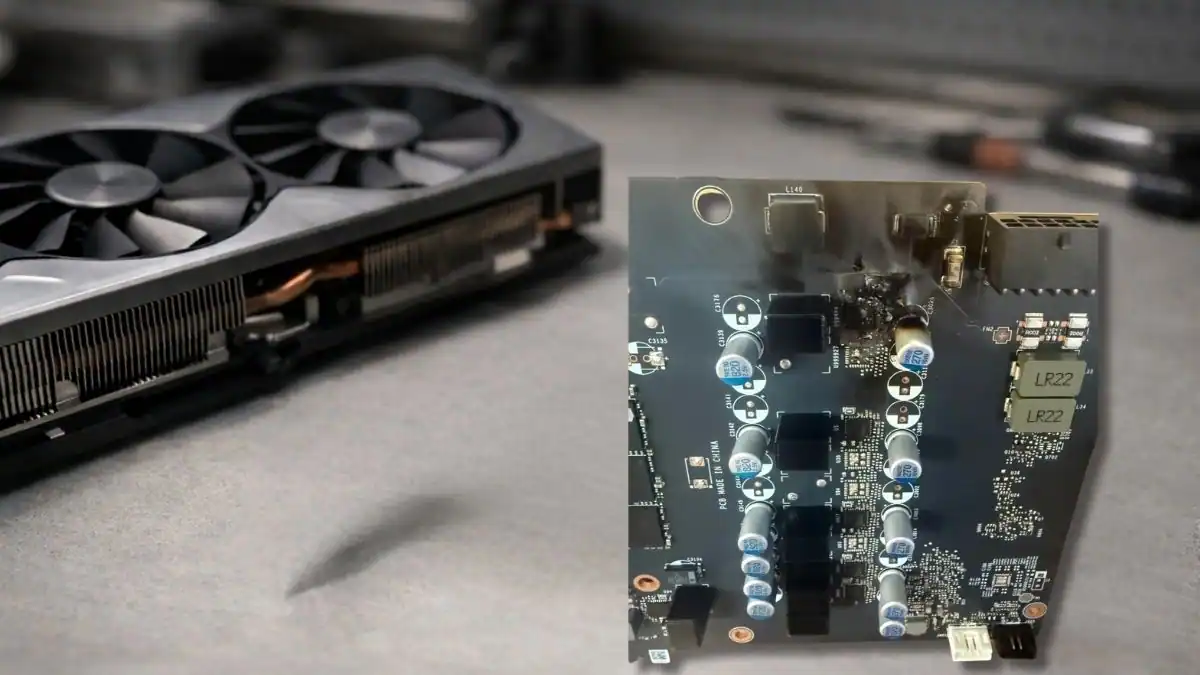
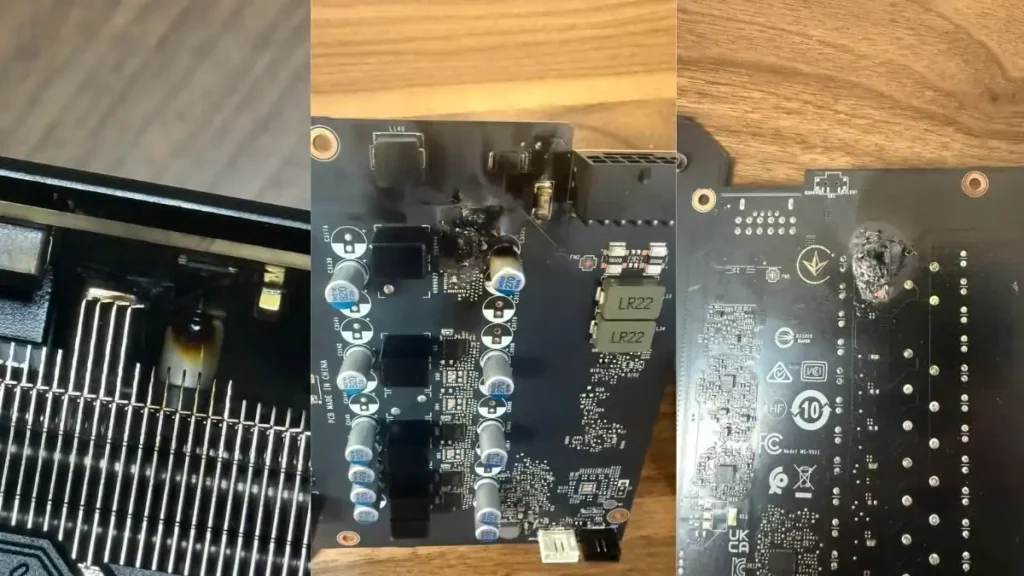
An MSI GeForce RTX 4080 Super graphics card has reportedly suffered a catastrophic hardware failure during testing, with images shared online showing severe burn damage and a hole burned straight through the printed circuit board. The incident, which surfaced this week on a PC hardware forum, has renewed discussion around reliability risks associated with modern ultra-high-end GPUs operating at extreme power levels.
The graphics card involved is identified as an MSI RTX 4080 Super Ventus 3X OC. According to the individual who documented the failure, the card was acquired through secondary market channels as part of a batch of used GPUs intended for inspection, testing, and refurbishment. Its previous usage history remains unknown.
The user reported that the card initially showed no power draw when installed on a test bench. However, after being moved to a secondary system and powered on, the GPU failed almost instantly, producing a loud electrical pop and visible scorching near the power delivery area. Subsequent inspection revealed extensive localized damage and a perforation in the PCB.
Photos shared alongside the report show charring concentrated around components associated with voltage regulation, rather than near the GPU die itself. Experienced users and hardware technicians commenting on the images suggested the failure pattern is consistent with a short circuit or VRM-related fault, potentially involving capacitor or regulator failure under load. Importantly, there is no visible evidence of connector melting or improper cabling, issues that previously affected some high-end NVIDIA cards.
Incident Summary
| Aspect | Details |
|---|---|
| GPU Model | MSI RTX 4080 Super Ventus 3X OC |
| Condition | Used/refurbished unit |
| Initial Behavior | No power draw on first test |
| Failure Moment | Immediately upon second power-on |
| Damage Location | Power delivery / VRM area |
| Connector Involved | No visible 12VHPWR damage |
| Likely Cause | Short circuit or VRM component failure |
According to the reddit user TwistedCollossus, who reported the incident, the graphics card had not been opened before the failure, and the cooler was removed only afterward to document the damage. This suggests the fault originated internally rather than being caused by user modification or installation error.
While isolated failures of complex electronics are not unusual, the visibility of this incident has drawn attention due to the RTX 4080 Super’s premium positioning and high power requirements. Modern flagship GPUs routinely operate at or above 300 watts, placing sustained electrical and thermal stress on power-delivery components, particularly during transient load spikes.
Hardware engineers note that even rare manufacturing defects or prior electrical stress in used hardware can result in rapid and destructive failures when operating at these power levels. The fact that the card was sourced from the secondary market complicates attribution, as prior workloads, environmental exposure, or partial component degradation cannot be ruled out.
It is also important to distinguish this case from earlier reports involving melted power connectors on certain NVIDIA GPUs. In this incident, damage appears localized to the board’s power regulation circuitry, with no indication that cabling or connector design played a role.
Neither MSI nor NVIDIA has issued a public statement addressing this specific failure at the time of publication. Manufacturers typically evaluate such incidents through return and failure analysis procedures, though warranty outcomes often depend on purchase history and prior handling of the hardware.
Also Read: MSI Prices RTX 5090 Lightning Z at $5,200 in Taiwan Lottery
The incident serves as a reminder of the growing electrical and thermal complexity of modern high-end graphics cards. For system builders and enthusiasts, it highlights the importance of quality power supplies, careful sourcing of used components, and thorough validation testing, particularly when dealing with flagship GPUs that operate close to the limits of current consumer power-delivery designs.
Source: Reddit (TwistedCollossus)