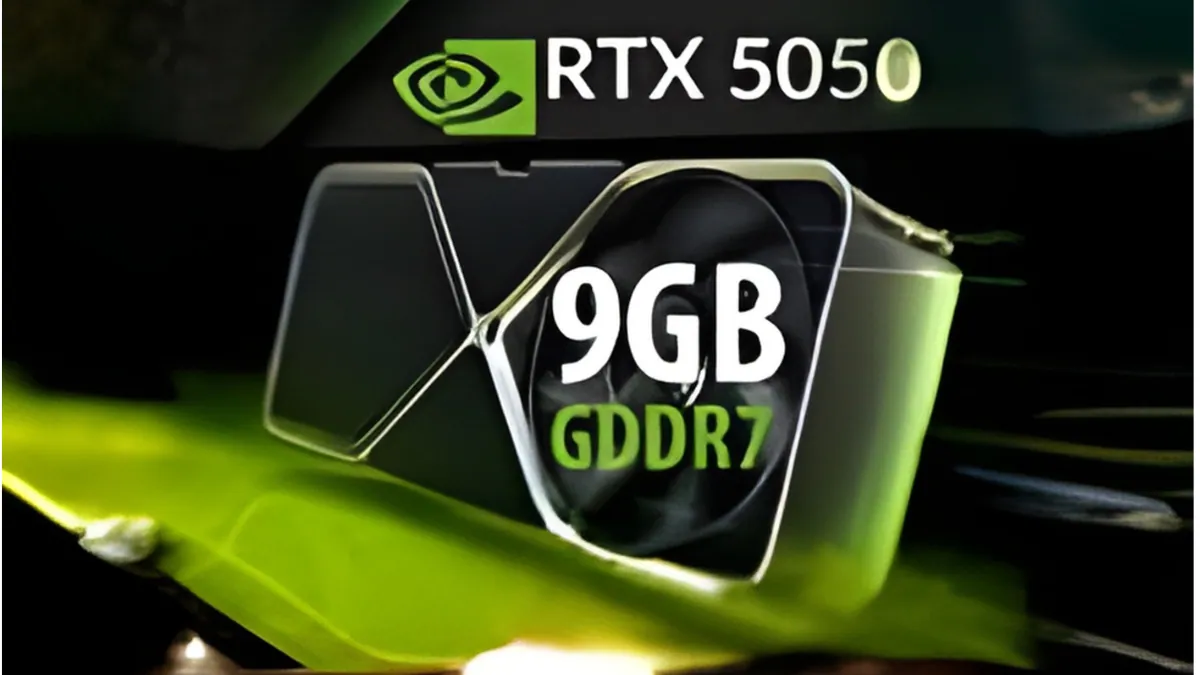
A new leak suggests NVIDIA may release a revised version of its entry-level GeForce RTX 5050 graphics card with an unusual 9GB GDDR7 memory configuration. The rumored design would expand the upcoming RTX 50-series lineup based on NVIDIA’s Blackwell architecture and introduce a different memory layout compared with typical entry-level GPUs.
According to information circulating among hardware leak sources, the graphics card could use three 3GB GDDR7 memory modules instead of the more common 8GB configuration. This setup would increase total VRAM capacity to 9GB while running on a 96-bit memory interface.
Although the memory bus is narrower than the 128-bit interfaces commonly used on many mainstream graphics cards, the faster GDDR7 memory could help maintain competitive bandwidth. The modules are rumored to operate at speeds of around 28 Gbps, which would give the card an estimated memory bandwidth of roughly 336 GB/s.
For comparison, many entry-level GPUs using 128-bit GDDR6 memory deliver about 320 GB/s of bandwidth. The higher transfer rate of GDDR7 could allow the RTX 5050 to slightly exceed that level despite using a narrower interface.
Leaked specifications suggest the GPU may continue using the GB207 graphics processor, which is believed to be part of NVIDIA’s upcoming Blackwell architecture. The chip is rumored to feature around 2,560 CUDA cores, positioning the RTX 5050 as an entry-level gaming GPU aimed primarily at 1080p systems.
Power requirements are expected to remain relatively modest. Early information suggests a total board power close to 130 watts, with the card likely using a standard 8-pin PCIe power connector. That configuration would allow the GPU to work with many mainstream desktop power supplies and compact gaming builds.
The 9GB memory capacity would be possible because of higher-density GDDR7 memory packages. Instead of using four memory chips, the reported configuration uses three larger modules connected to the 96-bit memory interface.
If accurate, the RTX 5050 could become one of the first entry-level GPUs to combine NVIDIA’s Blackwell architecture with GDDR7 memory technology. GDDR7 significantly increases transfer speeds compared with previous GDDR6 memory used on earlier RTX cards.
Rumors surrounding the broader RTX 50-series lineup indicate that NVIDIA may be adjusting specifications across multiple models while preparing its next generation of GPUs. Similar developments in next-generation hardware have also appeared across other computing platforms, including systems such as the GMKtec 180 TOPS AI Mini PC, which targets compact AI workloads.
Entry-level graphics cards like the RTX 5050 are commonly used in budget gaming PCs and OEM desktop systems. They often appear in prebuilt computers and gaming laptops paired with mid-range processors, similar to systems such as the Lenovo Legion 7a Gen 11.
NVIDIA has not confirmed the existence of a 9GB RTX 5050 variant, and the specifications remain based entirely on leak reports. Final specifications, pricing, and launch timing will only become clear once the company officially introduces its RTX 50-series graphics cards.
Source: MEGAsizeGPU(X)