
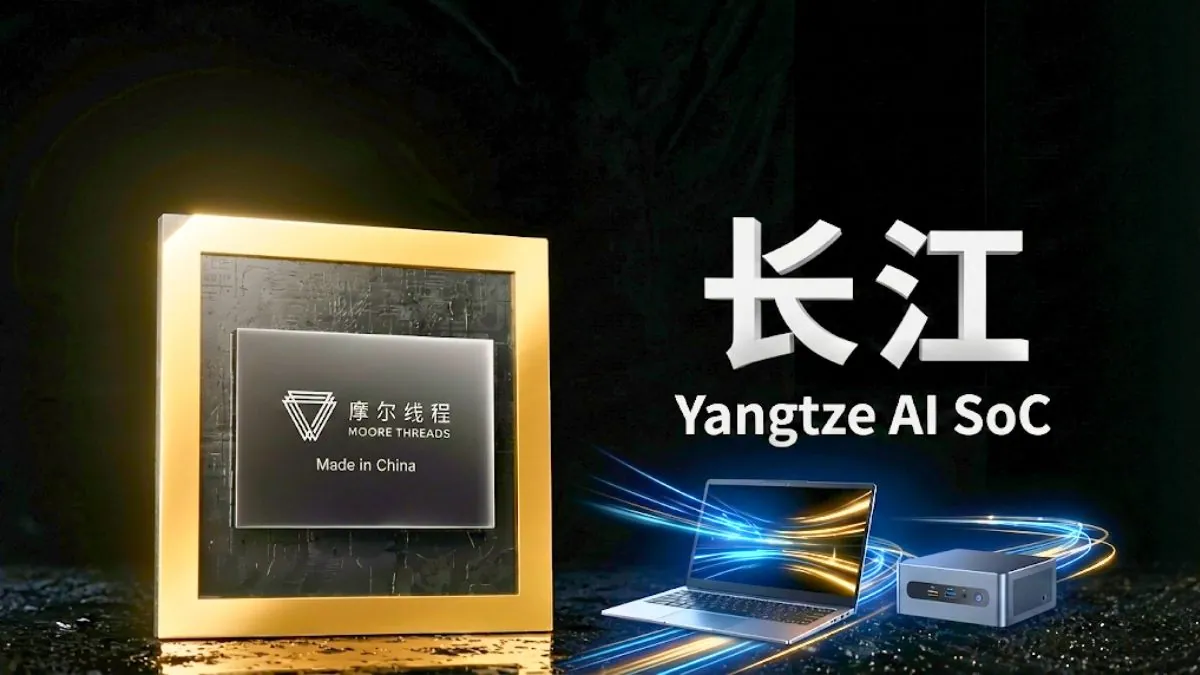
Moore Threads has taken its first step towards building a complete AI PC platform by introducing Yangtze. This is a fully integrated system-on-a-chip designed for laptops and compact desktop systems. The announcement was made during the company’s MUSA Developer Conference 2025, where Moore Threads also showcased reference laptop and mini PC designs based on the new platform.
With Yangtze, Moore Threads has expanded beyond discrete graphics processors to a full PC-class SoC, integrating the CPU, GPU, NPU, and system controller into a single low-power chip.
Yangtze Integrates CPU, GPU, and NPU in a Single PC-Class Chip
According to Moore Threads, Yangtze is a heterogeneous SoC that integrates multiple processing blocks traditionally spread across separate components. This chip combines an 8-core CPU cluster, an integrated GPU, a dedicated AI accelerator, and media and display engines, designed for thin and light laptops and compact PCs.
The company stated that Yangtze is designed with local AI workloads and general-purpose computing in mind, rather than high-frequency peak performance, targeting everyday productivity, media processing, and on-device inference.
Yangtze positions Moore Threads alongside global efforts to bring AI workloads directly to consumer PCs, a space currently dominated by Intel, AMD, and Qualcomm. Instead of competing in high-end data-center AI, Moore Threads is targeting local AI inference, media processing, and everyday computing workloads within a single low-power SoC.
Moore Threads shared the following specifications to illustrate Yangtze’s intended workload focus, rather than peak performance targets.
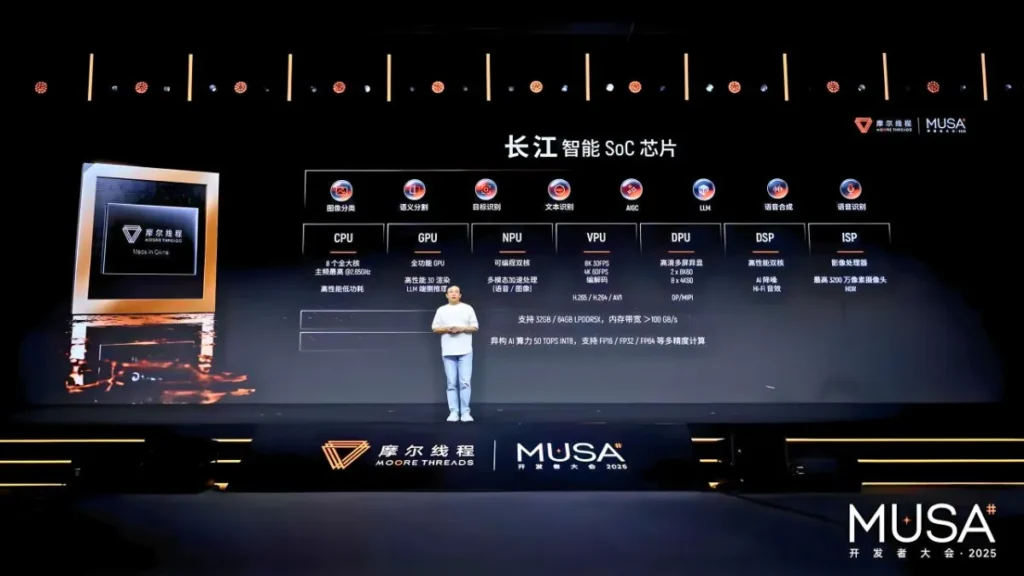
Image Credit: Moore Threads via Wcctech
Eight-Core CPU and 50 TOPS AI Accelerator
Yangtze features a CPU with a maximum clock speed of 2.65 GHz. Moore Threads has not disclosed detailed CPU microarchitecture information.
The AI subsystem is built around a multi-core neural processing unit rated at up to 50 TOPS (INT8). According to the company, the NPU is intended for tasks such as speech recognition, image processing, and local AI inference, aligning Yangtze with the emerging AI PC category.
Moore Threads did not position the chip for large-scale AI training workloads.
Integrated Graphics and Media Support
The SoC includes an integrated GPU capable of handling both graphics and AI-related workloads, though Moore Threads has not released detailed architectural specifications.
Media capabilities include support for H.264, H.265, and AV1 encoding and decoding. The company states that Yangtze can handle 8K video playback at 30 fps and 4K video playback at 60 fps, expanding its use beyond basic office tasks.
Built-In Display, Camera, and Audio Processing
Yangtze integrates several system controllers directly on-chip, reducing the need for external components. These include:
- A display processing unit capable of driving dual 8K displays at 50 Hz or up to eight 4K displays
- A digital signal processor for AI-based noise reduction and audio processing
- An image signal processor supporting camera sensors up to 32 MP with HDR
Moore Threads states that integrating these subsystems is intended to improve power efficiency and simplify system design.
Memory Support and Reference Systems
The Yangtze SoC supports up to 64 GB of LPDDR5X memory, with reported memory bandwidth exceeding 100 GB/s.
To demonstrate real-world implementations, Moore Threads showcased two reference platforms at the event:
- MTT AIBook, a laptop design
- MTT AICube, a compact mini PC
The company indicated that these reference systems are primarily intended for the Chinese domestic market and serve as development platforms rather than confirmed global retail products.
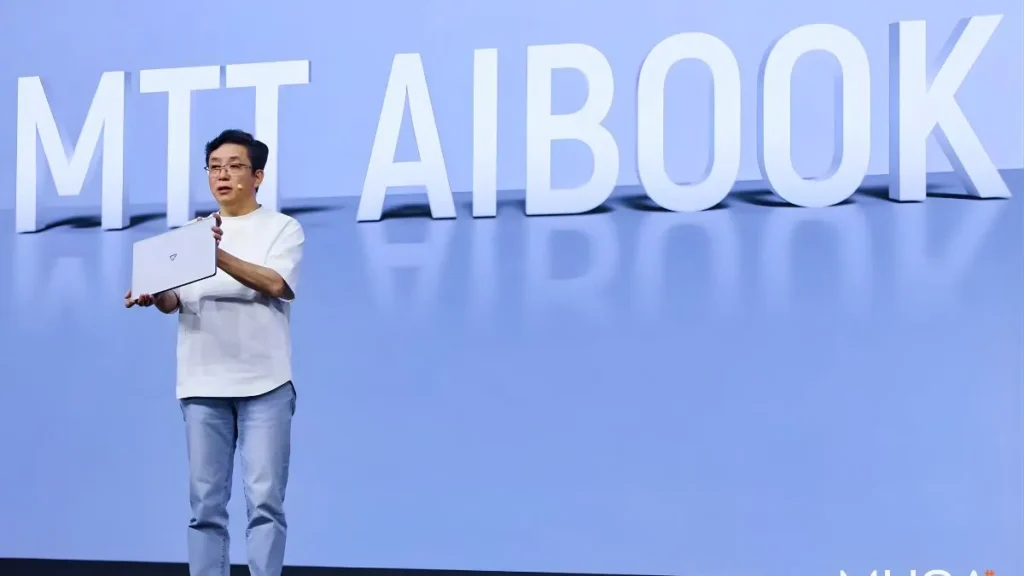
Image Credit: Moore Threads via Wcctech
Positioning and Availability
In this MUSA event, Moore Threads did not announce pricing or commercial availability timelines for Yangtze-based systems. The company indicated that the platform is currently focused on developer enablement, with broader ecosystem and product updates expected as the SoC matures.
Source: Wccftech (based on Moore Threads MUSA Developer Conference)