
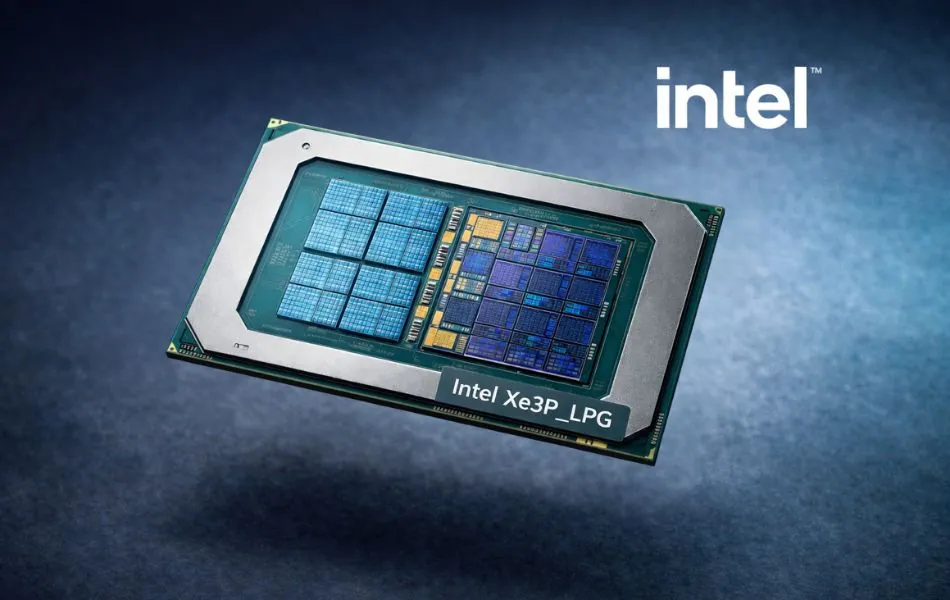
Intel has confirmed that its upcoming Core Ultra 400 mobile processors, codenamed Nova Lake-P, will feature the Xe3p-LPG integrated graphics architecture, following the appearance of explicit platform support in upstream Linux graphics driver code. The early enablement provides the clearest public signal yet that Intel’s next-generation mobile platform is well into active bring-up and validation.
The confirmation comes from newly submitted Linux driver patches that add full graphics support for Nova Lake-P, Intel’s mobile-focused branch of the broader Nova Lake platform. While media and display components had already been partially enabled, the latest updates complete the graphics stack by introducing Xe3p-LPG and formally wiring the platform together inside the driver.
In Intel’s development pipeline, upstream Linux driver work typically appears months ahead of commercial hardware launches, making it a reliable indicator of platform maturity rather than a speculative or placeholder reference. The presence of Nova Lake-P support in public kernel code strongly suggests that internal validation is already underway across multiple configurations.
The patches also introduce multiple new PCI device IDs associated with Nova Lake-P graphics. As is common during late pre-launch development, not every ID necessarily corresponds to a retail SKU – some may remain tied to engineering samples – but their inclusion points to active testing across a broad hardware matrix.
The Linux enablement helps further define Intel’s increasingly layered integrated graphics strategy:
- Xe2 debuted with Lunar Lake
- Xe3 is rolling out with Panther Lake as the next mainstream architecture
- Xe3p-LPG arrives with Nova Lake-P as a refined, mobile-optimized variant
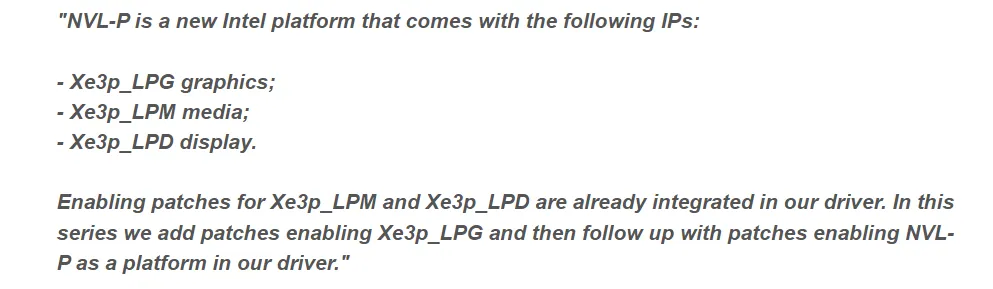
Importantly, this confirms that Xe3p-LPG is not a replacement for Panther Lake’s Xe3 graphics, but a targeted evolution designed specifically for mobile platforms under the Core Ultra 400 umbrella.
At this stage, the Linux driver lists Xe3p-LPG as carrying over the software-enabled feature set from Xe2, while explicitly flagging additional capabilities to be enabled later. That detail suggests Intel may activate performance and feature enhancements progressively through driver updates, rather than delivering the full graphics feature set on day one.
Although the confirmation originates from Linux development, its implications extend well beyond open-source platforms. Early upstream driver work typically mirrors Intel’s internal hardware readiness and validation timelines—factors that directly influence Windows driver quality and OEM launch schedules.
For laptop manufacturers, this early groundwork often translates into more stable graphics drivers at launch, fewer post-release fixes, and smoother rollouts for new mobile platforms.
Also Read: Intel Core Ultra 9 290K Plus Leak Shows 11% Gain Over 285K
Historically, mobile processors tend to benefit first from this kind of early enablement, reinforcing the likelihood that Core Ultra 400 laptops will be among the first Nova Lake systems to reach consumers.
Intel has stated that Nova Lake is expected toward the end of the year, but has not confirmed whether desktop or mobile models will lead the launch. The Linux patches focus squarely on the P-series client platform, strengthening the case that mobile systems are a primary target for Xe3p-LPG graphics and may deliver the first real-world gains from the architecture.
While the driver updates stop short of revealing performance figures or architectural deep dives, they quietly lock in Intel’s direction. Nova Lake-P is real, Xe3p-LPG is confirmed for mobile Core Ultra 400 processors, and the software foundation for Intel’s next-generation integrated graphics is already being laid well ahead of official product announcements.
Source: Phoronix Media