


Intel appears to have quietly wound down its controversial On-Demand Software Defined Silicon program, a pay-to-unlock feature model tied to select Xeon server processors, after public development tooling linked to the initiative was archived and official documentation quietly disappeared. The shift signals a retreat from one of Intel’s most debated attempts to monetize processor features after sale, without a formal announcement from the company.
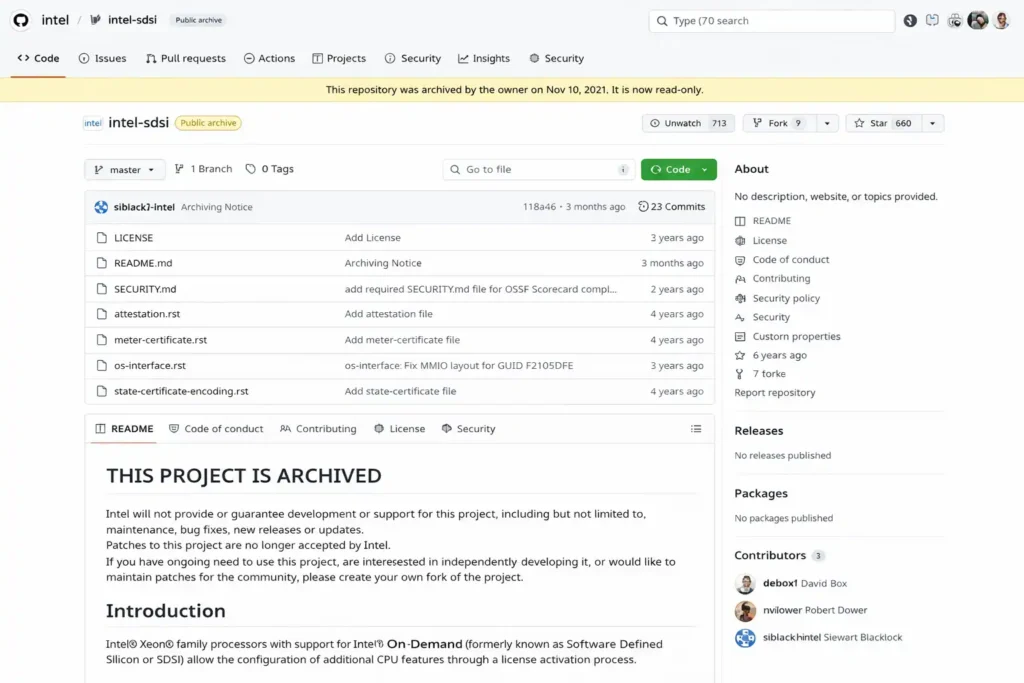
The change became visible after Intel archived the public GitHub repository used to support Software Defined Silicon, also known as SDSi. The repository was marked read-only in November 2025, a move that typically signals the end of active development and strongly suggests the underlying program is no longer being maintained.
Intel On Demand was designed to let customers activate additional hardware capabilities already present on select Xeon SKUs through paid licenses. Intel documentation described both a one-time activation option and a usage-based consumption model, positioning the approach as a way to offer flexibility without increasing base processor prices.
Industry analysts note that Intel On Demand arrived as enterprise buyers were pushing for simpler licensing, predictable long-term costs, and clearer ownership of hardware capabilities, especially in large-scale server deployments where licensing complexity can translate directly into operational risk.
The program covered a range of accelerators and platform features, including Quick Assist Technology, Dynamic Load Balancer, In-Memory Analytics Accelerator, Data Streaming Accelerator, Software Guard Extensions, and Virtual RAID on CPU. While technically ambitious, the idea of paying to unlock dormant silicon was widely criticized by customers and developers who viewed it as blurring the line between hardware ownership and software subscription.
Reports suggest Intel’s broader on-demand web presence has also quietly diminished. Dedicated pages outlining the program appear to have been removed, with only older PDF documents still accessible. Intel has not issued a public announcement confirming the end of the initiative, but the absence of updates, tooling, and active documentation points to a de facto shutdown.

For enterprise customers, the quiet wind-down removes uncertainty around future licensing obligations tied to long-lived server hardware. In data centres where systems are often deployed for many years, avoiding unexpected feature fees can simplify budgeting, compliance planning, and procurement decisions.
The move also mirrors wider shifts in the server market. Competing platforms have largely stayed away from pay-to-unlock silicon, opting instead for clear SKU-based differentiation and platform-level software strategies rather than licensing individual processor features.
Intel first outlined the Software Defined Silicon concept in 2021, presenting it as a forward-looking way to make processors more configurable over time. However, the lack of customer adoption suggests the execution did not align with enterprise expectations, even as interest in flexible silicon capabilities continues across the industry.
Also Read: Intel Core Ultra 7 270K Plus and Ultra 5 250K Plus reviews
The apparent shutdown may influence how Intel approaches configurable hardware in the future, potentially pushing the company toward bundling capabilities directly at the SKU level rather than monetizing them after purchase. Intel did not respond to a request for comment at the time of publication and has not publicly addressed the apparent end of the On Demand program.
Sources: Phoronix via Videocardz