

ASRock has released a new BIOS update for its AMD AM5 motherboards aimed at resolving system stability problems and persistent no-boot scenarios, an issue that has drawn increased attention as more users report systems failing to start after periods of normal operation.
The update matters because boot failures at this stage are typically linked to firmware behavior rather than assembly errors, placing responsibility on platform-level fixes rather than end-user troubleshooting. The release applies across ASRock’s AM5 600-series and 800-series motherboard lineup, covering a broad portion of the current desktop platform.
According to recent information from ASRock, the update integrates AMD’s AGESA ComboAM5 PI 1.3.0.0a firmware and is being distributed as Beta BIOS version 4.07.AS01 across supported AM5 motherboards.
The company says the release focuses on improved platform compatibility, optimized memory behavior, and a fix for boot failures occurring on certain CPUs. While ASRock characterizes the update as comprehensive, it does not provide detailed reproduction conditions or CPU-specific guidance, reflecting the early validation status typical of beta firmware releases.
Industry sources indicate that the most disruptive cases involve systems that stop booting only after extended use, rather than failing immediately after installation. This pattern is significant because post-use boot failures are commonly associated with memory training edge cases, firmware state handling, or compatibility regressions introduced through earlier updates, all of which fall squarely within BIOS and AGESA control rather than hardware assembly faults. Such behavior has been reported across multiple memory configurations, reinforcing the firmware-centric nature of the issue.
The BIOS update is intended to correct these firmware-level problems by refining how the platform initializes the processor and memory during startup. AGESA serves as the core firmware layer that governs CPU bring-up, memory training, and low-level compatibility across the AM5 ecosystem, meaning changes at this level can have broad effects on system stability when properly validated across a wide range of hardware combinations.
ASRock does not specify which processor models are affected, and the company stops short of naming any particular CPU family. This omission reflects ongoing cross-platform validation rather than a narrowly targeted fix, as motherboard vendors typically avoid publishing CPU-specific impact lists until firmware behavior has been confirmed across multiple SKUs, memory kits, and board revisions. This approach also avoids prematurely attributing the issue to a single processor generation while investigation continues.
While the update is designed to address systems that fail to boot due to firmware incompatibilities, it is not expected to recover processors that are already physically damaged.
BIOS updates can resolve training failures, initialization loops, and compatibility regressions, but they cannot restore hardware that has become electrically nonfunctional, a distinction that remains important for users diagnosing severe or permanent boot failures.
The release also highlights a broader phase of firmware stabilization across the AM5 platform as newer processors, memory densities, and board revisions continue to expand. Because AGESA updates provided by AMD are distributed to all motherboard partners, similar fixes are likely to appear across other vendors’ BIOS releases as shared edge cases are identified and resolved at the platform level.
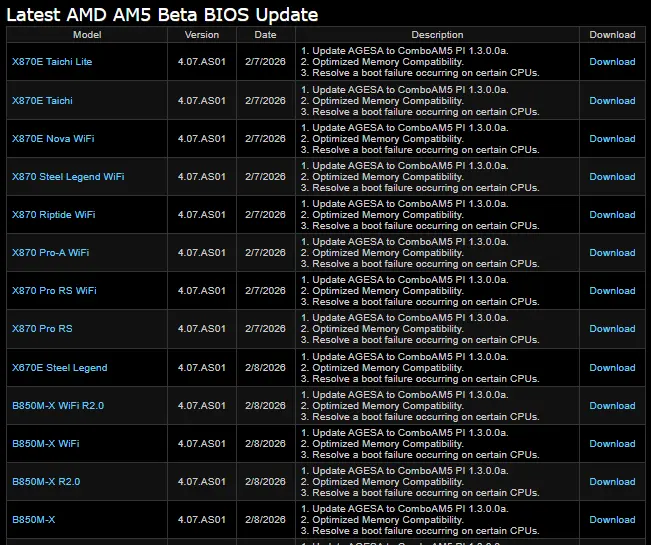
ASRock has made the beta BIOS available through its official support channels, with a finalized, non-beta release expected to follow after additional validation. Users experiencing unexplained no-boot behavior or post-use startup failures on affected AM5 systems may benefit from applying the update using supported flashing methods for their specific motherboard model, while systems operating normally may prefer to wait for the stable release once testing is complete.
Source: ASRock