


A newly surfaced leak suggests Intel’s upcoming Nova Lake-S desktop processors could ship with dramatically higher power limits than current-generation chips, raising fresh questions about thermals, motherboard design, real-world efficiency, and next-generation desktop platform requirements.
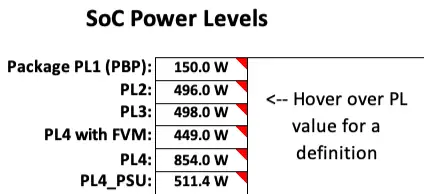
According to information circulating among established hardware leakers HXL on X (formerly Twitter), internal documentation lists a PL2 value of 496 watts and a PL4 spike limit of 854 watts for certain dual-compute-tile Nova Lake-S K-series processors. If accurate, those figures would represent one of the most aggressive turbo power envelopes ever seen on a mainstream Intel desktop CPU platform.
These reported limits place Nova Lake among the most power-intensive enthusiast-class processors ever rumored, potentially redefining expectations for high-end PC builders, overclockers, and workstation users.
Nova Lake-S Leaked Power Targets
| Power State | Reported Value | What It Represents |
|---|---|---|
| PL1 | 150W | Sustained base power (Processor Base Power) |
| PL2 | 496W | Short-duration turbo boost limit |
| PL3 | 498W | Secondary turbo enforcement ceiling |
| PL4 | 854W | Instantaneous transient spike limit |
| PL4_PSU | 511.4W | PSU-constrained electrical ceiling under load |
The inclusion of a distinct PL4_PSU value suggests Intel may be defining different electrical handling scenarios depending on power supply limitations, transient spikes, and motherboard power delivery capabilities. That distinction becomes increasingly important as next-generation desktop CPUs push toward unprecedented turbo behavior.
If these numbers hold, Nova Lake would mark a substantial leap over Intel’s recent flagship desktop architectures.
For context, recent high-end CPUs such as Arrow Lake and Raptor Lake have typically operated with PL2 limits in the mid-200W range. A move toward nearly 500W turbo scaling signals a significant architectural shift in how Intel may be prioritizing peak multi-threaded performance and benchmark leadership.
How Nova Lake Compares to Current Intel Flagships
| Processor | Base Power (PL1) | Max Turbo Power (PL2) |
|---|---|---|
| Core Ultra 9 285K (Arrow Lake) | 125W | 250W |
| Core i9-14900K | 125W | 253W |
| Nova Lake-S (Leaked) | 150W | 496W |
This highlights the excited of the rumored change, particularly in short-duration turbo power scaling under heavy parallel workloads.
Reports suggest these elevated power targets apply to dual-compute-tile Nova Lake-S K-series SKUs, with configurations rumored to scale up to 52 cores at the top end, positioning the chip as a potential flagship for enthusiast desktops and creator-class systems.
The highest-end configuration is expected to feature 16 performance cores, 32 efficiency cores, and 4 low-power efficiency cores. A debated 42-core configuration has also surfaced, reportedly consisting of 14 performance cores, 24 efficiency cores, and 4 low-power efficiency cores.
Such extreme core counts, combined with aggressive turbo algorithms and expanded compute tiles, could explain why the platform may require significantly elevated power ceilings during sustained rendering, AI inference workloads, large code compilation, and professional content creation tasks.
However, not all sources agree on the interpretation of the leaked data. Some industry voices suggest the figures may correspond to early engineering validation samples or alternative SKU configurations rather than finalized retail silicon. As with most pre-launch disclosures, tuning targets often evolve before mass production.
Interpreting these numbers requires a clear understanding of Intel’s defined power states and turbo scaling mechanisms.
PL1 typically represents sustained base power, also referred to as Processor Base Power. PL2 governs short-duration turbo boost behavior when the CPU temporarily exceeds its base limit. PL3 acts as an additional enforcement ceiling, while PL4 reflects ultra-short electrical spikes during rapid voltage-frequency transitions.
An 854W PL4 rating does not mean the processor will continuously draw that amount of power. Instead, PL4 events generally occur for microseconds during turbo engagement or disengagement cycles. These instantaneous spikes can place considerable stress on motherboard VRM phases, transient response handling, and PSU stability.
As turbo envelopes expand, power delivery quality may become just as critical as cooling performance in next-generation Intel desktop builds.
If Nova Lake sustains turbo behavior anywhere near the rumored 496W PL2 ceiling, cooling requirements would likely increase significantly compared to current Intel flagship CPUs.
High-end 360mm or 420mm AIO liquid coolers could become standard recommendations for top-tier Nova Lake-S K-series processors. Custom loop cooling solutions may offer more consistent thermal headroom during prolonged multi-core stress tests and professional workloads.
Motherboard vendors would likely respond with reinforced multi-phase VRM designs, upgraded PCB layers, and enhanced transient filtering to support aggressive turbo scaling. PSU selection could become equally critical, particularly for builders pairing Nova Lake with high-end GPUs and PCIe 5.0 storage.
Intel has faced mounting pressure to scale core counts while maintaining competitive performance-per-watt metrics against rival desktop architectures. At the same time, modern desktop CPUs are increasingly optimized for AI-accelerated workloads, real-time rendering engines, simulation tasks, and enterprise-level productivity applications.
High parallel core counts paired with expansive turbo envelopes may reflect a deliberate performance-first strategy designed to maximize peak benchmark output in heavily threaded scenarios. In such environments, short bursts of extreme power can translate directly into faster completion times and measurable productivity gains.
For gaming-focused systems, sustained 500W-class turbo ceilings may not always be necessary. However, for creator workflows, 3D rendering pipelines, AI model inference, and scientific computation, burst performance remains a decisive advantage.
It is important to emphasize that Nova Lake remains months away from any official announcement. Intel has not confirmed final specifications, power targets, socket compatibility, or chipset segmentation for the Nova Lake-S desktop platform.
Leaked engineering documentation frequently represents early validation stages before firmware tuning and microcode optimization are finalized. Power limits in internal testing environments can change significantly before retail launch.
Some observers suggest the circulating figures may already be outdated or tied to specific validation scenarios rather than final consumer products.
If even part of the reported data proves accurate, Nova Lake could become one of the most power-demanding mainstream desktop CPU generations ever introduced.
Such a shift would reshape expectations around motherboard tiers, PSU wattage recommendations, cooling standards, and overall next-generation desktop platform design.
Rather than signaling inefficiency alone, these rumored limits may represent Intel’s renewed push for absolute performance leadership in the enthusiast desktop CPU segment.
For system integrators, PC builders, and hardware enthusiasts, the coming months will clarify whether Intel tempers these turbo ceilings before launch or formally embraces them as the new benchmark for peak desktop performance.
Source: HXL (X)