
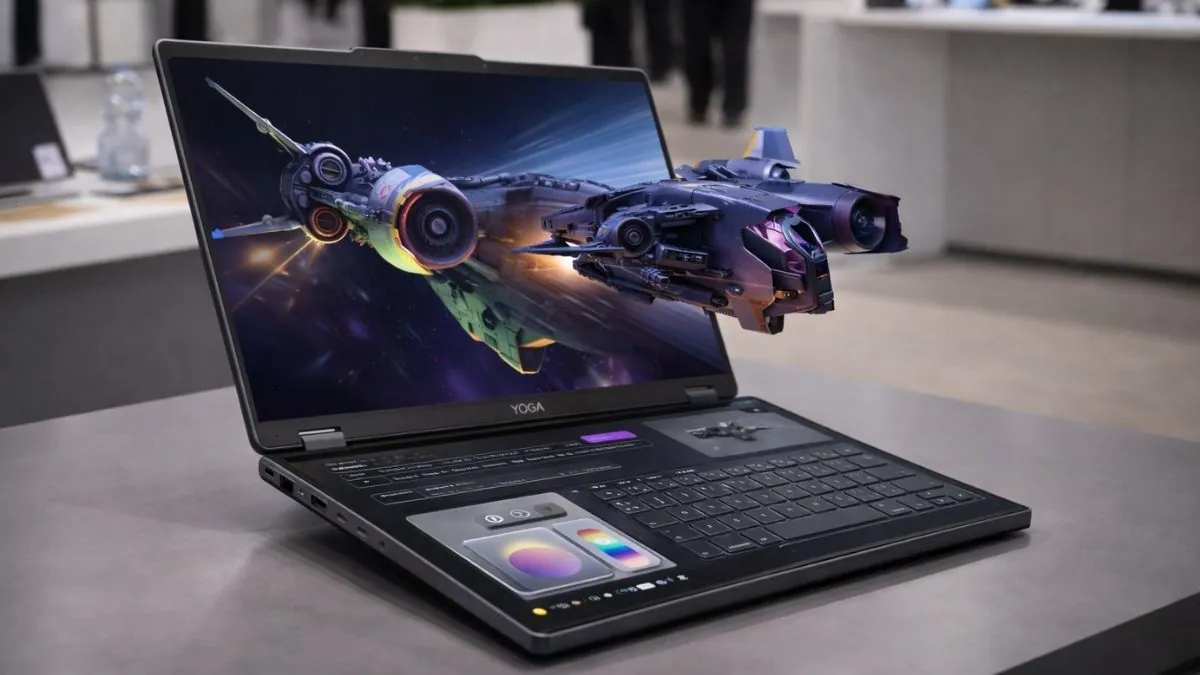
Lenovo has unveiled the Lenovo Yoga Book Pro 3D Concept at Mobile World Congress 2026 in Barcelona, introducing a dual OLED, glasses-free 3D laptop built specifically for creators. The concept device combines two 3.2K PureSight Pro Tandem OLED displays, AI-powered 2D-to-3D conversion, gesture controls, and RTX 5070-class graphics in a single mobile workstation.
Recent Updates
See what’s changed in this article
March 2, 2026: Updated with Lenovo’s official MWC 2026 announcement, adding confirmed specs including dual 3.2K OLED displays, RTX 5070-class graphics, and gesture camera details.
February 28, 2026: This article was first published based on pre-event leak information.
The announcement was made during Lenovo’s official MWC 2026 showcase in Barcelona, Spain, where the company highlighted its broader push into AI-integrated premium hardware. Lenovo also introduced the Yoga Pro 7a with Ryzen AI Max+ at the same event, targeting creators who prioritize performance and on-device AI acceleration.
The Yoga Book Pro 3D Concept reflects Lenovo’s strategy to reduce dependence on external monitors, depth cameras, and separate input tools in professional 3D workflows.
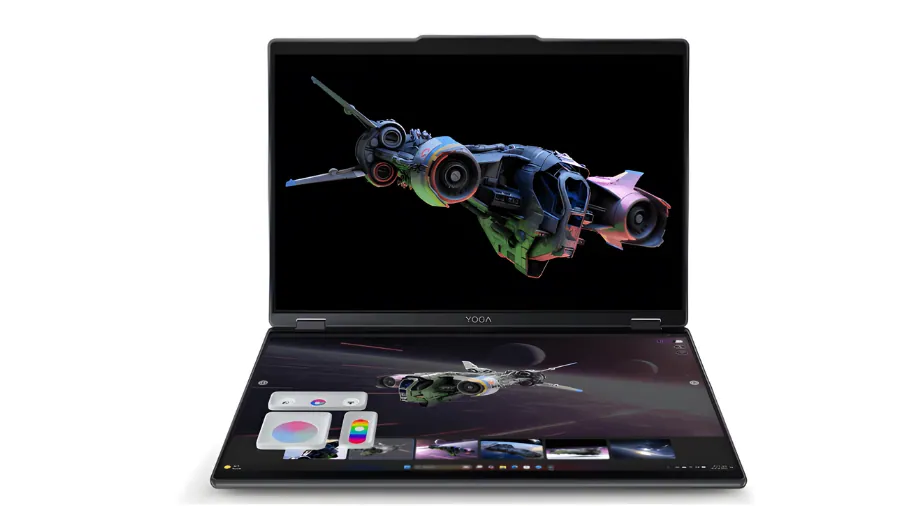
The device features two stacked 16:10 OLED panels with 3.2K resolution and a 120Hz refresh rate. The upper display supports glasses-free 3D rendering, allowing users to see depth effects without wearing a headset. The lower OLED screen works as an interactive control surface that supports touch input and modular creative tools, replacing a traditional keyboard when needed.
Lenovo has integrated proprietary AI software that enables real-time 2D-to-3D conversion directly on the device. Artists can import flat images and convert them into spatial models on the upper display. The system can also generate interactive environments around converted objects, helping creators move faster from concept to editable 3D assets. This positions the Yoga Book Pro 3D Concept within the emerging category of AI-powered creator PCs.
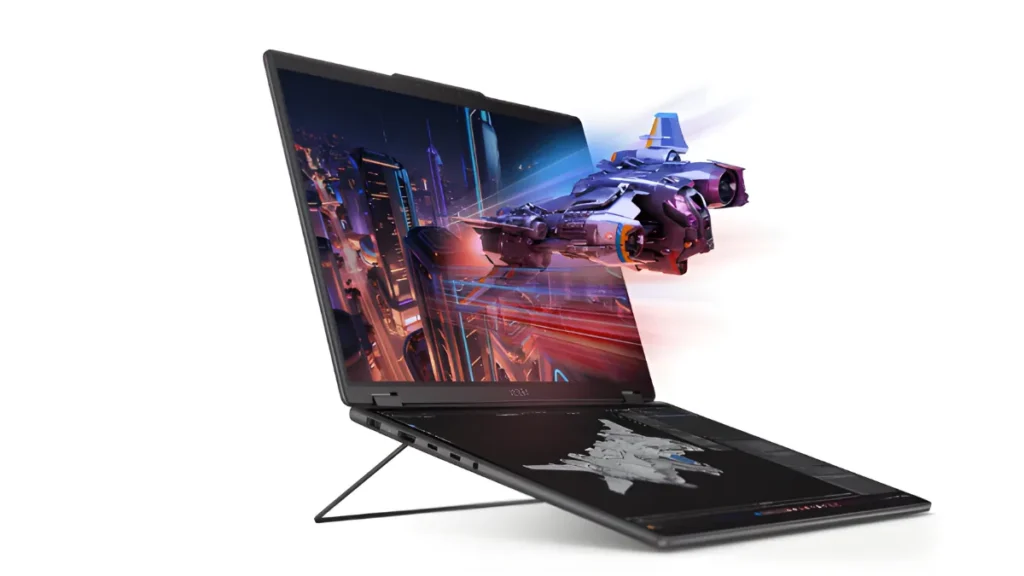
A 50-megapixel RGB camera above the display enables gesture recognition and spatial tracking. Users can rotate, zoom, and manipulate 3D objects using hand movements, reducing reliance on external controllers. Snap-on control pads on the lower display provide quick access to lighting adjustments, viewing angles, and tonal controls, allowing workflows to adapt based on the project.
The concept system pairs an Intel Core Ultra 7 processor with Nvidia GeForce RTX 5070-class graphics. Memory configurations reach up to 64GB of LPDDR5x RAM, with storage options up to 1TB. Lenovo has also refreshed its gaming lineup with the Legion 7a Gen 11 with RTX 5060, highlighting its broader use of RTX-class GPUs across categories.
A 92Wh battery powers the dual OLED setup. Connectivity includes Thunderbolt 4, HDMI 2.1, USB Type-A, Wi-Fi 7, Bluetooth 5.4, and an SD card reader. Weighing around 2.7 kilograms, the device is clearly aimed at professional creators rather than ultraportable consumers.
Lenovo stated that the global glasses-free 3D display market is projected to triple between 2025 and 2032. By introducing this concept at MWC 2026, the company is signaling early exploration into mainstream spatial computing within a traditional laptop form factor.
There is no confirmed release date or US pricing. The Yoga Book Pro 3D remains a proof-of-concept device. However, its unveiling alongside commercial AI laptops such as the Slim 5i Ultra and Yoga Slim 7i Aura suggests Lenovo is actively testing market interest in a dedicated glasses-free 3D mobile workstation.
For professional 3D artists, engineers, and digital content developers, the importance of this concept lies in interaction design. By combining depth-enabled dual OLED displays, AI-assisted modeling, RTX-class graphics, and camera-based gesture control in a single system, Lenovo is exploring whether spatial computing can move from specialized studio setups into everyday creative workflows.
Source: Lenovo