
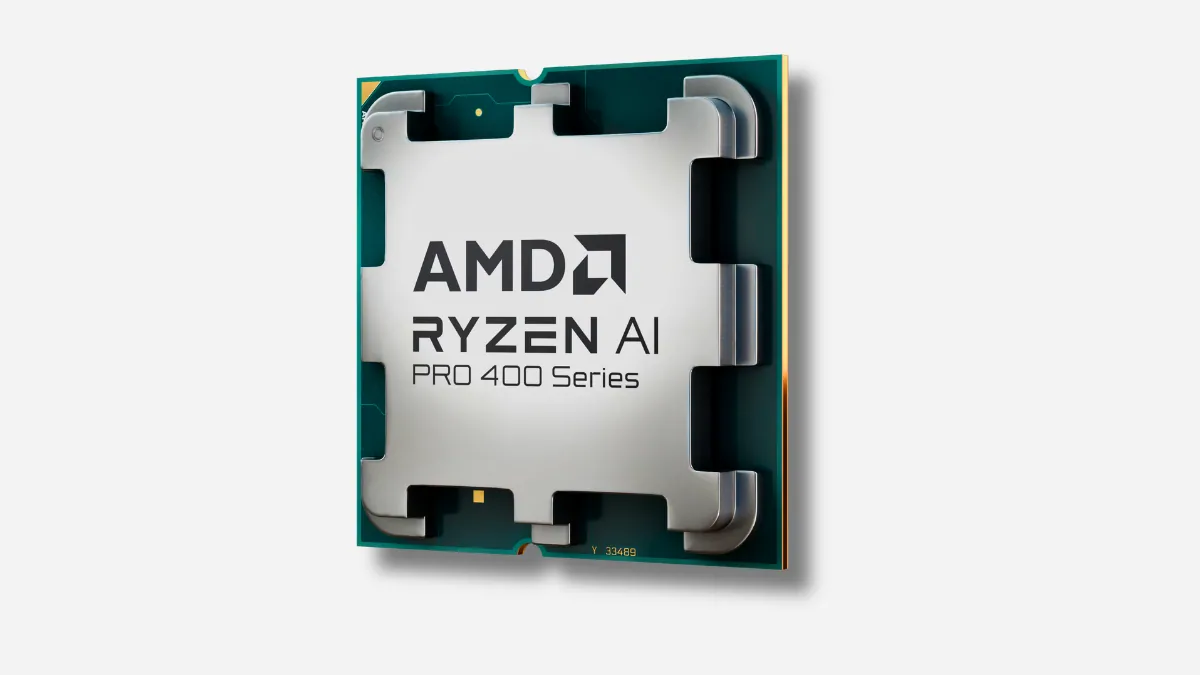
AMD has expanded its AI-focused processor lineup at Mobile World Congress 2026 with the introduction of Ryzen AI 400 Series desktop processors and Ryzen AI PRO 400 Series mobile chips for enterprise notebooks and workstations. AMD detailed the desktop-focused variants in its comprehensive Ryzen AI 400 desktop launch.
The launch brings Microsoft Copilot+ PC support to AM5 desktop systems, extending AI acceleration beyond ARM-based platforms into upgradeable x86 PCs.
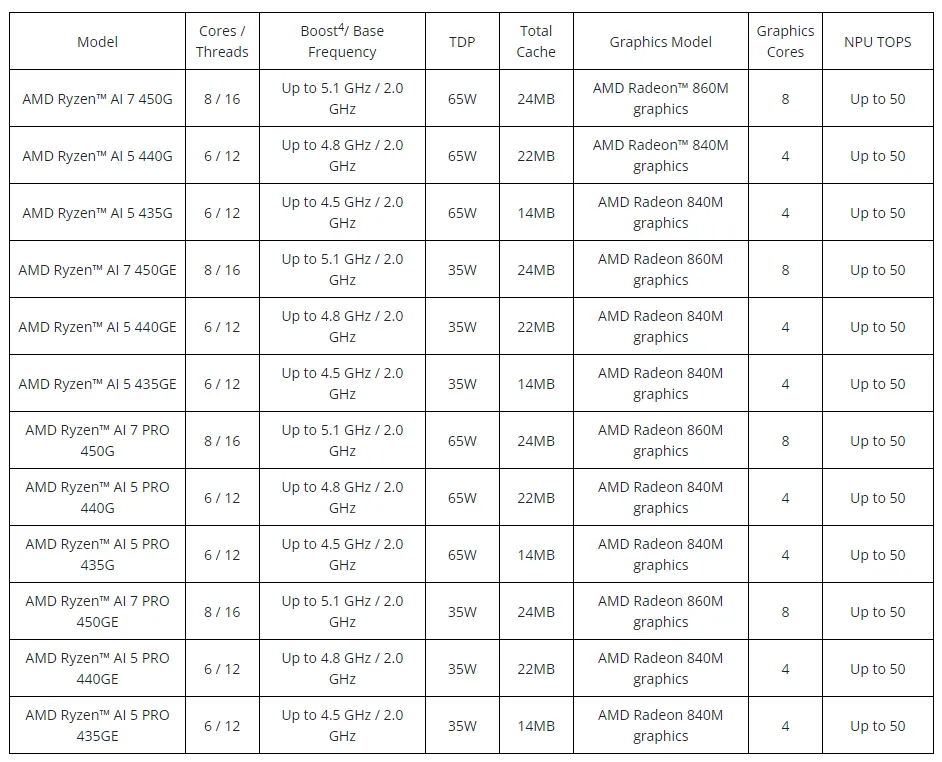
The Ryzen AI 400 desktop lineup is built on AMD’s Zen 5 architecture and combines Zen 5 CPU cores, RDNA 3.5 integrated graphics, and an XDNA 2 neural processing unit. On desktop models, the NPU delivers up to 50 TOPS of AI performance. That exceeds Microsoft’s 40 TOPS threshold required for Copilot+ PC classification, enabling on-device AI features in Windows 11.
Desktop variants are offered in 65W “G” models aimed at mainstream towers and 35W “GE” versions designed for small form factor and energy-efficient systems. Core configurations scale up to 8 cores and 16 threads, with boost clocks reaching up to 5.1 GHz.
Key consumer desktop models include:
- Ryzen AI 7 450G – 8 cores, 16 threads, Radeon 860M graphics
- Ryzen AI 5 440G – 6 cores, 12 threads, Radeon 840M graphics
- Ryzen AI 5 435G – 6 cores, 12 threads
All desktop models use RDNA 3.5 integrated graphics and the XDNA 2 NPU rated at up to 50 TOPS.
In parallel, AMD introduced Ryzen AI PRO 400 Series mobile processors targeting enterprise notebooks and mobile workstations. AMD’s AI silicon also appears in consumer-focused laptops like the Yoga Pro 7a. These chips increase NPU performance to as much as 60 TOPS, offering higher AI acceleration for professional workloads. The PRO lineup integrates AMD PRO technologies focused on security, remote management, and long-term platform stability.
The flagship Ryzen AI 9 HX PRO 470 is positioned as a high-performance enterprise mobile processor. According to AMD Performance Labs testing, it delivers up to 30 percent faster multithreaded performance compared to Intel Core Ultra X7 358 under controlled benchmark conditions.
The move to bring Copilot+ capability to AM5 desktops marks a shift in how AI acceleration is being deployed across PC categories. Instead of limiting advanced AI features to mobile or ARM-based devices, AMD is enabling locally accelerated AI workloads on upgradeable desktop systems. Tasks such as real-time transcription, AI-assisted content creation, and large language model inference can run directly on supported hardware.
AMD states that systems powered by Ryzen AI 400 Series desktop processors will begin shipping in the second quarter of 2026 from OEM partners including HP and Lenovo. Lenovo’s own Legion laptops have also shifted to Ryzen AI silicon in its new RTX 5060 model. Enterprise notebooks and mobile workstations using Ryzen AI PRO 400 Series chips are also expected in Q2 2026 from Dell, HP, and Lenovo.
With Zen 5 CPU cores, RDNA 3.5 graphics, and XDNA 2 NPUs scaling up to 60 TOPS in mobile configurations, AMD is positioning Ryzen AI 400 as a cross-segment AI platform covering consumer desktops, small form factor systems, enterprise notebooks, and mobile workstations.
Key Specifications
| Category | Ryzen AI 400 Series (Desktop) | Ryzen AI PRO 400 Series (Mobile) |
|---|---|---|
| Target Segment | Consumer desktops, AM5 towers, small form factor PCs | Enterprise notebooks & mobile workstations |
| CPU Architecture | Zen 5 | Zen 5 |
| Core Configuration | Up to 8 cores / 16 threads | Up to 8 cores / 16 threads |
| Max Boost Clock | Up to 5.1 GHz | Varies by model |
| Graphics | RDNA 3.5 integrated (Radeon 860M / 840M) | RDNA 3.5 integrated graphics |
| NPU Architecture | XDNA 2 | XDNA 2 |
| AI Performance | Up to 50 TOPS | Up to 60 TOPS |
| Copilot+ Support | Yes | Yes |
| Enterprise Features | PRO variants available | AMD PRO security & manageability |
| TDP Options | 65W (G), 35W (GE) | Configurable mobile TDP |
| Availability | Q2 2026 (HP, Lenovo) | Q2 2026 (Dell, HP, Lenovo) |
Source: AMD