

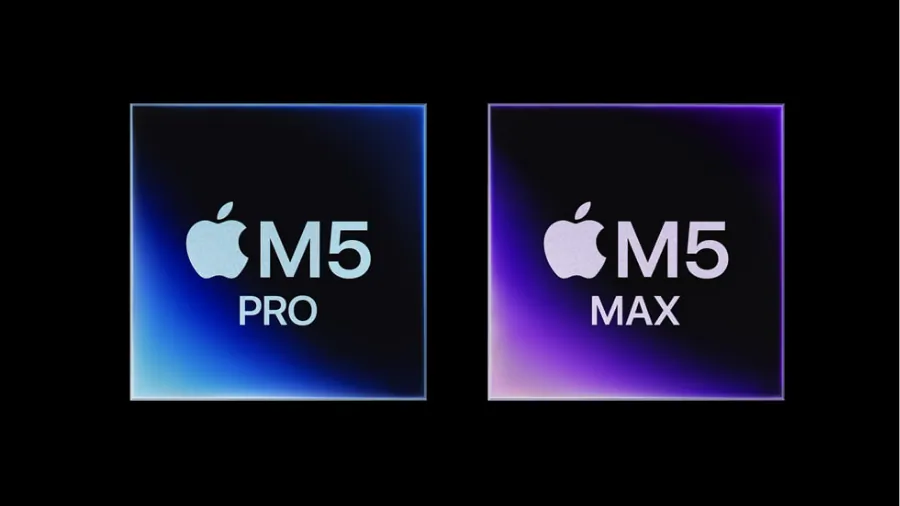
Apple has announced its latest high-performance laptop processors, the M5 Pro and M5 Max. These chips are designed for the latest MacBook Pro models and are intended to deliver much higher performance for professional tasks. The new processors focus on faster AI processing, improved graphics, and quicker unified memory. This helps users handle demanding work such as 3D rendering, software development, machine learning, and complex simulations more smoothly.
With this launch, Apple continues to expand its custom silicon lineup. The company is pushing both performance and efficiency forward, strengthening the MacBook Pro’s role as a powerful laptop for creators, developers, engineers, and researchers.
Apple has also updated its mainstream laptop lineup with the new M5 chip. We previously reported on the MacBook Air M5 launch with upgraded storage and connectivity.
One of the biggest highlights of the new chips is Apple’s Fusion Architecture. This technology combines two chip dies into a single system-on-chip using advanced packaging. It integrates CPU cores, GPU cores, unified memory controllers, media engines, and AI processing units into one platform. By connecting the two chip dies at high speed, Apple enables faster data transfer between components.
This improves efficiency in tasks that rely on parallel computing and large datasets. The architecture also keeps Apple’s unified memory design, which allows the CPU, GPU, and AI engines to access the same memory without copying data.
Both the M5 Pro and M5 Max use a redesigned 18-core CPU architecture. The processor includes six high-performance cores, called “super cores,” along with twelve additional performance cores built for multithreaded workloads.
Apple says this new design can deliver up to 30 percent higher performance for professional workloads compared to the previous generation. Improvements such as higher front-end bandwidth, a new cache system, and better branch prediction help speed up tasks like software compilation, scientific simulations, and large data analysis.
Earlier Apple silicon generations also focused on balancing performance and efficiency. We previously compared the MacBook Air M4 vs MacBook Pro M4 to show how Apple differentiates its laptop lineup.
Graphics performance has also been improved with a next-generation GPU architecture. Each GPU core includes built-in Neural Accelerators to support AI-based workloads and advanced rendering.
Apple says graphics performance in applications that use ray tracing can improve by up to 35 percent compared with the previous generation. This helps professional software run faster for visual effects, 3D modeling, animation, and game development.
The M5 Pro is aimed at professionals who need strong CPU and GPU performance for tasks like data analysis, audio production, and engineering simulations.
It can support up to a 20-core GPU and up to 64GB of unified memory, with memory bandwidth reaching about 307GB per second. These specifications allow the chip to handle large datasets and complex creative projects more efficiently.
For users who need the highest performance, Apple offers the M5 Max as the flagship option. It uses the same 18-core CPU but can be configured with up to a 40-core GPU.
It also supports up to 128GB of unified memory with memory bandwidth reaching around 614GB per second. This powerful configuration is designed for extremely demanding workloads such as large-scale simulations, advanced visual effects production, high-resolution 3D rendering, and large language model processing.
Both processors include a faster 16-core Neural Engine to speed up on-device AI tasks and Apple Intelligence features. They also support hardware acceleration for video formats such as H.264, HEVC, AV1, and ProRes. In addition, the chips support Thunderbolt 5 connectivity for faster external devices and high-resolution displays.

Apple is continuing to move its silicon platform toward AI-focused computing and high-performance creative workflows. The company says new MacBook Pro models powered by the M5 Pro and M5 Max will be available for preorder soon after the announcement, with retail availability expected later this month.
We also covered the MacBook Pro models powered by the M5 Pro and M5 Max, which introduce Apple’s new Fusion Architecture.
The launch represents another step in Apple’s plan to expand its custom silicon ecosystem while maintaining the strong performance-per-watt efficiency that has defined its Mac processors in recent years.
Source: Apple