
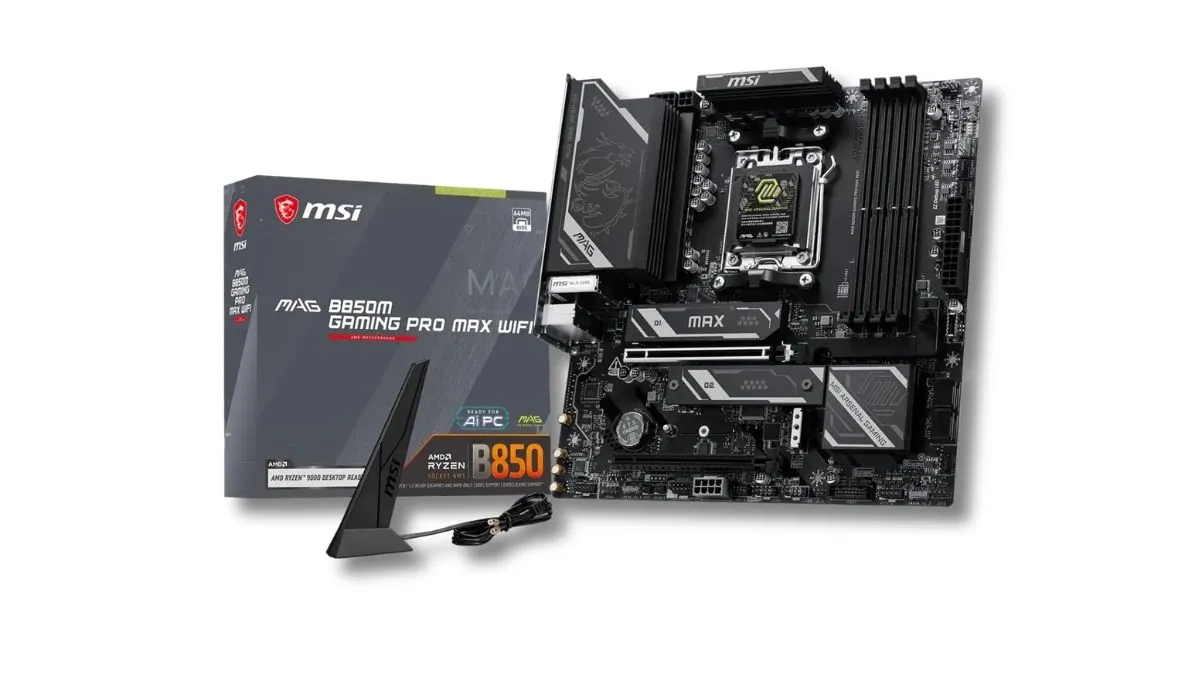
MSI has added a new Micro-ATX motherboard to its AMD AM5 lineup called the MAG B850M Gaming Pro Max WiFi. The board recently appeared on MSI’s official product page and introduces updated connectivity and platform features for modern Ryzen desktop systems. It supports AMD Ryzen 7000, Ryzen 8000, and the newer Ryzen 9000 processors, allowing builders to use current and upcoming AM5 CPUs in compact gaming or workstation builds.
The motherboard replaces the earlier B850M Gaming Pro WiFi6E and moves the product into MSI’s MAG series under the company’s Arsenal Gaming family. Boards in this category are designed to provide strong core features for gaming systems without the higher cost of flagship models. The focus is on reliability, stable power delivery, and modern connectivity rather than extreme overclocking.
AMD’s B-series chipsets sit in the middle of the desktop platform lineup. High-end X-series boards usually provide more expansion lanes and additional connectivity options. However, CPU performance in games and most applications depends mainly on the processor itself. For most gaming PCs that use one graphics card and a few storage drives, a B-series motherboard can deliver the same real-world performance as more expensive options.
The MAG B850M Gaming Pro Max WiFi follows that approach. It combines PCIe 5.0 support for graphics and storage with modern networking and memory support. This combination gives builders access to new platform technologies while keeping the board in the mainstream price segment.
The motherboard uses a six-layer PCB built with thicker copper to help maintain stable signal quality and power delivery. MSI also uses server-grade materials to improve durability and reduce electrical noise during heavy workloads. Power delivery is handled by an 8+2+1 phase design using 60-amp Smart Power Stages along with an 8+4-pin CPU power connector configuration. This setup is designed to support a wide range of Ryzen processors, including higher core count chips running at stock settings or mild tuning.
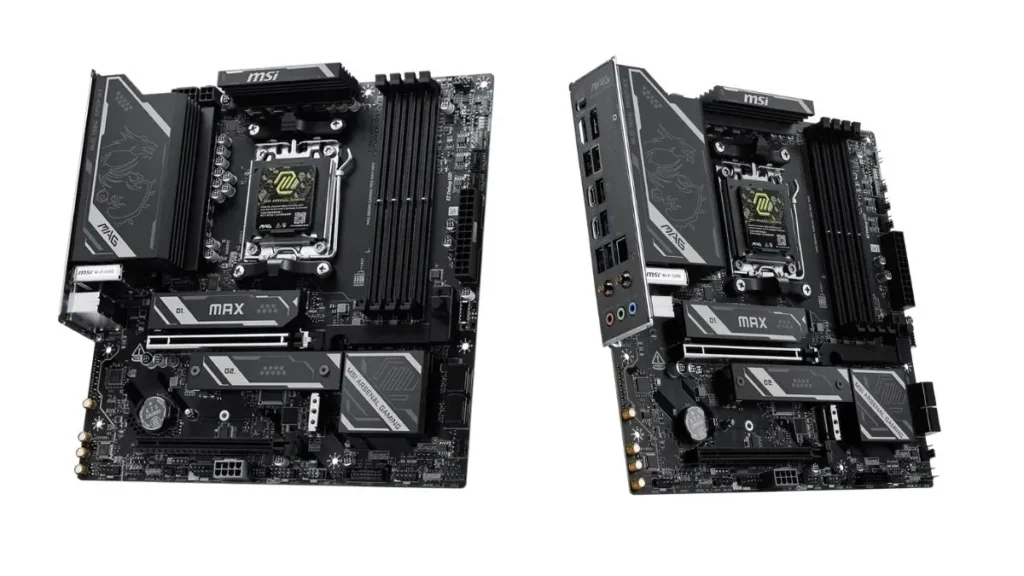
Cooling is managed with extended heatsinks over the voltage regulator modules and reinforced heatsinks for the M.2 storage slots. Thermal pads rated at 7 W/mK help move heat away from critical components during sustained workloads. These cooling elements are part of MSI’s thermal design intended to keep temperatures stable during gaming or content creation tasks.
Networking is one of the key upgrades on this motherboard. Instead of the 2.5 gigabit Ethernet commonly seen on many midrange boards, MSI includes a Realtek controller that supports 5 gigabit Ethernet. The board also supports Wi-Fi 7 and Bluetooth 5.4, giving it higher theoretical wireless bandwidth and lower latency compared with earlier Wi-Fi standards.
The real benefit of faster networking depends on the rest of the home or office network. Users with multi-gig routers, high-speed switches, or network attached storage may see faster transfers. Systems connected to older gigabit networks will still work normally but will not use the full bandwidth available on the board.
Memory support is built around DDR5, which is standard for AMD’s AM5 platform. The motherboard includes four DIMM slots that support dual-channel DDR5 memory. Overclocked memory speeds above DDR5-8200 are supported depending on the CPU memory controller and the memory kit used. The board also supports AMD EXPO memory profiles, which allow compatible DDR5 kits to run optimized settings with a simple BIOS configuration.
Expansion support includes PCIe 5.0 for the main graphics slot. This slot connects directly to the CPU and runs at full PCIe Gen5 x16 bandwidth. While current graphics cards do not yet require PCIe 5.0 bandwidth, the slot ensures compatibility with future GPUs.
Expansion and Storage Configuration
| Component | Specification |
|---|---|
| Primary PCIe Slot | PCIe 5.0 x16 connected to CPU |
| Secondary PCIe Slot | PCIe 4.0 x4 |
| M.2 Slot 1 | PCIe 5.0 x4 NVMe |
| M.2 Slot 2 | PCIe 4.0 x4 NVMe |
| M.2 Slot 3 | PCIe 4.0 x2 NVMe |
| SATA Ports | 4 × SATA III 6Gbps |
The PCIe 5.0 M.2 slot allows the system to support the newest generation of NVMe solid state drives. These drives can reach very high sequential speeds, although they are still more expensive than PCIe 4.0 SSDs. The slot ensures the platform can support faster storage upgrades in the future.
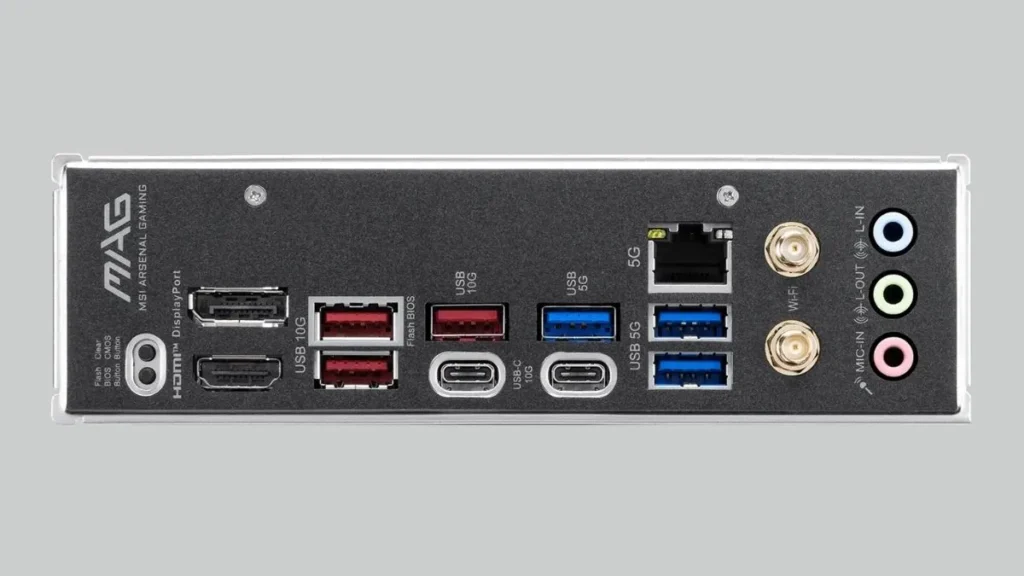
Rear connectivity includes a mix of high-speed USB ports and display outputs. These display connectors allow the motherboard to run systems using Ryzen processors with integrated graphics.
Rear I/O Connectivity
| Port | Details |
|---|---|
| USB-C | 2 × USB-C 10Gbps |
| USB-A 10Gbps | 3 ports |
| USB-A 5Gbps | 3 ports |
| Display Output | HDMI 2.1 |
| Display Output | DisplayPort 1.4 |
| Ethernet | 5GbE RJ45 |
| Wireless | Wi-Fi 7 antenna connectors |
| Audio | 3 analog audio jacks |
The board also includes internal headers for front-panel connectivity used by modern PC cases.
Internal Connectivity
| Header | Details |
|---|---|
| Front USB-C | 1 × USB-C 10Gbps header |
| USB-A headers | 2 × USB-A 5Gbps headers |
| USB 2.0 headers | 2 × USB 480Mbps headers |
Audio is handled by the Realtek ALC897 codec together with MSI’s Audio Boost design. This system uses isolated audio circuits and dedicated capacitors intended to improve sound clarity and reduce electrical interference when using headphones or speakers.
MSI also includes several features designed to make PC building easier. These EZ DIY tools include a PCIe release button that helps remove large graphics cards, tool-free M.2 installation clips, reinforced SSD heatsinks, and a simplified Wi-Fi antenna connector. These small design changes can make upgrades easier, especially inside compact Micro-ATX cases.
The motherboard is also marketed as ready for modern AI workloads. This mainly reflects support for new processors and GPUs that include AI acceleration features used in creative software, productivity tools, and gaming applications.
Typical systems built with a board like the MAG B850M Gaming Pro Max WiFi include Ryzen 5 or Ryzen 7 gaming desktops, compact Micro-ATX builds, and midrange workstations used for streaming or content creation. With PCIe 5.0 graphics support, next generation NVMe storage capability, and updated networking, the platform is designed to remain useful through several future hardware upgrades.
MSI has not yet confirmed official pricing or a global release date for the motherboard. Hardware products often appear on manufacturer product pages before retail listings become available, so availability details are expected to follow once distribution begins in different regions.
Source: MSI