

Dell is bringing its Pro 5 Series 14 to global markets with Intel Core Ultra processors, upgradeable LPCAMM2 memory, and PCIe Gen5 storage, adding AI-focused performance to a compact 14-inch business laptop.
The lineup spans Intel Core Ultra Series 3 chips, starting with Core Ultra 5 options and extending to the Core Ultra X7 368H vPro, detailed in Intel Core Ultra X9 378H vs X7 368H. These processors include integrated NPUs rated between 46 and 50 TOPS, meeting Copilot+ PC requirements and enabling on-device AI tasks such as real-time transcription, background processing, and intelligent search without relying on cloud services.
Graphics scale with the processor tier, with Intel Arc developments covered in ASRock Intel Arc Pro B65 Creator GPUs. Entry configurations rely on integrated Intel graphics, while higher-end options pair select CPUs with Intel Arc GPUs, including Arc B370 and B390 variants. These provide additional performance for content creation, data-heavy workflows, and GPU-accelerated applications without requiring a separate discrete GPU.
Memory is a key upgrade in this generation. The laptop supports both DDR5-5600 and LPCAMM2 modules, with LPCAMM2 reaching speeds up to 8533 MT/s and capacities up to 64GB in a single module design. This layout improves bandwidth while keeping memory upgradeable, allowing businesses to expand capacity over time without replacing the entire device.
Storage moves forward with PCIe Gen4 and PCIe Gen5 SSD options up to 2TB, with next-gen speeds highlighted by MSI Spatium M571 PCIe 5 SSD. Gen5 drives increase available bandwidth compared to previous generations, which benefits large file transfers, data processing, and heavy multitasking workloads. Select configurations also include self-encrypting drives, adding an extra layer of data protection for enterprise use.
Display configuration is one of the most flexible areas of the Pro 5 Series 14. Buyers can choose from multiple IPS panels, including standard WUXGA options, low-power variants, and higher-end WQXGA panels with up to 120Hz variable refresh rate and brightness up to 500 nits. Select configurations include an OLED panel with full DCI-P3 color coverage, offering deeper contrast and improved color accuracy for media and design work.
Panel quality varies across configurations. Entry-level displays cover around 62.5% of the sRGB color space, while higher-end options reach full 100% sRGB. This makes display selection important depending on workload, especially for users working with color-sensitive content.
The chassis follows Dell’s updated design language with aluminum across the lid, palm rest, and bottom panel, consistent with builds in Dell Pro Micro thin client. Despite the metal build, the laptop starts at around 2.96 lbs (1.34 kg), making it lighter than many 14-inch business laptops with similar hardware. The thinner profile is supported by the compact LPCAMM2 layout and updated internal design.
Battery options include 45Wh, 57Wh, and 70Wh variants, allowing users to choose between lower weight or longer runtime. Combined with efficient processors and variable refresh rate displays, the laptop is tuned for extended work sessions away from a charger.
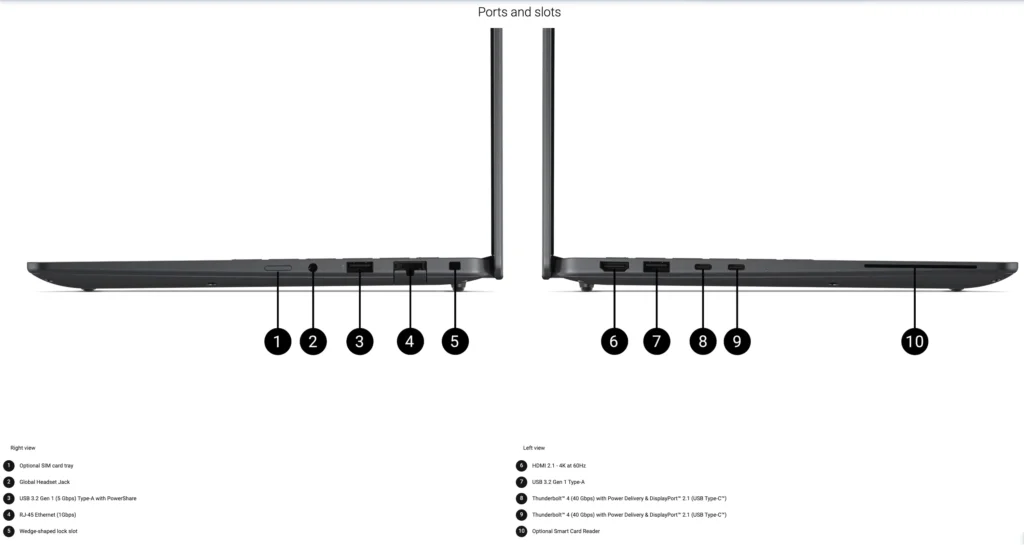
Connectivity covers both modern and legacy needs. The laptop includes two Thunderbolt 4 ports with DisplayPort 2.1 and power delivery, HDMI 2.1 with 4K at 60Hz output, two USB-A ports, a 3.5mm audio jack, and a full RJ-45 Ethernet port. Wireless connectivity includes Wi-Fi 7 and Bluetooth 6.0, with optional features such as SIM support, NFC, and smart card readers for enterprise deployments.
Camera options range from a standard 1080p IR unit to an upgraded 8MP sensor with HDR and presence detection, improving video call clarity and enabling secure login features. Dual microphones and stereo speakers support conferencing and everyday communication.
The Pro 5 Series 14 includes modular components such as replaceable USB-C ports, batteries, and internal parts, making repairs easier and extending the product lifespan. The device is tested for durability, including drop resistance, hinge reliability, spill protection, and environmental stress.
Sustainability is part of the overall design, aligning with broader industry shifts covered in PC price hikes power GPU SSD memory. The chassis incorporates recycled aluminum and plastics, including ocean-bound materials, while packaging relies on recycled and renewable content. Certifications such as ENERGY STAR, EPEAT Gold, and TCO reflect its environmental standards.
Pricing starts around $2,300 in the US, £2,008 in the UK, CAD 2,931 in Canada, and roughly €2,249 across parts of Europe, depending on configuration. Higher-end builds with maximum memory, faster storage, and advanced display options increase the price significantly. Availability is live across multiple regions, with some markets offering phone-based ordering instead of direct online purchase.
The result is a business laptop that pairs upgradeable high-speed memory, next-generation storage, and flexible display options, including OLED, in a lighter design built for long-term use.
Sources: Dell US, Australia, UK, Canada, France, Germany & Ireland