
Samsung has introduced the world’s first High Bandwidth Memory 5 (HBM5) technology at Computex Taipei 2026, giving the semiconductor industry an early look at the next generation of memory expected to power future AI accelerators, hyperscale data centers, and high-performance computing (HPC) systems.
The demonstration gives an early look at Samsung’s next step beyond HBM4 as demand for AI hardware keeps rising. As companies train larger AI models and deploy more powerful accelerators, faster memory has become one of the key requirements for improving overall system performance.
The next significant development in AI memory technology is anticipated to be HBM5, or High Bandwidth Memory 5. In comparison to existing HBM4-class systems, the new standard is intended to provide far greater bandwidth, enhanced power efficiency, and larger memory capacity.
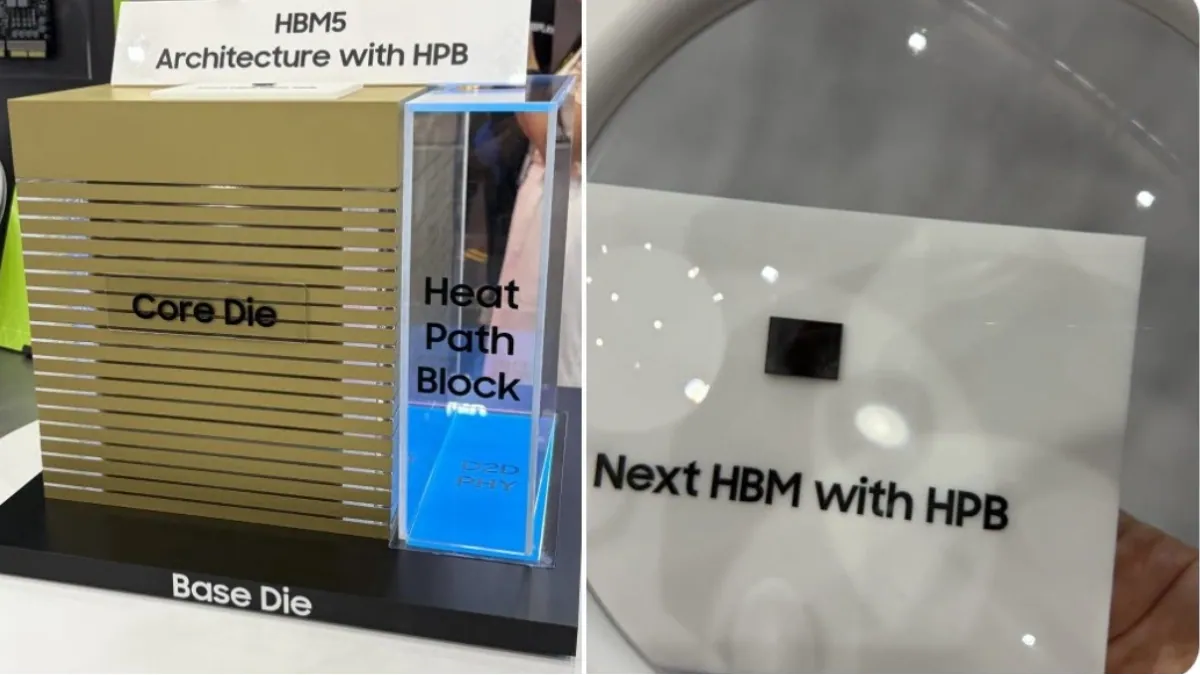
Images shown at Samsung’s Computex exhibit revealed an HBM5 design that includes a dedicated Heat Path Block (HPB), a thermal solution intended to improve heat dissipation in future high-performance memory stacks. The addition suggests Samsung is paying close attention to cooling as memory speeds and power demands continue to rise in next-generation AI systems.
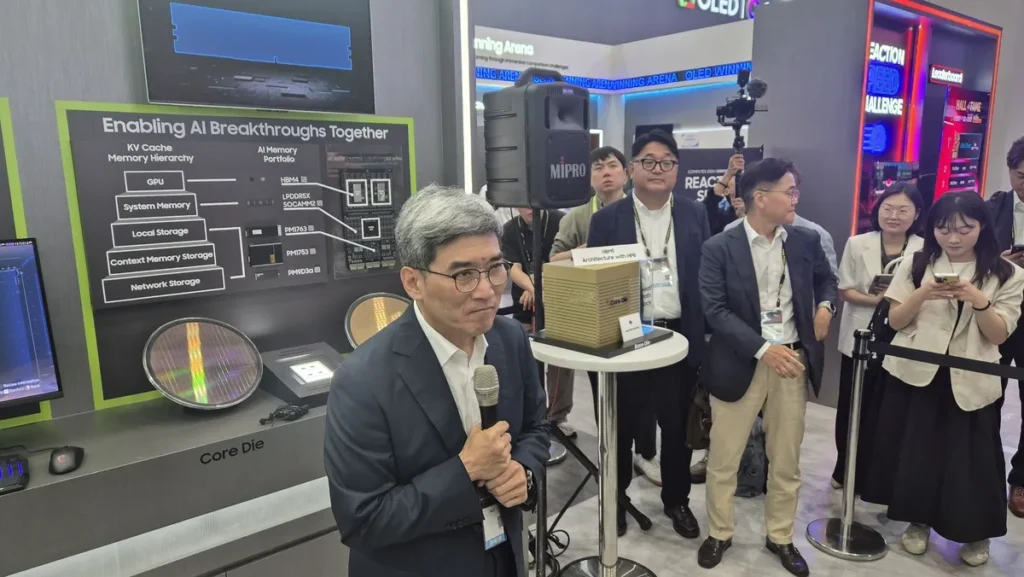
According to information shared during the event, HBM5 is expected to reach the market sometime between 2029 and 2031. The technology is expected to use a 2nm-class base die together with advanced DRAM manufacturing processes, which could deliver significant gains in both performance and power efficiency.
Memory bandwidth is one of the biggest improvements anticipated from HBM5. Future HBM5 stacks might achieve transfer speeds close to 4TB/s per stack, potentially tripling the bandwidth available from current HBM4-class architectures, according to industry forecasts.
These improvements could be especially important for AI training and inference workloads. Modern AI accelerators from companies like NVIDIA and AMD depend heavily on high-bandwidth memory to move large amounts of data to their compute engines. In many advanced AI systems, memory speed is now just as important as raw processing power.
Samsung’s roadmap also points to wider memory interfaces and higher-density stacking technologies. Early details suggest future HBM5 designs could use a 4096-bit interface along with advanced 16-layer memory stacks, making it possible to increase memory capacity significantly without taking up more physical space.
Thermal efficiency also appears to be a major focus for Samsung. The company’s HBM5 prototype includes support for immersion-cooling environments, a cooling approach that is becoming more popular among hyperscale data centers as they look for better ways to handle the rising power demands of AI infrastructure.
Immersion cooling works differently from traditional air cooling by placing hardware in specially designed cooling fluids that can remove heat more efficiently. By designing HBM5 with support for immersion cooling, Samsung is preparing for future AI data centers where conventional cooling methods may struggle to keep up with growing power and heat demands.
Samsung, SK hynix, and Micron are all investing heavily in next-generation HBM technologies as AI demand continues to drive major changes across the semiconductor market.
Over the past two years, high-bandwidth memory has become one of the most important components in AI servers. Growing demand from cloud providers, AI companies, and enterprise customers has led to major investments in memory production and advanced packaging technologies.
Samsung’s Computex 2026 presentation offers an early look at the technologies anticipated to power the next generation of AI infrastructure, even if commercial HBM5 devices are still some years away. The company’s prototype shows that future memory innovation will concentrate on resolving the power and thermal issues brought on by increasingly demanding AI workloads in addition to increasing speeds and capacities.
Samsung’s decision to publicly showcase HBM5 highlights how quickly the AI hardware market is moving, even as HBM4 is still making its way into wider adoption. As competition in AI computing continues to grow, advances in memory technology could become just as important as improvements in processors and AI accelerators over the coming years.
Source: Seoul Economic Daily