


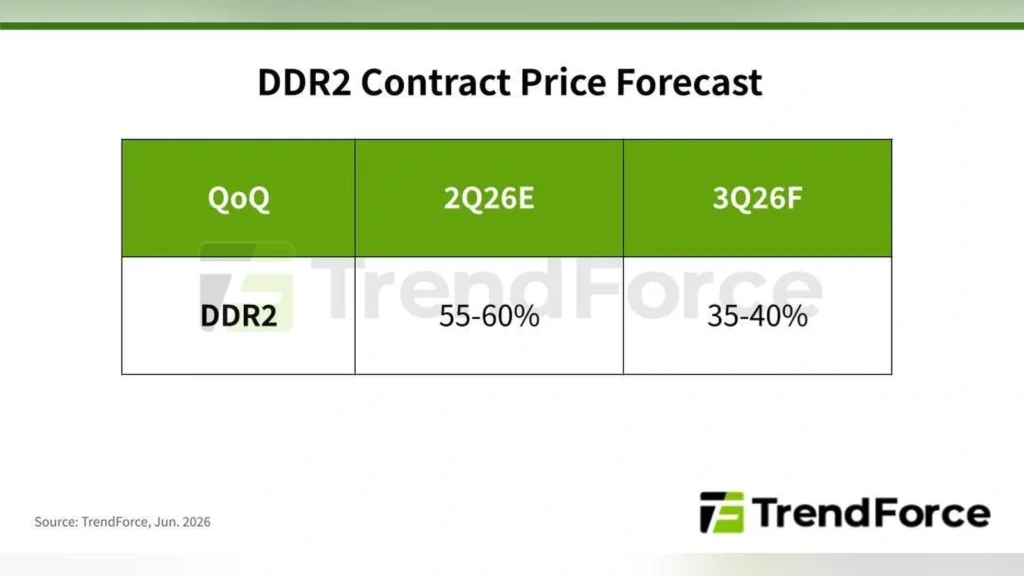
Tightening supplies in mature-node consumer DRAM are driving up contract prices for older memory generations like DDR2 and DDR3. Market research firm TrendForce reports that DDR2 contract prices will rise by 55% to 60% in 2Q26. The legacy memory standard is expected to climb an additional 35% to 40% in 3Q26 as buyers scramble to secure allocations.
The shortage occurs as the three major DRAM manufacturers prioritize advanced-node production to supply high-bandwidth memory (HBM) and server DRAM for artificial intelligence infrastructure. This shift has reduced the wafer capacity allocated for mature-node consumer DRAM like DDR4. As a result, hardware manufacturers are turning to Taiwanese suppliers like Nanya and Winbond, giving those vendors substantial pricing power.
Also read: Best 32GB RAM Laptops Details
To cope with rising hardware costs, some original design manufacturers are downgrading their memory specifications. Some product designs are shifting from DDR4 down to DDR3, while other designs are swapping out DDR3 in favor of DDR2. While high-end notebooks still require the fastest components, these design downgrades are common in budget-friendly hardware and the best 16GB RAM laptops.
Supply of DDR2 will likely tighten further as Winbond reallocates its manufacturing capacity toward higher-margin products like DDR3 and DDR4. In response, competitor ESMT plans to expand its DDR2 output using its existing wafer allocation at foundry partner PSMC. This output increase aims to offset the supply gap left by Winbond’s partial exit and capture more of the market.
Source: TrendForce