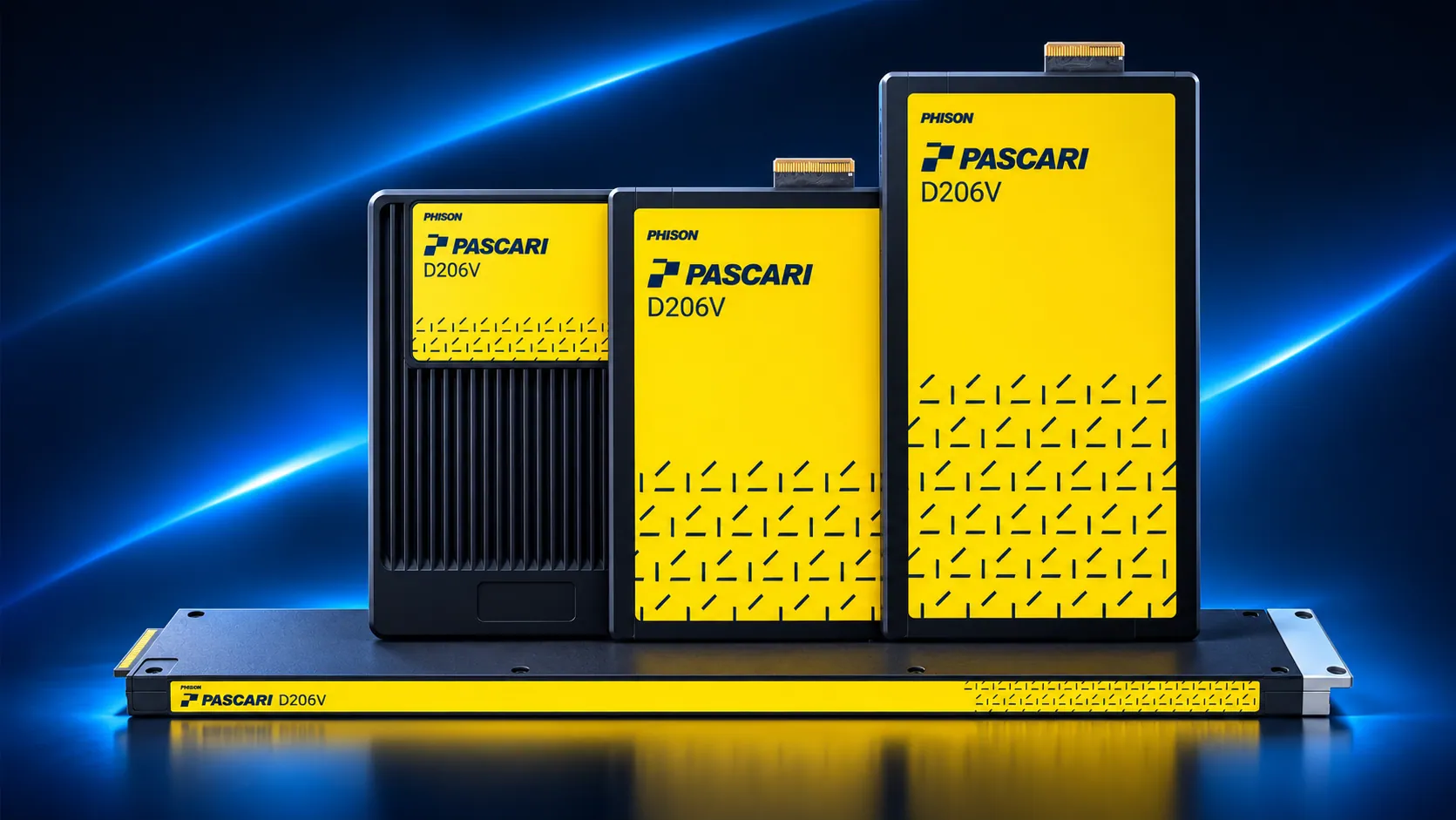
Phison has demonstrated a new enterprise SSD design that can run AI workloads directly on the drive using an integrated Neural Processing Unit (NPU). The computational storage technology was showcased at Supercomputing 2026 (SC26) in Chicago, with 64GB of onboard memory and support for several popular AI frameworks.
The main idea is to process data where it is stored instead of transferring entire datasets to a server’s CPU or GPU. Phison says this approach could reduce data transfers by 10 to 100 times for suitable workloads.
The SSD combines an integrated NPU with 64GB of memory that delivers up to 130GB/s of bandwidth. Its architecture can scan and process datasets in parallel before sending relevant results to the host system. This could reduce data movement and free up CPU resources for other tasks.
Phison has included support for PyTorch, vLLM, OpenVINO, and llama.cpp. These frameworks allow developers to work with familiar AI tools without requiring specialized programming software for the storage architecture.
The company lists the NPU’s compute performance at 36,800 DMIPS. However, it has not provided a TOPS rating, which is commonly used to describe AI processing performance. The available information also does not confirm the memory type or the exact controller used in the SSD.
Alongside the computational storage design, Phison presented two other storage technologies at SC26. One is its next-generation X3 (PS5303) enterprise SSD controller, designed for the PCIe 6.0 x4 interface and NVMe 2.3. It targets sequential read speeds of up to 28GB/s and 6.8 million IOPS.
Phison is also developing PCIe 6.0 redrivers and retimers to maintain signal integrity at higher transfer speeds. The company says its PS7161 is the first PCIe 6.0 redriver on the PCI-SIG Integrators List.
The third technology is its Mixed Media architecture, which combines high-endurance pSLC and high-capacity QLC NAND flash behind a single 16-channel controller. This design aims to remove the need for separate cache drives in enterprise storage systems.
Phison says the architecture distributes cache across multiple drives. If one drive fails in a 24-drive server, the system would lose around 4% of its cache capacity instead of the usual 25%. It also uses standard NVMe interfaces to support integration with existing infrastructure without specialized host software.
The AI-powered SSD is still under development. Phison has not announced its product name, interface, form factor, memory type, or sampling date. The company says several technologies showcased at SC26 are still being developed, so commercial availability and final specifications have not been confirmed.
Source: PHISON