
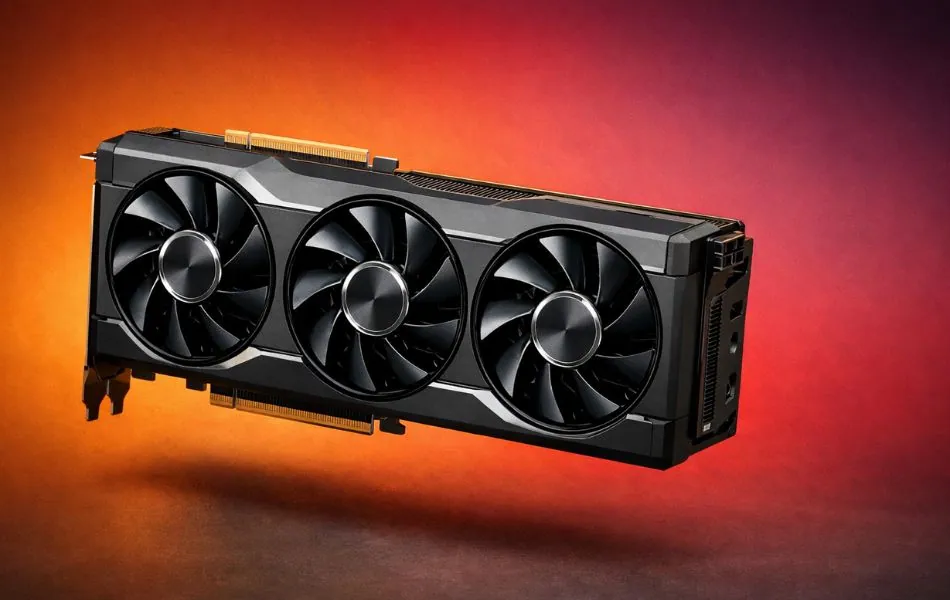
AMD’s add-in board partners are preparing a second round of graphics card price increases as the company reportedly pivots its Radeon strategy toward prioritising 8GB GPUs, a move that could significantly reshape the mid-range GPU market in 2026
According to board-level supply chain sources, the new pricing adjustments could arrive later this month or in early March, following an initial 5–10 percent hike implemented in January.
Sources familiar with add-in board planning indicate the fresh price hike is intended to bring AMD GPU pricing closer in line with competing products from NVIDIA. If implemented, upcoming Radeon RX 9000 series models, including the RX 9060 XT and RX 9070 or RX 9070 XT, could see noticeable price inflation across multiple regions.
The broader GPU market is already under pressure. In some regions, the GeForce RTX 5060 Ti 16GB is reportedly approaching the $700 mark. By comparison, the Radeon RX 9060 XT 16GB has so far remained in the $400 to $500 range at major retailers. However, supply chain sources suggest that the gap may narrow substantially if the planned pricing adjustments move forward.
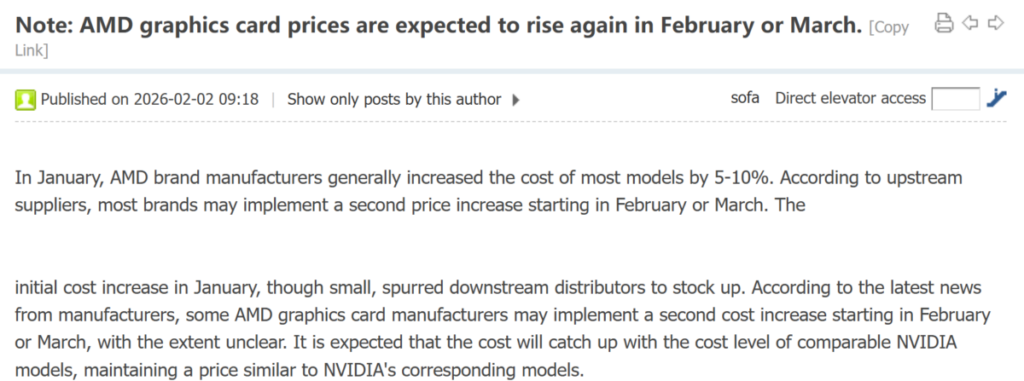
The reported strategy shift is largely being driven by rising memory costs. High DRAM prices have made it increasingly difficult for GPU manufacturers to maintain official MSRPs, particularly on 16GB models. With memory costs said to have increased severalfold, both AMD and NVIDIA are now prioritising lower-capacity GPUs as a way to protect margins and stabilise supply. Similar reports previously pointed to NVIDIA’s RTX 50 series focusing more heavily on 8GB variants, and AMD now appears to be following the same path.
As part of this adjustment, AMD is reportedly prioritising 8GB models across both new and existing product lines. This includes the RDNA 4-based Radeon RX 9060 XT 8GB and the RDNA 3-based Radeon RX 7650 GRE, a graphics card that initially launched as a China-exclusive product.
The RX 7650 GRE currently sells for under $400 at retailers such as Amazon and Newegg, though sources warn that the upcoming price hike could push even these cards closer to the $400 threshold.
The timing of AMD’s reported shift is particularly notable as modern game engines continue to push beyond the limits of 8GB graphics cards, even at 1080p settings. If both AMD and NVIDIA increasingly prioritise lower-capacity models, mainstream buyers may face a narrowing choice between higher prices or reduced long-term gaming headroom, reshaping expectations for mid-range GPUs in 2026.
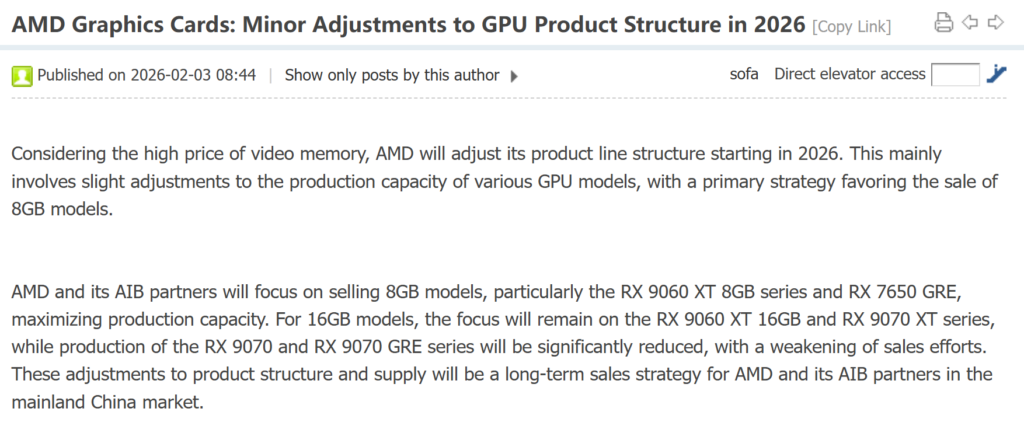
The reported strategy shift highlights a growing divide between short-term cost control and long-term gaming requirements, as shown below.
| Aspect | 8GB Radeon GPUs | 16GB Radeon GPUs |
|---|---|---|
| Production priority | Increasing focus | Likely reduced |
| Sensitivity to DRAM costs | Lower | Significantly higher |
| Current pricing trend | Rising but controlled | Rising faster |
| Availability outlook | More consistent supply | Potentially limited |
| Long-term gaming headroom | Adequate for esports and light gaming | Better suited for modern AAA titles |
If these plans materialise, 2026 could mark a turning point where affordable high VRAM graphics cards become increasingly scarce, forcing buyers to reassess value, longevity, and upgrade cycles across the mainstream GPU market.
Source: Board Channels (In Chinese)