
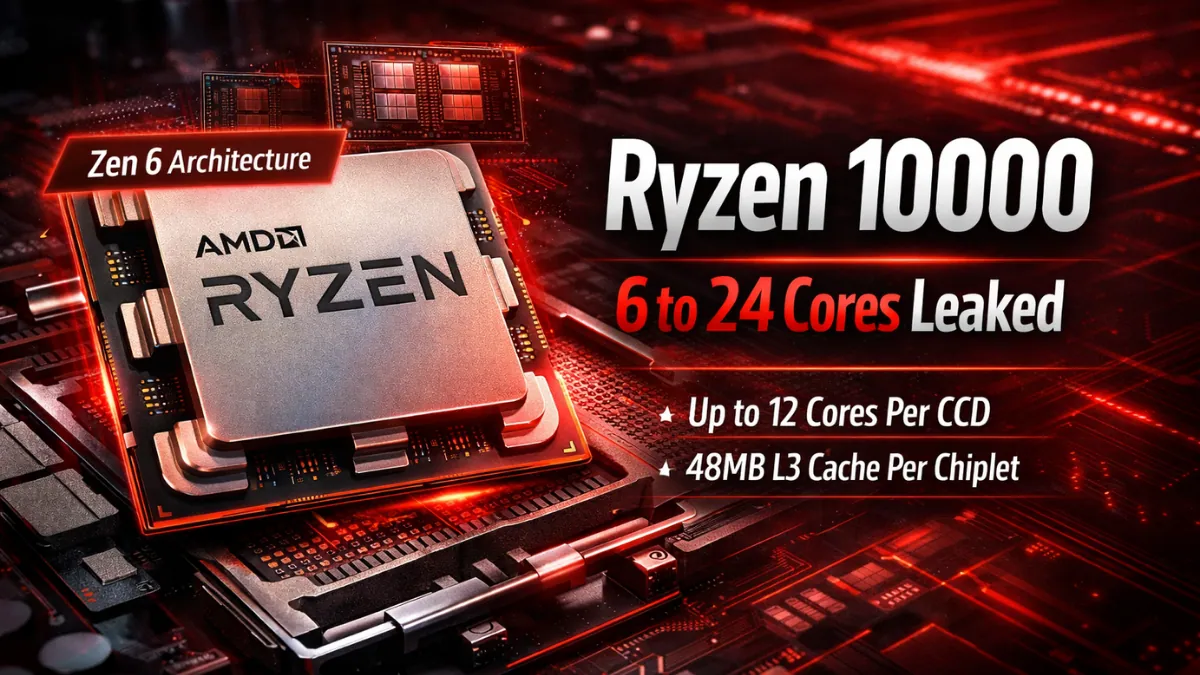
AMD’s upcoming Ryzen 10000 desktop processors, based on the Zen 6 architecture and reportedly codenamed “Olympic Ridge,” could arrive in configurations ranging from 6 to 24 cores, according to recent information shared by industry leaker HXL (X). If accurate, the expanded range would represent one of the most flexible mainstream desktop stacks AMD has ever introduced and could significantly reshape segmentation on the AM5 platform.
What the Leak Suggests:
- 6 to 24 core configurations
- Up to 12 cores per CCD
- Up to 48MB L3 per chiplet
- Possible 20-core and 10-core SKUs
- Likely AM5 support
The report indicate that AMD may introduce as many as seven distinct desktop configurations, spanning single-chiplet and dual-chiplet designs. The single-CCD models are expected to include 6-core, 8-core, 10-core, and 12-core variants, while dual-CCD versions may scale to 16-core (8+8), 20-core (10+10), and 24-core (12+12) configurations.
Although AMD has not officially confirmed these specifications, consistency across multiple industry reports suggests a deliberate restructuring of its desktop hierarchy rather than a routine generational refresh.
Current leak-based reporting suggests the following: core counts of 6, 8, 10, 12, 16, 20, and 24; up to seven desktop configurations; up to 12 cores per CCD (Core Complex Die); up to 48MB of L3 cache per CCD; dual-chiplet designs scaling to 24 cores; likely continued AM5 socket support; all based on the Zen 6 architecture. These details originate from industry leaker HXL and remain unconfirmed pre-release information.
Reported Ryzen 10000 “Olympic Ridge” Core Configurations
| Segment Tier | Core Count | Chiplet Layout |
|---|---|---|
| Entry | 6-core | 1× CCD |
| Mainstream | 8-core | 1× CCD |
| New Mid-Tier | 10-core | 1× CCD |
| Performance | 12-core | 1× CCD |
| High-End | 16-core | 2× CCD (8+8) |
| New Enthusiast | 20-core | 2× CCD (10+10) |
| Flagship | 24-core | 2× CCD (12+12) |
If realized, this would mark one of the broadest desktop SKU spreads AMD has ever deployed under a single Ryzen generation.
The introduction of 10-core and 20-core models would be particularly notable. AMD’s current mainstream lineup typically jumps from 8 cores to 12 cores, and from 16 cores directly to its flagship tier.
A 10-core SKU would fill a long-standing performance and pricing gap, giving system builders a new option for high-refresh gaming, streaming, and productivity multitasking. Likewise, a 20-core model would sit strategically between 16-core and 24-core parts, enabling AMD to fine-tune competition against Intel’s upper-tier desktop offerings.
AMD’s existing Ryzen 9000 desktop processors are built around 8-core CCD designs with 32MB of L3 cache per chiplet before 3D V-Cache variants. Core scaling typically progresses from 6 and 8 cores in the mainstream tier up to 16 cores at the high end, without intermediate 10-core or 20-core SKUs.
The architectural implications may be even more significant. Reports suggest Zen 6 core complex dies could move from 8 cores per chiplet to as many as 12 cores per CCD. If AMD transitions to 12-core chiplets, that represents a 50 percent increase in core density per die compared with several previous Ryzen generations.
Leaks indicate each Zen 6 CCD may feature up to 48MB of L3 cache, a 50 percent increase over the 32MB configuration common in earlier desktop CCD designs prior to 3D V-Cache variants. If accurate, a 24-core model using two 12-core CCDs could feature 96MB of L3 cache before any stacked cache technologies are considered. While still unconfirmed, this aligns with the structural changes implied by the leaked core breakdown.
Higher core density per CCD changes cache topology, inter-core communication behavior, and power distribution characteristics. AMD may need to refine Infinity Fabric tuning and memory latency optimization to preserve gaming performance consistency, where latency sensitivity remains critical.
Thermals and power delivery will also be central considerations. Concentrating 12 cores within a single CCD increases localized heat density, potentially requiring updated boosting algorithms or more advanced voltage management strategies. While official TDP figures remain unknown, higher core counts in mainstream SKUs could push default power envelopes upward, particularly in 20-core and 24-core configurations designed to compete at the enthusiast level.
From a platform perspective, continued support for the AM5 socket appears likely, reinforcing AMD’s long-term upgrade strategy. The company previously extended AM4 compatibility across multiple Ryzen generations, building strong loyalty among DIY builders.
If Zen 6 maintains AM5 support, it would lower upgrade barriers for Ryzen 7000 and Ryzen 9000 users, assuming BIOS compatibility aligns with expectations. Socket longevity remains a major differentiator in the DIY desktop market, and expanded core counts on the same platform could further strengthen AMD’s ecosystem positioning.
The broader competitive context also matters. Intel has diversified its desktop stack with hybrid architectures and more granular segmentation in recent generations, and future Intel desktop platforms such as Nova Lake are expected to expand core counts further.
By introducing 10-core and 20-core SKUs, AMD would be matching that segmentation flexibility while retaining its symmetric high-performance core design. More incremental core steps allow tighter pricing control and more targeted positioning against rival offerings.
Workload implications could be substantial. A 10-core processor may appeal to gamers who stream or multitask heavily without stepping into 12-core pricing territory. Meanwhile, 20-core and 24-core models would provide increased parallel throughput for content creators rendering complex projects, software developers compiling large codebases, AI-assisted productivity workflows, prosumer 3D rendering, and heavy multitasking environments. If paired with higher L3 cache density, gaming performance consistency could also benefit, depending on latency optimizations and boost tuning.
AMD’s mainstream Ryzen lineup evolved in predictable tiers, with 6-core and 8-core models anchoring entry levels and 12-core and 16-core processors serving power users. If Zen 6 introduces seven distinct configurations under the Ryzen 10000 banner, it would represent a structural departure from that simpler ladder, signaling a more granular strategy aimed at capturing specific price-performance brackets across the desktop spectrum.
The “Ryzen 10000” branding and “Olympic Ridge” codename remain based on industry reporting rather than official confirmation. Clock speeds, finalized cache allocations, pricing tiers, X3D variants, TDP values, and launch timing are still unknown. As with all pre-release information, specifications may change before formal announcement.
The emerging picture suggests Zen 6 will be more than a routine iteration. If AMD delivers broader core configurations alongside higher CCD density and increased L3 capacity, the Ryzen 10000 series could mark a significant expansion of its desktop portfolio—one designed not only to improve performance metrics, but to redefine how mainstream and enthusiast tiers are segmented in an increasingly competitive CPU market.
Source: HXL (X)