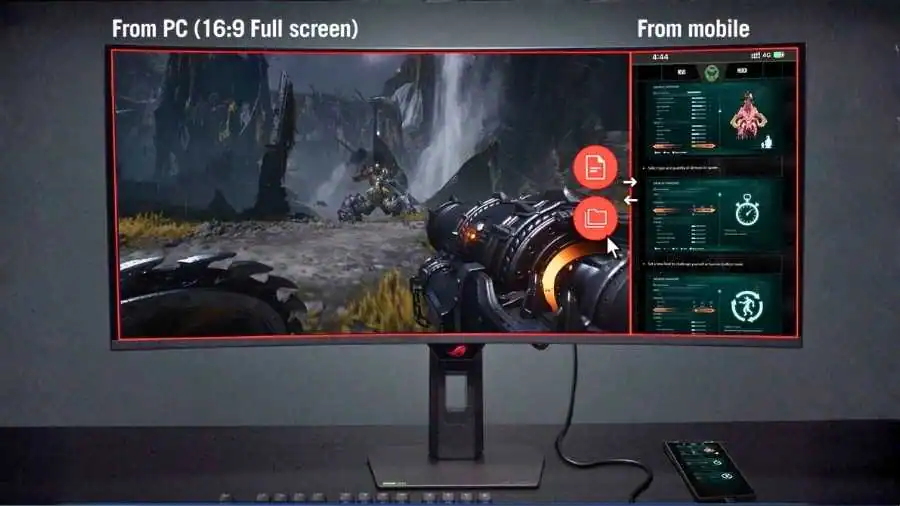

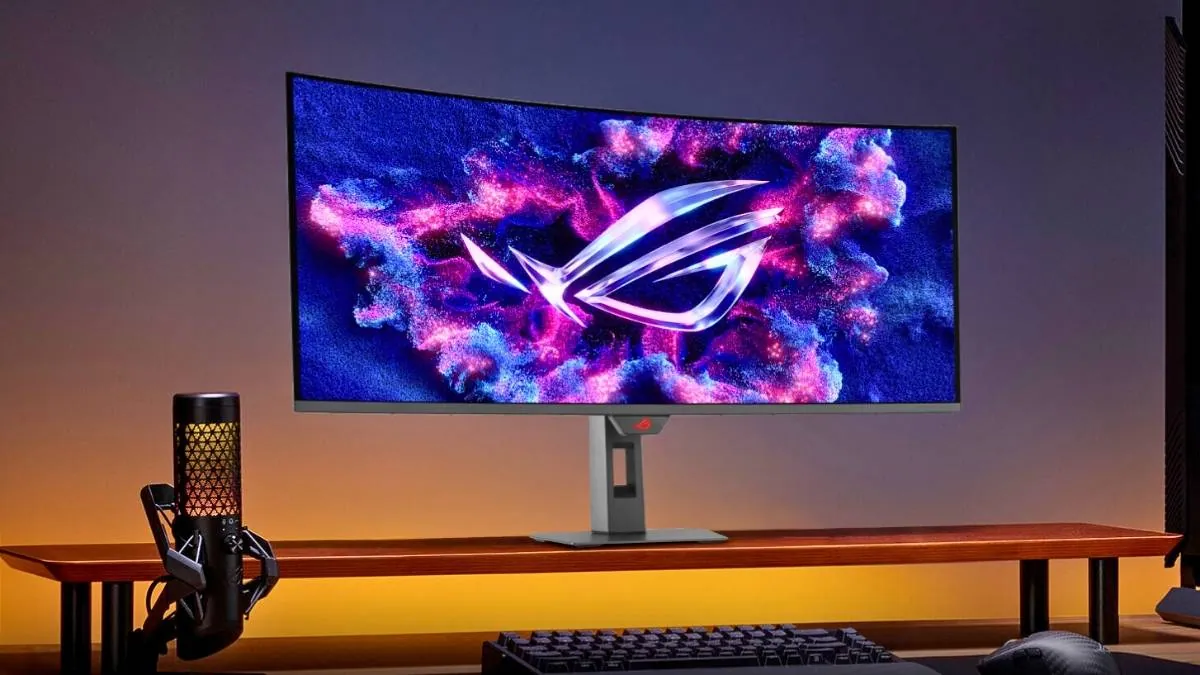
ASUS has officially launched the ROG Strix OLED XG34WCDMTG, a 34-inch ultrawide gaming monitor that combines a 240Hz QD-OLED panel with built-in Google TV. The new model blends high-refresh competitive gaming performance with full smart TV functionality, signaling a shift in how premium monitors are positioned in 2026.
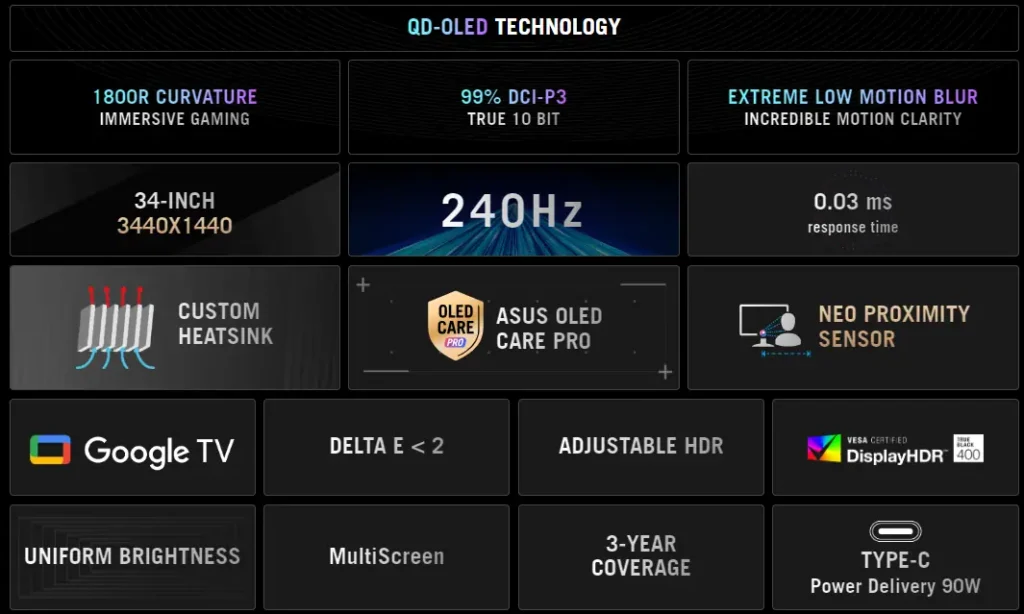
The display features a 34-inch 3440 × 1440 Gen 2 QD-OLED panel with a 1800R curve and a 21:9 aspect ratio, designed for immersive gaming and multitasking. Unlike standard WOLED-based ultrawides, the Samsung Display QD-OLED panel prioritizes higher color volume and improved brightness efficiency, particularly in HDR scenes.
ASUS has been steadily expanding its OLED lineup in 2026, following the recent early China launch of the 32-inch ROG Swift OLED PG32UCDM3 with DisplayPort 2.1 support and 4K 240Hz QD-OLED technology. The addition of a Google TV–enabled ultrawide model further broadens the company’s premium OLED portfolio.
The 240Hz refresh rate and 0.03ms response time position the monitor firmly for competitive gaming, while adaptive sync support ensures tear-free performance across PC and console platforms. Dual HDMI 2.1 ports allow high-refresh console gameplay, and DisplayPort 1.4 with DSC supports full-resolution 240Hz output from modern GPUs.
What differentiates this model from other OLED gaming monitors is its integrated Google TV platform based on Android 14. Users can stream apps, movies, and live TV directly from the display without connecting an external device. NVIDIA GeForce NOW integration allows instant access to cloud gaming titles over Wi-Fi 6, effectively transforming the monitor into a standalone entertainment hub.
This is where ASUS separates the XG34WCDMTG from its sibling, the XG34WCDG. While both models share the same 240Hz QD-OLED foundation, the MTG variant integrates full smart functionality, Dolby Vision support, and wireless connectivity features not present in the standard WCDG version.
Key Specifications
| Specification | Details |
|---|---|
| Panel Type | Gen 2 QD-OLED (Samsung Display) |
| Screen Size | 34-inch ultrawide |
| Resolution | 3440 × 1440 (WQHD) |
| Curvature | 1800R |
| Refresh Rate | 240Hz |
| Response Time | 0.03ms (GTG) |
| HDR Certification | VESA DisplayHDR 400 True Black |
| Peak Brightness | Up to 1,000 nits (HDR), ~250 nits (SDR) |
| Color Gamut | 99% DCI-P3, True 10-bit |
| Adaptive Sync | AMD FreeSync Premium Pro, NVIDIA G-Sync Compatible |
| Smart Platform | Google TV (Android 14) |
| Cloud Gaming | NVIDIA GeForce NOW pre-installed |
| Audio | Dolby Vision, Dolby Atmos, 2 × 5W speakers |
| Connectivity | 2 × HDMI 2.1, DisplayPort 1.4 (DSC), USB-C (90W PD), USB Hub |
| Wireless | WiFi 6 |
| Protection | OLED Care Pro, Neo Proximity Sensor |
| Extras | Included remote control, Custom heatsink, 3-year coverage |
The MTG carries roughly a $200 premium over the WCDG, positioning it as a hybrid gaming display and smart TV alternative rather than a pure desktop monitor.
Color performance remains central to its premium positioning. With 99% DCI-P3 coverage, true 10-bit color depth, and Display HDR 400 True Black certification, the panel targets both gamers and content consumers who demand vibrant reproduction and deep contrast. Peak HDR brightness reaches up to 1,000 nits in highlights, while SDR brightness sits around 250 nits under typical usage conditions.
To address OLED longevity concerns, ASUS includes its OLED Care Pro suite, a custom heatsink design, uniform brightness control, and a Neo Proximity Sensor that automatically switches the screen to black when no user is detected. Burn-in mitigation has become a critical consideration in desktop OLED panels, particularly for productivity users who display static UI elements for extended periods.
Connectivity is modern and flexible. USB-C with 90W Power Delivery enables single-cable laptop connectivity and charging, while the integrated USB hub supports peripherals. The addition of built-in speakers with Dolby Atmos and Dolby Vision support further reinforces the monitor’s all-in-one positioning.
The ROG Strix OLED XG34WCDMTG is priced at $1,199 in the United States and £949 in the United Kingdom. The premium reflects the inclusion of Google TV, cloud gaming support, Dolby integration, wireless connectivity, and a bundled remote control, effectively bridging the gap between high-end gaming monitors and compact smart TVs.
Also Read: Best Laptops for Multiple Monitors
XG34WCDMTG vs XG34WCDG: What’s the Differences
| Feature | XG34WCDMTG | XG34WCDG |
|---|---|---|
| Panel | 34″ Gen 2 QD-OLED | 34″ Gen 2 QD-OLED |
| Resolution | 3440 × 1440 | 3440 × 1440 |
| Refresh Rate | 240Hz | 240Hz |
| Smart TV Platform | Google TV (Android 14) | No |
| WiFi | WiFi 6 | No |
| Cloud Gaming | GeForce NOW built-in | No |
| Dolby Vision | Yes | No |
| Remote Control | Included | No |
| Price (US) | $1,199 | ~$999 |
With this release, ASUS is pushing the idea that a gaming monitor no longer needs to be tethered to a PC. By combining esports-level refresh rates with built-in streaming, Wi-Fi connectivity, and cloud gaming, the XG34WCDMTG represents a broader shift toward fully integrated, standalone display ecosystems for 2026.
The strategy also aligns with ASUS’ broader 2026 monitor roadmap, which includes high-speed dual-mode models such as the ROG Strix XG27UCG Gen 2, offering switchable 4K and 1080p ultra-high refresh gaming options.