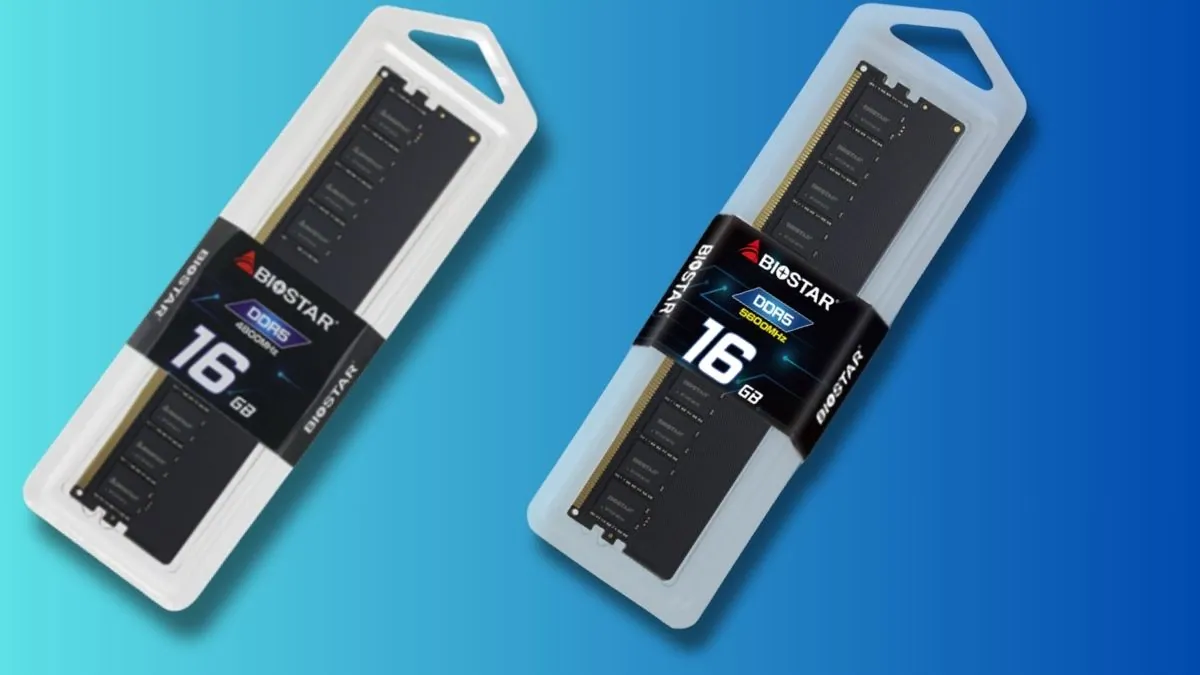
BIOSTAR has expanded its mainstream DDR5 lineup with two new 16GB UDIMM modules rated at 4800 MT/s and 5600 MT/s, designed specifically for stable, JEDEC-compliant desktop deployments rather than enthusiast overclocking systems.
Unlike performance-focused gaming memory kits, these modules emphasize voltage stability, compatibility, and predictable operation across Intel and AMD platforms. The positioning clearly targets OEM system builders, enterprise desktops, education deployments, HTPC systems, NAS builds, and cost-conscious DDR5 upgrades where reliability is more important than frequency tuning.
DDR5 adoption has now moved firmly into the mainstream phase. Entry-level Intel and AMD motherboards increasingly ship without DDR4 support, and new processor platforms are standardizing around DDR5-only configurations. As DDR4 gradually phases out of new motherboard roadmaps, stable and affordable JEDEC-compliant DDR5 modules become essential for volume system deployment. In this environment, compatibility and consistency matter more than squeezing out marginal latency improvements.
Both modules are standard 288-pin unbuffered DDR5 DIMMs operating at 1.1V and integrate a JEDEC-certified power management IC (PMIC) for tighter voltage regulation at the module level. They also feature on-die ECC, a built-in DDR5 capability that improves internal data integrity during operation, although this should not be confused with full server-grade ECC memory.
The 4800 MT/s variant carries primary timings of CL40-40-40-77 at 1.1V. With CL40 timing, effective latency calculates to approximately 16.67 nanoseconds. The module delivers a theoretical bandwidth of 38.4 GB/s per stick.
The 5600 MT/s model is rated at CL46-45-45-90 while maintaining the same 1.1V operating voltage. Although the CAS latency number is higher, the increased transfer rate keeps effective latency close at approximately 16.43 nanoseconds. Theoretical bandwidth rises to 44.8 GB/s per module, representing roughly a 16 percent increase in throughput over the 4800 MT/s model.
DDR4-3200 provides 25.6 GB/s per module. DDR5-4800 increases that to 38.4 GB/s, roughly 50 percent higher, while DDR5-5600 reaches 44.8 GB/s, representing around a 75 percent uplift over DDR4-3200. Even baseline DDR5 delivers significantly improved throughput while maintaining comparable effective latency ranges.
Both modules operate strictly within JEDEC specifications and do not include XMP or EXPO tuning profiles. JEDEC-only DDR5 memory boots at officially supported speeds without requiring BIOS tuning, reducing compatibility risks and minimizing deployment complexity in enterprise and institutional rollouts. This approach favors stability and predictable cross-platform behavior over aggressive performance tuning.
The 4800 MT/s variant aligns with baseline DDR5 support across Intel 12th and 13th Gen processors and entry-level chipsets such as H610, B660, and B760, as well as AMD A620 and B650 motherboards. The 5600 MT/s version fits comfortably within officially supported DDR5 speeds on modern midrange boards.
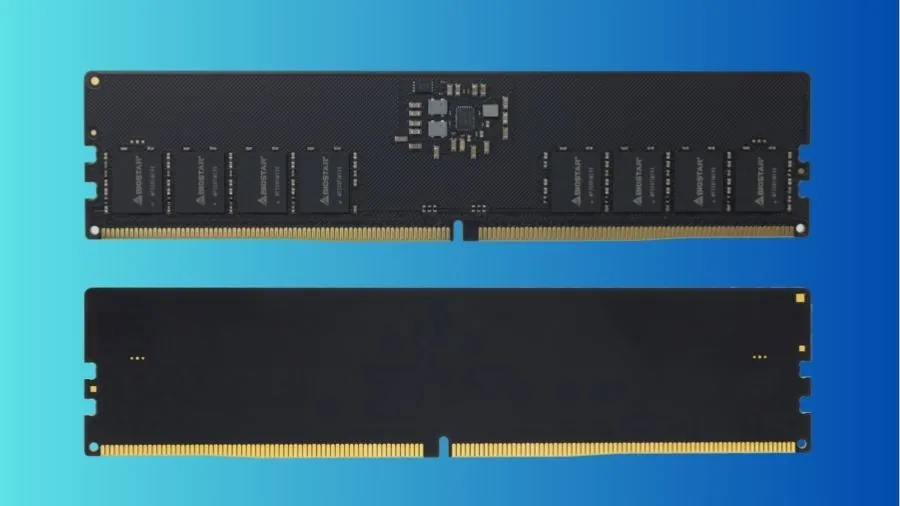
Both modules leverage DDR5’s dual 32-bit subchannel architecture and expanded bank structure, improving efficiency in multitasking and light parallel workloads compared to DDR4.
DDR5-4800 remains sufficient for office desktops, HTPC systems, NAS builds, and entry-level gaming PCs using Core i3, Core i5, or Ryzen 5 processors. DDR5-5600 may offer measurable gains in integrated graphics workloads, heavier multitasking environments, and light content creation tasks, though real-world latency differences between the two remain minimal.
4800 MT/s vs 5600 MT/s DDR5 16GB
| Feature | 4800 MT/s | 5600 MT/s |
|---|---|---|
| Voltage | 1.1V | 1.1V |
| Primary Timing | CL40 | CL46 |
| Bandwidth | 38.4 GB/s | 44.8 GB/s |
| Effective Latency | ~16.67 ns | ~16.43 ns |
| XMP / EXPO | No | No |
| Heatsink | None | None |
| Target Market | OEM / Entry | Mainstream |
| Stability Priority | High | High |
BIOSTAR has not disclosed pricing at the time of writing. However, based on broader DDR5 market trends, 16GB JEDEC-compliant modules without heatsinks or RGB elements typically sit within the lower price tier compared to performance-tuned kits.
If positioned competitively, these modules could appeal strongly to system integrators, education sector bulk purchases, government deployments, and entry-level desktop builds as DDR5 continues replacing DDR4 in new platform ecosystems.
BIOSTAR’s 4800 MT/s and 5600 MT/s DDR5 releases are clearly aimed at the growing mainstream and OEM segment, prioritizing stability, compatibility, and predictable operation over enthusiast-grade tuning.
Source: BIOSTAR