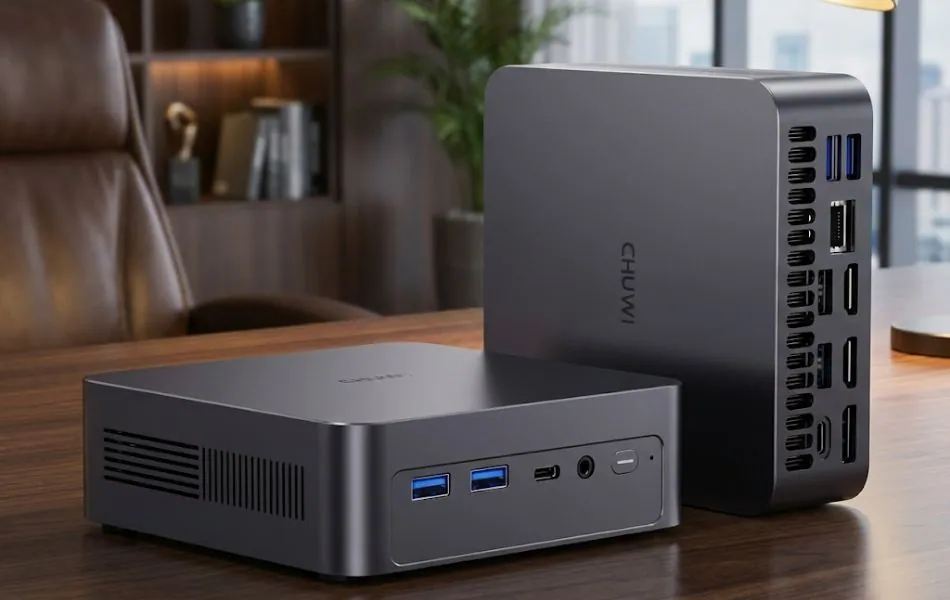
Chuwi has introduced the AuBox X1, a compact desktop PC built around Intel’s Core Ultra 5 226V platform and marketed as a Copilot+ system capable of running local AI workloads. At first glance, it fits neatly into the increasingly crowded mini PC market, but its design choices reveal a device aimed less at raw flexibility and more at efficient, self-contained computing with built-in AI acceleration.
The system is powered by Intel’s Core Ultra 5 226V, part of Intel’s low-power Core Ultra V-series lineup. Unlike the higher-wattage 226H, 155H, or 125H processors commonly found in performance-oriented mini PCs, the 226V prioritizes efficiency and sustained operation over peak CPU or GPU throughput. That distinction matters: while H-series Core Ultra systems are better suited for heavy multitasking, compilation, or light gaming, the 226V is designed to deliver consistent performance in compact, thermally constrained designs like the AuBox X1.
Chuwi advertises up to 97 TOPS of AI performance, a figure that combines throughput from the CPU, GPU, and neural processing unit. In practice, the NPU itself contributes 40 TOPS, which is the metric that matters most for sustained on-device AI tasks in Windows. This places the AuBox X1 firmly within Microsoft’s Copilot+ requirements on paper, enabling features such as on-device background effects, AI-assisted productivity tools, and future Windows features designed to offload inference from the CPU and GPU. However, how useful those capabilities are today remains software-dependent, as most current AI workloads still rely heavily on the GPU or cloud services rather than the NPU alone.
The system ships with 16GB of LPDDR5X memory, soldered directly to the board. This improves power efficiency and reduces physical complexity but eliminates any possibility of future memory upgrades. For typical productivity workloads, development environments, and light local AI tasks, 16GB remains adequate, but it does limit the system’s long-term flexibility as AI-enabled applications continue to grow in memory demand. Buyers looking for a mini PC that can scale over time will need to factor this in.
The AuBox X1 includes a 512GB PCIe 3.0 SSD and provides two M.2 2280 slots for expansion. One supports PCIe 5.0 with four lanes, while the second operates at PCIe 4.0 with two lanes. This configuration allows for a fast primary drive but reflects platform I/O constraints rather than workstation-class expandability. Sustained high-speed transfers on a secondary drive may be limited, but for most desktop workloads, the layout is practical.
Chuwi has opted not to include OCuLink support, which immediately defines the system’s intended use. While USB4 is present and offers up to 40 Gbps of bandwidth, the absence of OCuLink effectively rules out high-performance external GPUs or PCIe-based expansion. This positions the AuBox X1 as a closed, integrated system rather than a modular mini PC designed to grow into a more powerful workstation.
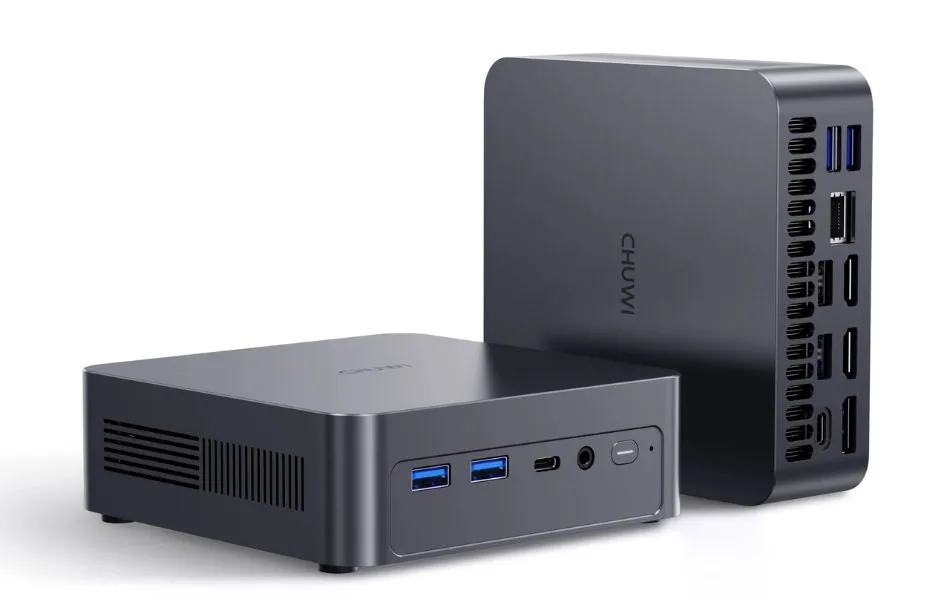
The AuBox X1 includes USB4, USB 3.2 Gen 2, four USB 3.2 Gen 1 ports, and a USB 2.0 port for legacy peripherals. Display output is handled via USB4, DisplayPort 1.4, and two HDMI 2.1 ports, with support for high-refresh 4K output on compatible displays and outputs. Wireless connectivity includes Wi-Fi 6E and Bluetooth 5.3, while wired networking is provided through a 2.5Gb Ethernet port.
Also Read: Thunderbolt 5 vs Thunderbolt 4
Power delivery is handled entirely over USB-C using a 100W USB Power Delivery adapter, eliminating the need for a proprietary barrel connector. This simplifies cable management and makes replacement power adapters easier to source, though sustained performance will depend on how aggressively the system manages power limits and thermals under continuous load.
Physically, the AuBox X1 measures approximately 5 × 5 × 1.6 inches and supports VESA mounting, making it suitable for clean desk setups or monitor-mounted installations. Chuwi expects the system to launch in late March with pricing between $600 and $700, placing it in the premium segment of the mini PC market rather than the budget category the brand is often associated with.
Several important factors remain unknown, including cooling capacity, noise levels, and the system’s ability to maintain boost clocks during prolonged CPU- or AI-intensive workloads. These aspects will ultimately determine whether the compact design can consistently deliver the performance implied by its specifications.
The AuBox X1 is best suited for users who value a compact, efficient desktop with built-in AI acceleration and modern connectivity, and who are comfortable with fixed memory and limited expansion. Those seeking maximum CPU performance, GPU flexibility, or long-term upgrade paths may be better served by H-series Core Ultra mini PCs or systems with OCuLink support. The AuBox X1 instead reflects a broader shift in the mini PC market toward tightly integrated designs where AI capability, power efficiency, and simplicity take precedence over modularity.
Source: Notebookcheck