
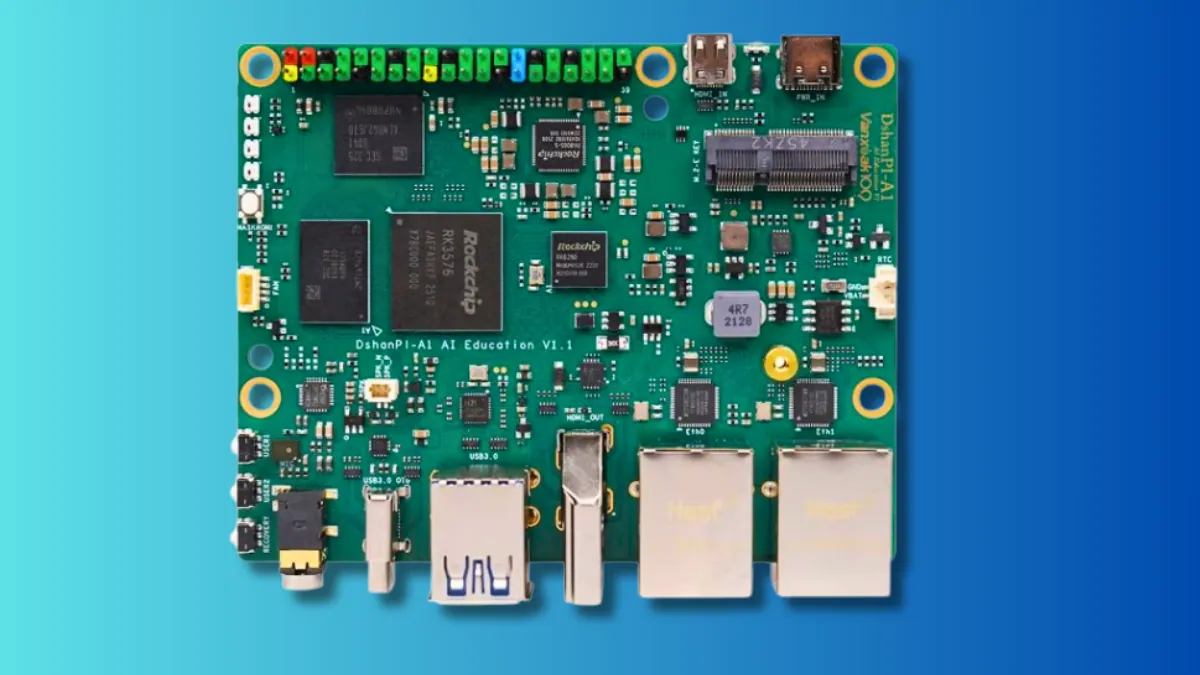
The DShanPi-A1 is a new RK3576-based single-board computer built for edge AI, video capture and networking workloads. It runs on Rockchip’s RK3576 octa-core processor and stands out with dual Gigabit Ethernet ports, both HDMI input and output, support for multiple cameras, and a 6 TOPS NPU for AI workloads. This makes it a strong alternative to the Raspberry Pi for developers building smart gateways, AI vision systems, or embedded analytics projects.
The board is now available online starting at around $82.90. That price puts it below many RK3588-based boards while still offering stronger connectivity than most entry-level single-board computers. With SBC prices fluctuating in recent months, its sub-$90 starting point makes it attractive for developers comparing cost versus performance and I/O features.
The DShanPi-A1 uses the Rockchip RK3576, an 8-core Arm processor with four Cortex-A72 performance cores running up to 2.2 GHz and four Cortex-A53 efficiency cores. Graphics are handled by the Mali-G52 MC3 GPU, which supports OpenGL ES 3.2, OpenCL 2.0, and Vulkan 1.2. The built-in 6 TOPS NPU helps speed up AI inference and supports different precision formats such as INT4, INT8, INT16, BF16, and TF32.
In benchmark tests, RK3576 platforms usually score between 1,200 and 1,400 in Geekbench 6 multi-core results based on early benchmarks. That puts them well above RK3568 boards but below higher-end RK3588 systems, which often score above 3,000. This gives the DShanPi-A1 a balanced level of performance for edge AI tasks without pushing into premium pricing.
Overall, the board fits neatly between low-cost quad-core gateway boards and high-performance RK3588 platforms. Developers who do not need PCIe Gen3 NVMe speeds or 8K display output may find the RK3576 offers a better mix of performance, efficiency, and price for long-running edge workloads.
Multimedia support is also strong for this price range. The RK3576 supports AV1, H.265/HEVC, VP9, and AVS2 decoding up to 8K at 30fps or 4K at 120fps. It also supports H.264 and MJPEG decoding up to 4K at 60fps. Hardware encoding is available up to 4K at 60fps for H.264 and H.265. This makes the board suitable for video analytics, AI-powered streaming devices, and embedded media processing systems.
Key Specifications
| SoC | Rockchip RK3576 |
| CPU | 4× Cortex-A72, up to 2.2GHz + 4× Cortex-A53 |
| GPU | Mali-G52 MC3 (OpenGL ES 3.2, OpenCL 2.0, Vulkan 1.2) |
| NPU | 6 TOPS AI accelerator (INT4 / INT8 / INT16 / BF16 / TF32) |
| Video Output | HDMI 2.1 (up to 4Kp120), 4-lane MIPI DSI |
| Video Input | Micro HDMI (via RK628D bridge chip) |
| Camera Support | 2× 4-lane MIPI CSI (up to 4 cameras) |
| Networking | 2× Gigabit Ethernet |
| Wireless Expansion | M.2 Key-E (PCIe 2.0 x1 + USB 3.0) |
| USB Ports | 2× USB 3.0 Type-A, 1× USB-C OTG |
| Power | USB-C with USB Power Delivery |
| Memory Options | 2GB / 4GB / 6GB / 8GB LPDDR4 |
| Storage | MicroSD slot, optional 32GB / 64GB eMMC |
| GPIO | 40-pin Raspberry Pi-compatible header |
| Audio | 3.5mm headphone jack |
| Additional Features | RTC battery connector, fan header, recovery & user keys |
| Dimensions | 97 × 77 mm |
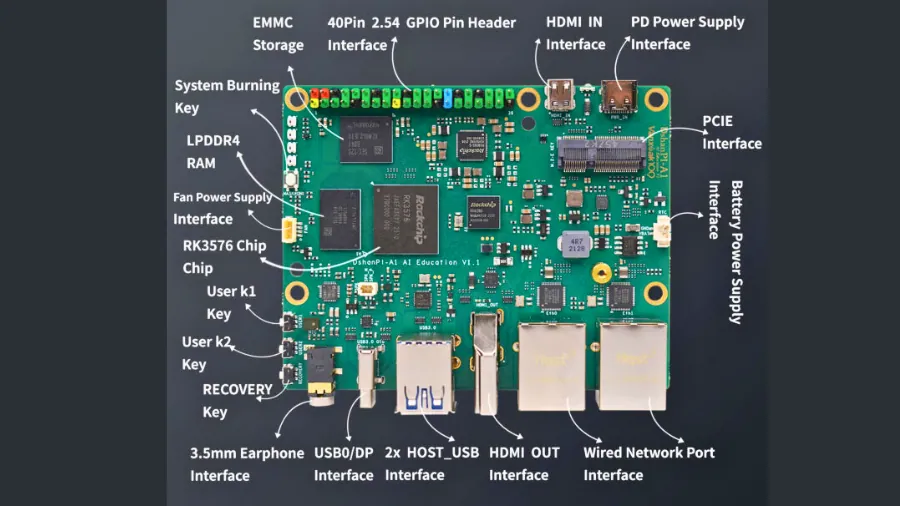
What really makes the DShanPi-A1 different from many other RK3576 boards is its HDMI input support. Along with an HDMI 2.1 output for 4K displays, the board also includes a micro HDMI input port powered by a Rockchip RK628D bridge chip. This allows the board to capture HDMI video directly, turning it into a compact HDMI capture device or the base of a real-time AI vision system.
This feature opens up many practical use cases. The board can be used for HDMI video capture in streaming setups, object detection projects using OpenCV, robotics development with ROS2, classroom computer vision labs, lecture recording systems, small NVR prototypes, AI inspection tools, and edge devices for retail analytics.
Unlike many single-board computers that focus only on hardware specs, the DShanPi-A1 is also promoted as an AI education platform. Official guides include tutorials for OpenCV, ROS2 robotics development, Qt applications, and even testing large vision-language models like DeepSeek-R1 and Qwen-VL. For universities and training programs working on edge AI and computer vision, the combination of HDMI input and a 6 TOPS NPU offers a practical learning environment without the higher cost of NVIDIA Jetson-class systems.
Camera support is another strong point. The board includes two 4-lane MIPI CSI connectors that can support up to four cameras, along with a 4-lane MIPI DSI port for display output. Together with the onboard NPU, this makes it suitable for multi-camera object detection, robotics vision systems, industrial inspection setups, and smart surveillance prototypes.
Networking is also a key strength. The DShanPi-A1 comes with two Gigabit Ethernet ports, allowing it to work as a router, firewall, SD-WAN device, or OpenWrt gateway without needing USB Ethernet adapters. Dual Ethernet combined with hardware video encoding also makes it suitable for compact AI-powered NVR systems or edge streaming devices in small offices or industrial settings.
For expansion, the board includes an M.2 Key-E slot (PCIe 2.0 x1 + USB 3.0) for Wi-Fi and Bluetooth modules. It also provides two USB 3.0 Type-A ports and a USB-C OTG port for high-speed peripherals. Power is supplied through USB-C with USB Power Delivery support, making it easier to integrate into standard enclosures and setups.
Memory configurations range from 2GB up to 8GB of LPDDR4. Storage options include a microSD card slot and optional 32GB or 64GB eMMC flash. Retail listings show the 6GB variant without onboard eMMC starting around $82.90, while an 8GB model with 64GB eMMC is priced near $130.98. Lower-memory versions are available through third-party sellers.
The board measures 97 × 77 mm and includes a 40-pin GPIO header largely compatible with Raspberry Pi-style HAT accessories. Additional features include a 3.5 mm audio jack, RTC battery connector, fan header, recovery and user keys, and system burning support, making it suitable for both hobbyist experimentation and structured embedded deployments.
Software support spans Armbian, Buildroot, OpenWrt, Arch Linux (Arm), OpenEuler and Fedora. However, hardware feature support varies between distributions. Buildroot currently offers the most complete implementation with support for NPU acceleration, video encoding/decoding, and MIPI CSI functionality. Armbian and OpenWrt are close behind but may lack full MIPI CSI support, while some Fedora and OpenEuler builds may not yet expose complete multimedia or NPU functionality.
Software support varies by distribution, which may matter for commercial or long-term deployments. Developers targeting commercial deployments should carefully validate kernel support, NPU drivers, and camera stack compatibility before scaling.
Thermally, RK3576 platforms typically operate within a manageable envelope under sustained loads, often supporting passive cooling for moderate AI inference tasks. However, multi-camera pipelines or continuous 4K encoding workloads may benefit from active cooling via the onboard fan header, particularly in enclosed industrial deployments.
The DShanPi-A1 sits between entry-level RK3568 boards and higher-end RK3588 systems. It offers significantly more I/O flexibility than basic RK3568 boards while avoiding the higher cost and power draw associated with RK3588 systems. Compared to Raspberry Pi 5-class boards, it adds dual Ethernet and HDMI input features that materially expand networking and video capture use cases. Compared to entry-level Jetson Nano deployments, it delivers lower upfront cost and comparable edge inference capacity for INT8 workloads, albeit without CUDA acceleration.
If software maturity and mainline kernel support continue to improve, the DShanPi-A1 could emerge as one of the more versatile RK3576-based development boards currently available, particularly for developers building intelligent edge systems where video, networking and AI inference intersect.
RK3576 SBC Comparison
| Board | SoC | NPU | HDMI Input | Ethernet | Starting Price |
|---|---|---|---|---|---|
| DShanPi-A1 | RK3576 | 6 TOPS | Yes | 2× GbE | ~$82.90 |
| Bit-Brick K1 Pro | RK3576 | 6 TOPS | No | 1× GbE | ~$95 |
| NanoPi M5 | RK3576 | 6 TOPS | No | 2× GbE | ~$110 |
Sources: CNX-Software, Liliputing