
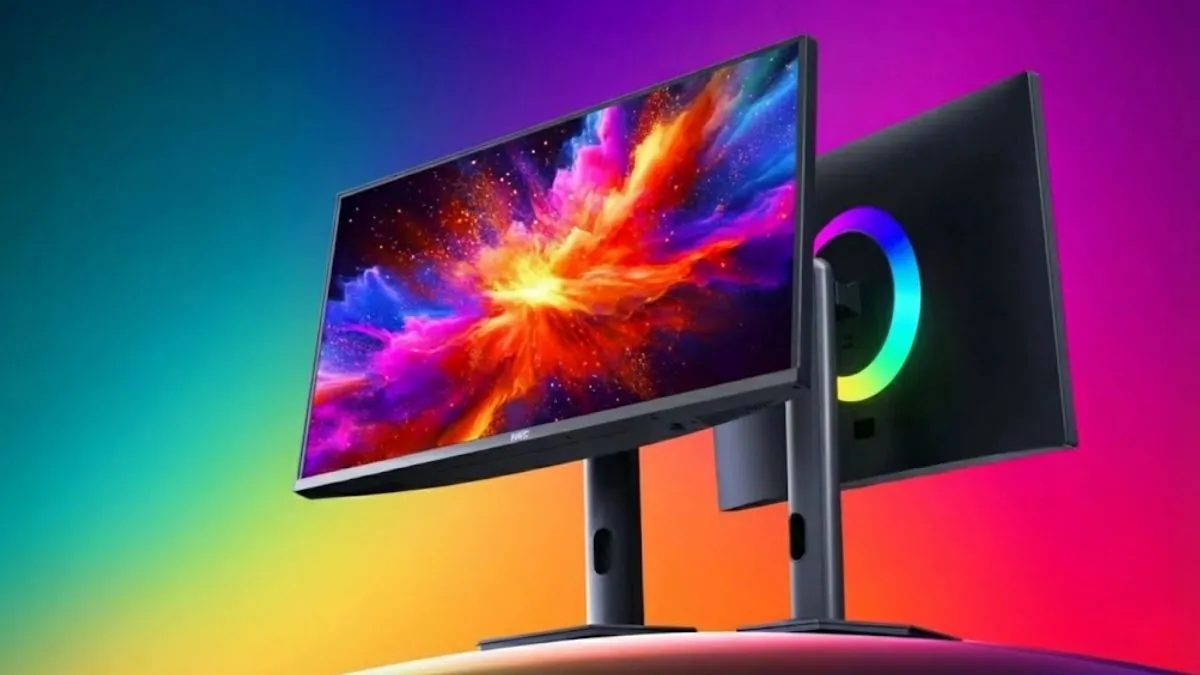
HKC has officially unveiled the M10 Ultra, a flagship 4K gaming monitor that brings RGB Mini-LED backlight technology to desktop displays for the first time. Rather than directly competing with OLED in terms of contrast alone, the M10 Ultra appears designed to forge a different path, pushing color accuracy, brightness, and HDR performance beyond what traditional Mini-LED monitors can currently achieve.
This announcement was confirmed through HKC’s official channels in China, along with initial specification details that position the M10 Ultra more as a technology showcase than a mainstream gaming monitor.
Why RGB Mini-LED is a significant change
Most Mini-LED monitors rely on white or blue LEDs with color filters to create the final image. The M10 Ultra takes a different approach by utilizing individual red, green, and blue Mini-LED elements in its backlight.
This design allows the monitor to control both brightness and color at the backlight level, reducing reliance on filters and potentially improving color purity and efficiency. HKC states that the M10 Ultra uses 4,788 individually controllable RGB light elements, which the company claims enables more precise local dimming and reduced halo effects in HDR scenes.
It’s important to note that the RGB Mini-LED elements are not mapped one-to-one with traditional dimming zones. Instead, the benefit lies in improved color volume and brightness consistency, especially at high luminance levels where standard Mini-LED designs often lose saturation.
Also Read: What is HD?
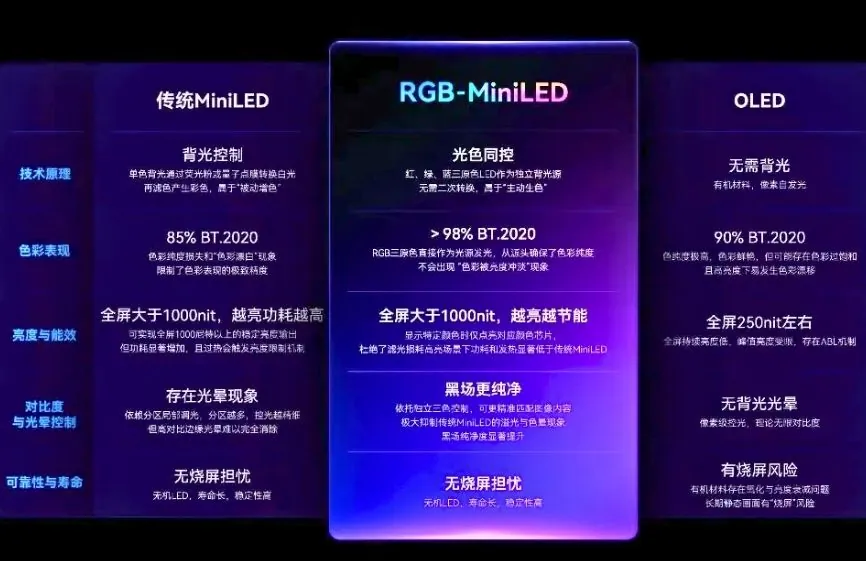
RGB Mini-LED vs Traditional Mini-LED vs OLED
| Category | Traditional Mini-LED | RGB Mini-LED | OLED |
|---|---|---|---|
| Backlight design | Uses a single-color backlight that is converted to white and then filtered into colors | Uses red, green, and blue Mini-LEDs as direct light sources | No backlight, each pixel emits its own light |
| Color coverage | Around 85% BT.2020, color can lose purity at high brightness | Above 98% BT.2020, better color purity even at high brightness | Around 90% BT.2020 with strong color vibrancy |
| Brightness capability | Can exceed 1000 nits full-screen, but power use increases | Can exceed 1000 nits full-screen with better efficiency | Full-screen brightness is usually around 200 to 300 nits |
| Power efficiency | Lower efficiency due to color filters | Higher efficiency since no color filters are needed | Efficient at low brightness, limited at high brightness |
| Halo control | Halo effects can appear around bright objects | Improved halo control due to precise RGB backlight control | No halo effect due to pixel-level lighting |
| Contrast | High contrast with local dimming | Higher contrast with cleaner black areas | Near-infinite contrast |
| Burn-in risk | No burn-in risk | No burn-in risk | Possible burn-in with long-term static content |
| Typical use case | High-brightness HDR monitors and TVs | Color-critical HDR gaming and professional displays | Gaming and media where perfect blacks matter |
Credit: HKC
Display Resolution and Refresh Rate Flexibility
The HKC M10 Ultra features a 31.4-inch panel with a native 3840 × 2160 4K resolution. The monitor supports a 165Hz refresh rate at its native resolution, targeting smooth motion for high-end PC gaming and professional use.
HKC has also included a dual-mode refresh option. When switched to 1080p, the panel can operate at up to 330Hz, catering to competitive gamers who prioritize frame rate over resolution. This flexibility allows the monitor to serve both cinematic gaming and esports-focused use cases.
Adaptive Sync support is expected, although HKC has not yet confirmed official FreeSync or G-SYNC certification details.
Color Accuracy and HDR Capabilities
Color performance is one of the M10 Ultra’s key selling points. According to HKC, this monitor covers 100 percent of the BT.2020 color space, along with full coverage of sRGB, DCI-P3, and Adobe RGB.
If this holds true in independent testing, the M10 Ultra would be one of the widest-gamut desktop monitors currently available. The panel boasts a full-screen brightness of 1,000 nits, and peak HDR brightness can reach up to 1,600 nits in supported content.
While HKC has not confirmed DisplayHDR certification, these figures suggest that this monitor falls into the upper tier of HDR performance rather than an entry-level HDR implementation. Connectivity Built for Next-Generation GPUs
The M10 Ultra features a modern collection of high-bandwidth inputs:
- DisplayPort 2.1
- Two HDMI 2.1 ports
- USB-C with DisplayPort Alt Mode
- USB-C Power Delivery up to 98W
DisplayPort 2.1 is particularly significant, as it provides sufficient bandwidth for high-refresh-rate 4K signals without requiring any special compression. This makes the monitor better suited for next-generation graphics cards compared to displays limited to DisplayPort 1.4.
Design Approach and Physical Features
HKC has equipped the M10 Ultra with a fully adjustable stand that supports height, tilt, and swivel adjustments. The back of the monitor features a circular RGB lighting element that acts as an ambient design accent rather than a distracting element.
The panel type has not yet been confirmed, and HKC has not disclosed whether the display uses IPS or VA technology. Details regarding screen coating and response time metrics are also expected closer to the launch date.
Price and Availability
HKC has not announced the price or final release date for the M10 Ultra. Based on current information, it will initially launch in China, and there is no confirmation of its availability in the United States or other global markets.
Given the complexity of RGB mini-LED manufacturing and the use of DisplayPort 2.1, the M10 Ultra is expected to be in the premium segment, likely competing with high-end mini-LED and OLED gaming monitors.
Also Read: What to Look for in a Computer? Best Tips
Why the M10 Ultra Matters for the Monitor Market
The HKC M10 Ultra is less about raw gaming specifications and more about whether RGB mini-LED can be scaled down from large televisions to desktop monitors. If successful, it could offer an alternative to OLED for users who prioritize brightness, color volume, and HDR impact without the concerns of burn-in or long-term luminance degradation.
Rather than completely replacing existing display technologies, the M10 Ultra signals a potential shift towards more specialized high-end monitors optimized for different strengths. Whether RGB mini-LED becomes a major trend will depend on real-world performance, manufacturing costs, and adoption beyond flagship models.
For now, the M10 Ultra is one of the most technologically ambitious desktop monitors announced in recent years.
Sources
- HKC official announcement
- HKC specification material shared via ITHome