

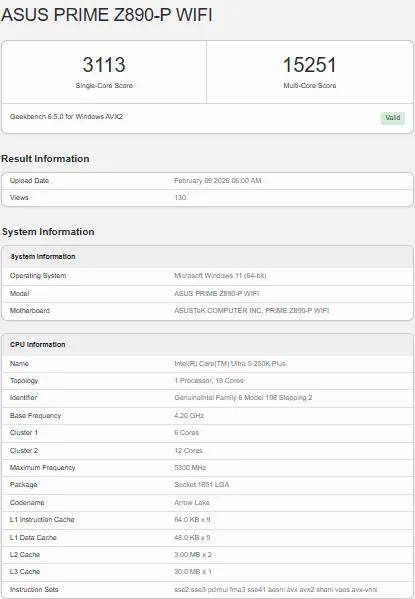
Intel’s upcoming Core Ultra 5 250K Plus desktop processor has surfaced in the Geekbench database, offering an early snapshot of Arrow Lake Refresh performance ahead of its expected launch window. According to a validated Geekbench 6.5.0 listing, the chip was tested on an ASUS PRIME Z890-P WIFI motherboard running Windows 11, making it one of the clearest public data points so far for Intel’s refreshed midrange desktop lineup.
The benchmark entry identifies the Core Ultra 5 250K Plus as an 18-core processor with a 6 performance core and 12 efficiency core configuration. The system recorded a single-core score of 3,113 and a multi-core score of 15,251, placing the chip firmly within Intel’s upper midrange segment based on early synthetic results. Geekbench also reports a 4.2 GHz base frequency and boost clocks reaching up to 5.3 GHz, aligning closely with previously leaked Arrow Lake Refresh specifications.
Test details show the platform was equipped with 32 GB of memory, and the result is marked as valid, reducing the likelihood of placeholder data or unverified engineering samples. While Geekbench does not directly translate to gaming or workstation performance, it remains a widely used reference for gauging generational shifts in CPU behavior under standardized workloads.
| Benchmark | Score |
|---|---|
| Geekbench 6 Single-Core | 3,113 |
| Geekbench 6 Multi-Core | 15,251 |
Early comparisons suggest the Core Ultra 5 250K Plus builds on the existing Core Ultra 5 245K by adding four additional efficiency cores while retaining the same 125 W base power rating and a 159 W maximum turbo power limit.
Based on early benchmark aggregates, single-core performance appears modestly higher than typical Core Ultra 5 245K results by roughly five percent, while multi-core scores trend lower by approximately eight percent, a gap that is likely platform-related rather than indicative of final silicon behavior.
Also Read: Intel Core Ultra 9 290K Plus Leak Shows 11% Gain Over 285K
Industry sources indicate memory support is also expected to increase to DDR5-7200, a change that could offer incremental gains in bandwidth-sensitive tasks once retail platforms and finalized BIOS revisions are in place.
As with many early Arrow Lake results, conservative firmware power limits, early hybrid-core scheduling profiles, and cautious memory training on Z890 boards may all be contributing factors to the restrained multi-core output seen here.
Despite the higher core count, the initial multi-core score appears modest relative to expectations for an 18-core configuration. This reinforces the view that the benchmark should be interpreted as a platform snapshot rather than a performance ceiling. Similar early-generation results in previous Intel launches have shown meaningful gains once motherboard firmware and operating system scheduling mature closer to retail availability.
Within Intel’s current naming scheme, the “Plus” suffix appears to signal expanded efficiency core counts and higher memory support rather than a new architectural revision. That positioning places the Core Ultra 5 250K Plus between the standard 245K and higher-tier Ultra 7 models, targeting users who prioritize sustained multitasking, background workloads, and thread-heavy applications over peak single-thread performance.
| CPU | Core Layout | Max Boost | Memory Support | Target Segment |
|---|---|---|---|---|
| Core Ultra 5 245K | 6P + 8E | 5.2 GHz | DDR5-6400 | Mainstream |
| Core Ultra 5 250K Plus | 6P + 12E | 5.3 GHz | DDR5-7200 | Upper midrange |
| Core Ultra 7 270K | 8P + 12E | 5.5 GHz | DDR5-7200 | Performance |
From a broader market perspective, the appearance of the Core Ultra 5 250K Plus suggests Intel is preparing to apply additional pressure in the midrange desktop segment at a time when competition around pricing, efficiency, and platform longevity remains intense.
Rather than signaling a major architectural shift, Arrow Lake Refresh appears focused on incremental core scaling, higher memory speeds, and refinement of the LGA1851 platform for system builders and upgraders seeking balanced performance.
With additional Arrow Lake Refresh processors expected to surface in the coming weeks, this Geekbench result serves as an early reference point rather than a definitive performance verdict. Real-world testing, finalized firmware, and retail pricing will ultimately determine how competitive the Core Ultra 5 250K Plus proves to be once it reaches the market.
Source: Geekbench