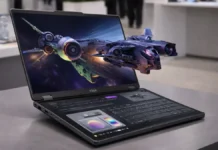
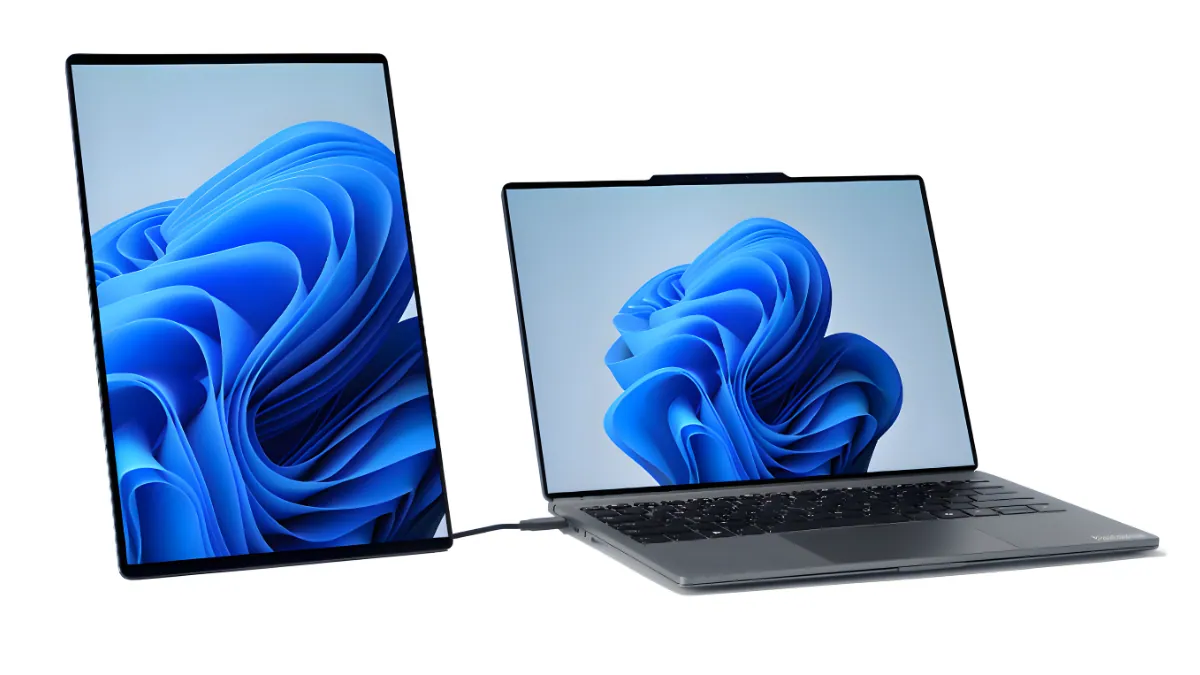
A new Lenovo ThinkBook concept has surfaced ahead of Mobile World Congress 2026, revealing a modular AI-focused design with a detachable secondary display. The images were shared by hardware leaker Evan Blass, known as evleaks, on X, and appear to show a ThinkBook variant built around interchangeable components rather than a fixed keyboard deck. Lenovo has not confirmed the device, but the timing suggests it could be previewed during the company’s MWC keynote in Barcelona.
The difference becomes clear in the lower half of the chassis, where the traditional keyboard base is replaced with a modular platform. The leaked renders indicate that the bottom section can accept different attachments, pointing to a configurable layout aimed at enterprise users.
One configuration shows a secondary display installed in place of the keyboard, effectively turning the device into a dual-screen setup. Another version features a detachable keyboard accessory that connects to the modular base. If the design reaches production, it would be the first ThinkBook built around a fully swappable input and display system tailored for AI-driven workflows.
The modular structure appears to separate the input hardware from the main computing unit. Unlike foldable OLED laptops that rely on flexible panels and complex hinge systems, this approach uses discrete physical components. That could simplify servicing and potentially improve durability, two factors that matter in large-scale enterprise deployments. By avoiding bendable displays, Lenovo may be pursuing a more practical alternative to foldable designs while still offering multi-screen flexibility.
Lenovo has a track record of testing unconventional designs before commercial release. Over the past few years, Lenovo has introduced dual-screen ThinkBook models and foldable ThinkPad concepts to test new productivity layouts.
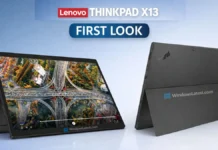
A recently spotted ThinkPad X13 detachable model also suggests Lenovo is refining modular input concepts across its business lineup.
While Lenovo has not confirmed the processor, any system branded as an AI PC in 2026 would likely rely on a platform with a dedicated NPU, such as Intel’s Lunar Lake, AMD’s Ryzen AI series, or Qualcomm’s Snapdragon X lineup. All three platforms meet Microsoft’s current Copilot+ AI acceleration thresholds.
Nvidia is also preparing its N1X ARM-based laptop processor for 2026, further intensifying competition in AI-accelerated Windows PCs.
Lenovo has used the ThinkBook Plus and ThinkPad X1 Fold as experimental platforms before moving new form factors into production. Based on that pattern, this ThinkBook Modular AI PC leak could be an early preview of Lenovo’s 2026 enterprise plans rather than just a one-time prototype.
The “AI PC” label typically indicates the presence of a dedicated neural processing unit (NPU) designed to handle AI workloads directly on the device. In 2026, that usually means support for on-device tasks such as real-time transcription, document summarization, image generation, and running large language models without relying entirely on the cloud.
The ThinkBook Modular AI PC may align with the broader shift toward Copilot+ PCs and on-device AI acceleration within the Windows ecosystem. Many enterprise customers now prefer local AI processing to reduce cloud dependency, improve speed, and address data privacy concerns in the US and other markets.
If Lenovo builds this laptop around strong local AI performance, the modular design could support new workflows. For example, one module could display an AI assistant or analytics dashboard, while the main screen stays focused on business apps like spreadsheets or coding tools. As companies integrate generative AI into daily work, a modular AI laptop could provide more flexibility.
The modular layout may also change how companies deploy hardware. IT teams could standardize a base computing unit and assign different modules based on job roles. Developers, analysts, designers, and field workers might receive dual-display setups, while employees who travel frequently could use a lighter keyboard-only configuration. For IT departments, a modular system could standardize hardware while allowing role-specific configurations.
The leak does not confirm how the modules connect, whether through magnets, pogo-pin connectors, or a proprietary interface. Power management, thermal design, and potential hot-swapping features will determine whether this concept can move beyond a demonstration at MWC 2026. Enterprise buyers will also expect clear information about durability standards, serviceability, and long-term support before adopting such a system.
The leak appears to place the device within the ThinkBook lineup rather than the premium ThinkPad X1 family. ThinkBook models typically target SMB and modern enterprise users, while ThinkPad systems serve large corporate deployments.
In Windows 11, Copilot+ features such as Recall, live captioning, and AI-enhanced search depend on local NPU acceleration. A modular ThinkBook designed around AI workflows would likely integrate tightly with those system-level capabilities rather than relying solely on cloud processing.
Also Read: Best Budget AI Laptops
Pricing may become an important factor. Foldable OLED laptops are still expensive due to complex display and hinge engineering. A modular design using traditional display panels and detachable components could offer similar screen flexibility without the high cost of flexible OLED hardware. If Lenovo prices the ThinkBook Modular AI PC competitively, it could become a more practical option for mid-size and large enterprises.
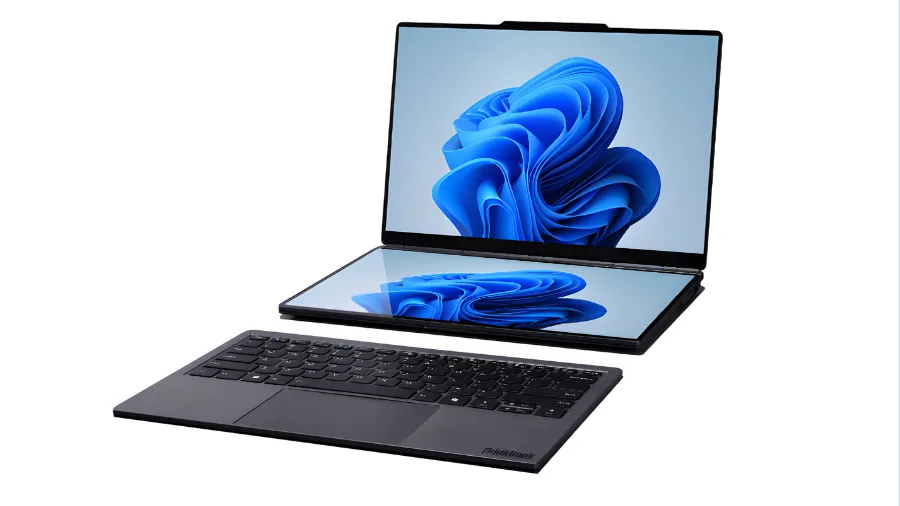
Sustainability could also play a role in Lenovo’s strategy. A modular system may extend device lifespan by allowing companies to replace or upgrade specific parts instead of replacing the entire laptop. With ESG reporting and environmental compliance becoming more important in enterprise purchasing decisions, this approach may strengthen Lenovo’s position in the corporate laptop market.
Mobile World Congress has become an important platform for launching forward-looking PC concepts, especially for professional and enterprise users. Lenovo frequently uses MWC Barcelona to preview technologies that shape its future roadmap. Whether the ThinkBook Modular AI PC remains a concept or becomes a commercial product, its potential MWC 2026 showcase highlights how Lenovo sees the next phase of AI-driven enterprise computing.
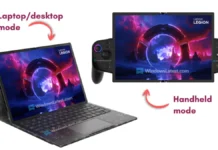
Earlier at MWC 2026, Lenovo also introduced the Legion Go Fold, a foldable Windows gaming handheld, signaling broader experimentation with flexible hardware designs.
Lenovo has not officially announced the device, and details about specifications, pricing, and availability are still unknown. More information is expected when Lenovo presents at Mobile World Congress 2026 in Barcelona. For now, the leak suggests Lenovo is exploring a modular alternative to foldables, combining AI acceleration with flexible hardware design to rethink the modern enterprise laptop.
Source: Evleaks on X