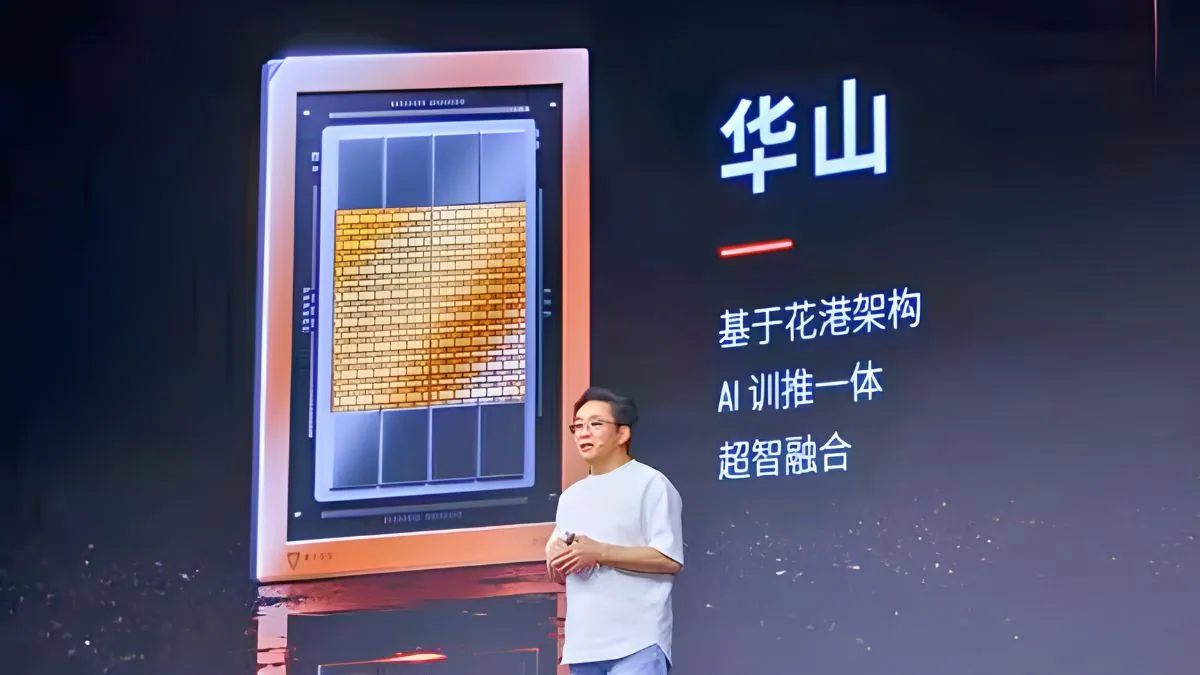
Moore Threads has revealed details of its next-generation HuaGang GPU architecture, which will form the basis of the company’s future gaming graphics cards and AI accelerators. The architecture was unveiled during the company’s MUSA Developer Conference 2025 in China.
Instead of announcing a single new graphics product, Moore Threads presented HuaGang as a long-term platform designed to support multiple GPU families across several product cycles. The company stated that this architecture will power both consumer gaming GPUs and large-scale AI processors, with products based on it expected to enter production next year.
A Platform-Level Redesign Instead of a Single GPU Launch
HuaGang demonstrates how Moore Threads is changing its approach to GPU development. According to the company, the new architecture introduces changes in instruction handling, execution flow, and task scheduling, particularly in environments where multiple GPUs operate together.
This design focus reflects the increasing importance of multi-GPU systems in modern AI workloads, where performance depends not only on raw computing power but also on how efficiently tasks are distributed across large clusters.
Moore Threads claims that HuaGang delivers approximately 50 percent higher compute density and ten times better energy efficiency compared to its previous designs. The company did not disclose details such as transistor count, die size, or manufacturing process.
One Architecture for Both Gaming and AI Workloads
Unlike previous generations that treated gaming graphics and AI acceleration as largely separate design paths, Huagang is intended to support both use cases using a shared architectural base.
The platform supports a wide range of compute formats, from traditional graphics operations to modern AI workloads, and introduces a new scheduling system aimed at improving efficiency in large, multi-GPU environments.
By keeping gaming and AI products on the same architectural foundation, Moore Threads said it aims to simplify development and improve long-term software support across its GPU lineup.
Lushan Targets the Next Generation of Gaming GPUs
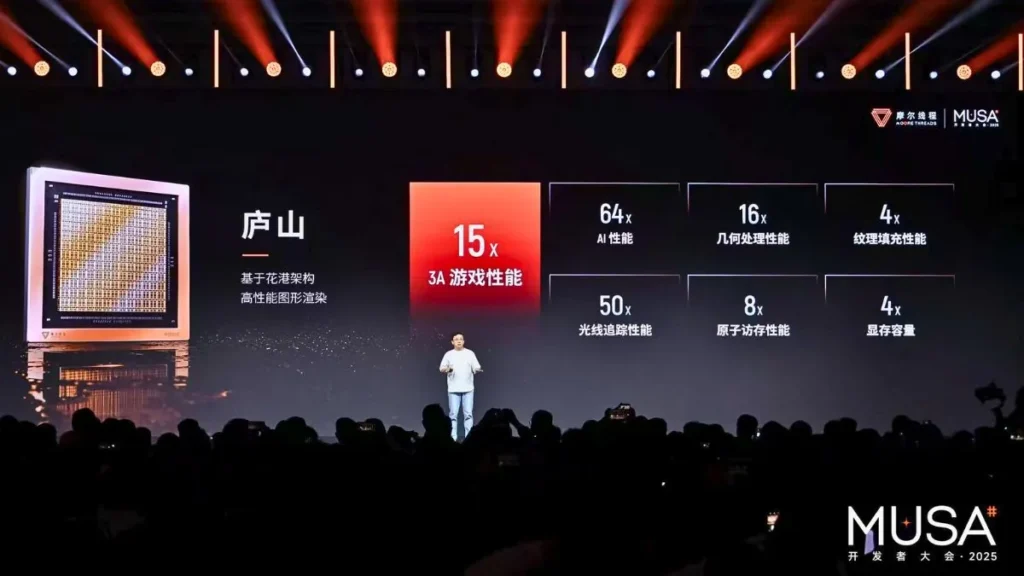
The first consumer-focused GPU built on Huagang is Lushan, which will replace Moore Threads’ current gaming products, such as the MTT S80 and S90.
During the conference, Moore Threads presented internal estimates claiming:
- Up to 15× higher performance in modern gaming workloads
- Around 50× improvement in ray tracing throughput
- Up to 64× increase in AI compute capability
The company also confirmed that Lushan will support DirectX 12 Ultimate, addressing a major limitation of earlier Moore Threads gaming GPUs.
No independent benchmarks were shown, and Moore Threads said gaming products based on Lushan are expected to launch in 2026.
Huashan Focuses on Large-Scale AI Deployments
For data centers and enterprise environments, Moore Threads introduced Huashan, an AI-centric GPU designed for large-scale training and inference.
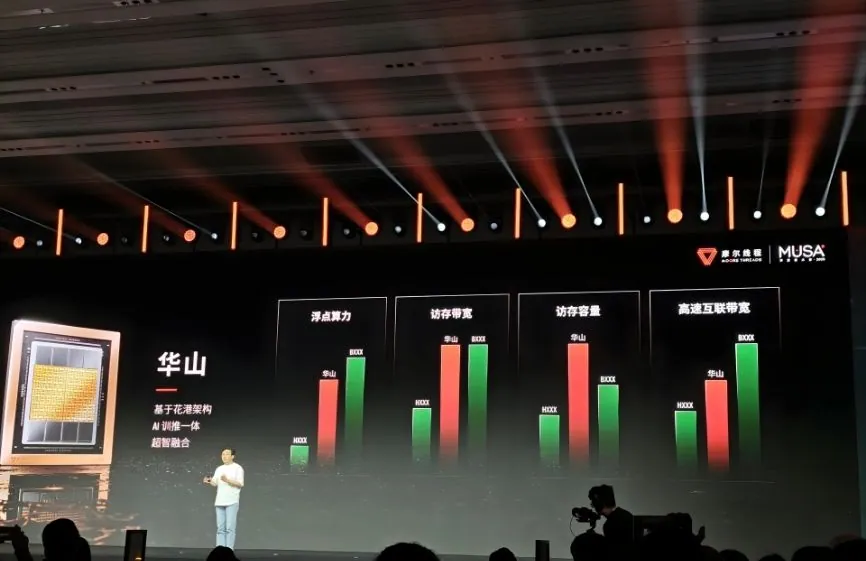
Huashan is described as a chiplet-based design with support for high-bandwidth memory and a large interconnect.
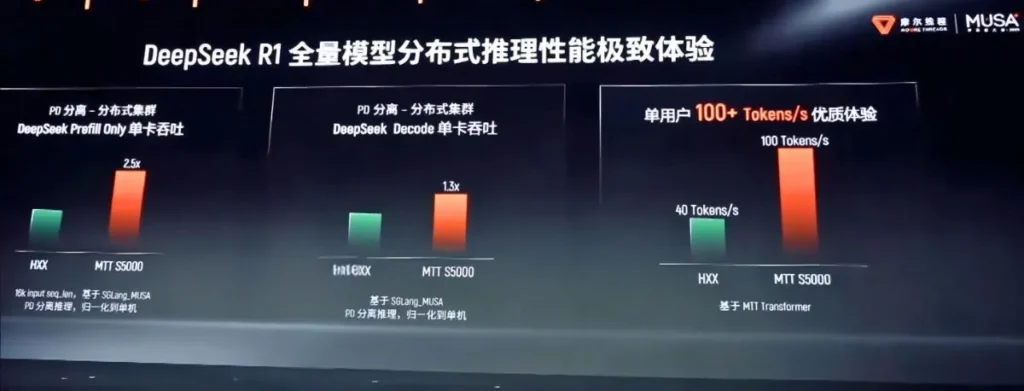
According to Moore Threads, this platform can be deployed in clusters of over 100,000 GPUs using standard networking technologies as well as its own MTLink interconnect.
In internal comparisons presented at the event, Moore Threads positioned Huashan’s compute and memory performance between NVIDIA’s Hopper and Blackwell platforms, while claiming higher memory capacity. These figures were presented as internal estimates and have not been independently verified.
Software and Ecosystem Play a Central Role
Moore Threads emphasized that Huagang’s success depends heavily on software maturity. The company highlighted its MUSA software platform, which includes native development tools and utilities designed to help migrate applications originally written for CUDA.
By maintaining a unified software stack across both gaming and AI products, Moore Threads aims to reduce fragmentation and improve long-term support for developers and system builders.
Initial deployments of Huagang-based products are expected to focus on the Chinese domestic market, where Moore Threads is positioning itself as a locally controlled alternative amid ongoing restrictions on advanced foreign GPUs.
Production Timeline and What Comes Next
Moore Threads stated that both Lushan and Huashan are planned to enter mass production in 2026, but did not disclose:
- Final product models or configurations
- Pricing details
- Manufacturing partners
- Exact release dates
Additional technical disclosures are expected as the products move closer to commercial availability.
Instead of immediately challenging global GPU leaders in terms of peak performance, Moore Threads appears to be prioritizing efficiency, scalability, and software consistency.
With HuaGang, the company is laying the foundation for a larger GPU ecosystem that could make significant inroads into the gaming and AI markets.
Whether the performance claims translate into real-world competitive products remains to be seen, but HuaGang represents Moore Threads’ most ambitious architectural undertaking to date.
Sources: Sina Finanace (In Chinese) via Wcctech