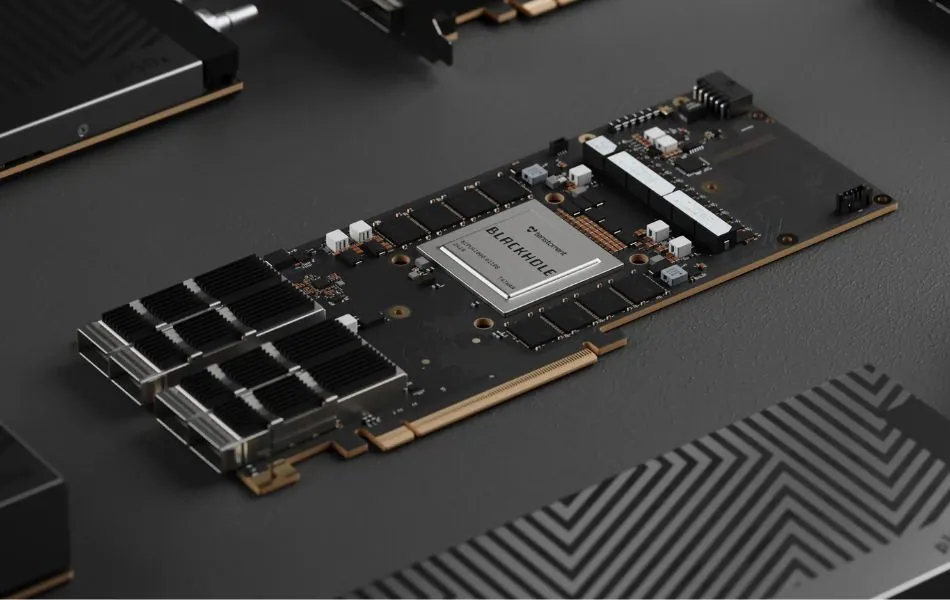
Tenstorrent has confirmed that its Blackhole p150 PCIe accelerator cards are now limited to 120 Tensix cores, down from the 140-core configuration shown in late-2025 materials. The change applies to all p150 variants, including both p150a and p150b, and affects not only new shipments starting January 2026 but also existing cards through a firmware update.
According to Tenstorrent’s TT Zephyr Platforms v19.5.0 release notes, firmware version 19.5.0 and later enforces the reduced core count across all deployed p150 hardware. Once updated, cards that were previously marketed as 140-core devices present themselves to system software as 120-core accelerators, with no indication of a new silicon revision or physical hardware change.
This makes the adjustment unusual in the accelerator market. Rather than revising the product at the manufacturing level, Tenstorrent is masking available Tensix cores in firmware, effectively shrinking the logical compute grid exposed to applications. The company says the move is intended to present a unified interface to Metal and other system software, standardizing how Blackhole hardware is exposed across platforms and deployments.
The change also brings a corresponding reduction in on-chip SRAM. Updated specification tables now list 180 MB of SRAM for p150 cards, down from the roughly 210 MB associated with the earlier 140-core configuration. Peak BLOCKFP8 throughput figures remain listed at 664 TFLOPS, although earlier materials paired the higher core count with higher implied throughput numbers.
For reference, the effective specification shift looks as follows:
| Specification | Late-2025 Materials | Current (v19.5.0+) |
|---|---|---|
| Tensix cores | 140 | 120 |
| On-chip SRAM | ~210 MB | 180 MB |
| BLOCKFP8 throughput | Higher listed | 664 TFLOPS |
| Enforcement | None | Firmware-level |
While the core reduction itself may appear modest, the SRAM change could be more consequential for certain workloads. On-chip memory capacity directly affects how much intermediate data can be retained without spilling to external memory, which in turn influences performance for workloads sensitive to memory locality and tiling efficiency.
Tenstorrent’s release notes also include a warning that users may observe a change in grid size within Metal. Applications that depend on specific grid layouts or hard-coded scheduling assumptions may require updates once the logical grid is reduced. For developers working close to the hardware, grid dimensions are not an abstract detail; many Metal workloads explicitly map work across Tensix cores, and assumptions made under the earlier configuration may no longer hold.
On performance, Tenstorrent characterizes the impact as non-material, estimating a typical reduction of around one to two percent. That figure is a vendor-provided assessment rather than an independently verified benchmark. Some third-party coverage has speculated about larger regressions, but no public data currently supports a double-digit performance drop, and Tenstorrent has not published detailed before-and-after measurements.
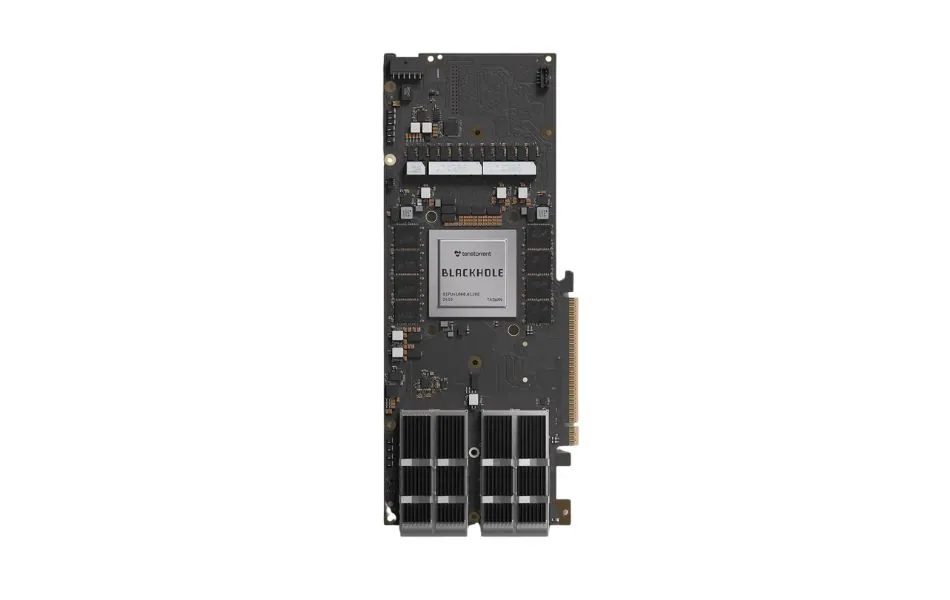
The timing of the change becomes clearer when viewed alongside other adjustments included in the same firmware release. TT Zephyr Platforms v19.5.0 also reduces Galaxy system power limits from 170 watts to 130 watts to remain within system constraints, along with a series of stability-focused updates affecting SerDes training and link behavior. While the Galaxy power change is a system-level adjustment rather than a downgrade of the p150 add-in cards themselves, taken together the updates point to a broader effort to tighten power envelopes and normalize behavior across Blackhole-based systems.
Tenstorrent’s documentation, however, remains in a transitional state. While store pages and add-in board tables now consistently list 120 Tensix cores for p150 products, some sections of the company’s broader documentation still reference 140-core configurations. For enterprise buyers and developers evaluating long-term platform commitments, that inconsistency raises unresolved questions about what earlier customers actually received and how future revisions will be handled.
Also Read: ASUS ROG Strix XG27UCG Gen 2 Brings 4K 162Hz and 485Hz Dual-Mode Gaming
What Tenstorrent has not clarified is whether any p150 cards ever shipped with all 140 cores fully enabled, whether the masked cores are power-gated for efficiency reasons, or whether future firmware could expose additional cores under specific conditions. Until those questions are answered, developers and buyers should treat 120 cores as the effective ceiling for the Blackhole p150 platform.
The practical impact will vary. Workloads that rely on higher-level abstractions and are throughput-bound may see little difference, while developers working close to Metal, particularly those relying on fixed grid assumptions or multi-card topologies, are more likely to feel the effects and may need to adjust code accordingly.
Rather than a simple downgrade, the move signals a shift in priorities. By enforcing a uniform logical configuration across both shipped and future hardware, Tenstorrent appears to be trading peak advertised specifications for predictability and platform stability. Whether that trade-off strengthens confidence in Blackhole as a deployable accelerator ecosystem will depend on how transparently the company addresses the remaining unanswered questions.
Sources: Tenstorrent, Tenstorrent