
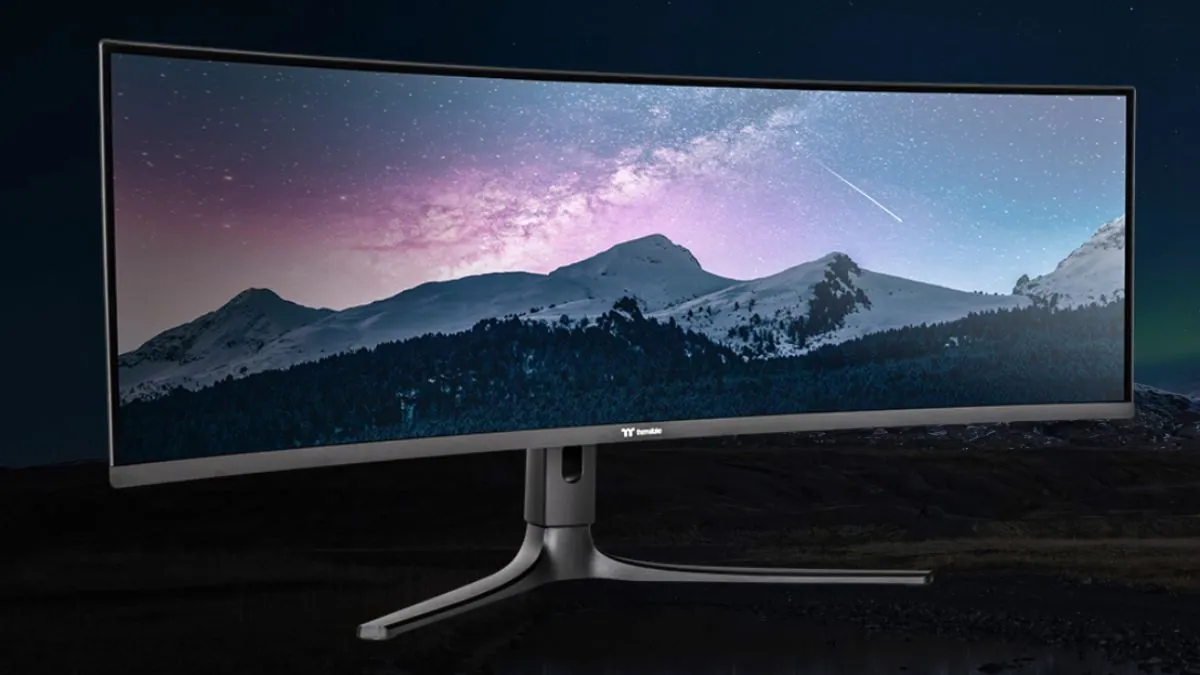
Thermaltake has expanded its gaming display portfolio with the TGM-V49CDQ, a 49-inch super ultrawide curved monitor featuring a 5120×1440 resolution and a 240Hz refresh rate.
Listed under part number GM-GCE-49CEUB-US, the display marks the company’s most aggressive entry yet into the premium 49-inch 32:9 gaming monitor segment, a category traditionally dominated by established display-focused brands.
Designed for competitive gaming, sim racing setups, and immersive multitasking environments, the TGM-V49CDQ combines high refresh performance with workstation-grade connectivity, including USB-C with 90W power delivery and integrated KVM functionality.
The 32:9 Dual QHD resolution effectively delivers the same screen real estate as two 2560×1440 monitors placed side by side, eliminating bezels in multi-monitor setups while maintaining a seamless viewing field.
Driving a 49-inch 5120×1440 gaming monitor at 240Hz requires substantial GPU horsepower. Achieving consistent high frame rates at Dual QHD resolution in modern AAA titles will likely require flagship-class graphics hardware. Even then, technologies such as DLSS, FSR, or XeSS may be necessary to consistently approach the 240Hz ceiling in graphically intensive games.
For esports titles, racing simulators, flight simulations, and competitive shooters, however, the high refresh rate becomes far more attainable and meaningful, offering improved motion clarity and reduced input latency.
From a bandwidth standpoint, DisplayPort 1.4 typically relies on Display Stream Compression to deliver 5120×1440 at 240Hz, while HDMI 2.1 offers greater throughput headroom. This makes the display clearly optimized for modern PC gaming systems. Console users should note that most current-generation consoles do not natively output 5120×1440 resolution, positioning this monitor primarily within the PC ecosystem rather than as a console-first solution.
The Fast VA panel implementation suggests Thermaltake is prioritizing motion performance. While traditional VA panels often advertise higher native contrast ratios, sometimes closer to 3000:1, the listed 1000:1 contrast figure indicates a tuning approach that favors response speed over deep black levels.
This is a common tradeoff in high-refresh VA panels engineered to reduce black smearing and improve pixel transition times. Competitive players may benefit from this tuning, though users expecting OLED-level contrast or mini-LED dynamic range should moderate expectations accordingly.
Color performance includes support for 1.07 billion colors with 10-bit depth and 95 percent DCI-P3 coverage, placing it comfortably above standard sRGB gaming monitors. Typical brightness is rated at 400 nits. HDR10 support is present, but without local dimming zones or significantly higher peak brightness, HDR performance should be considered entry-level. The display is more accurately described as HDR-compatible rather than a true high-dynamic-range reference panel.
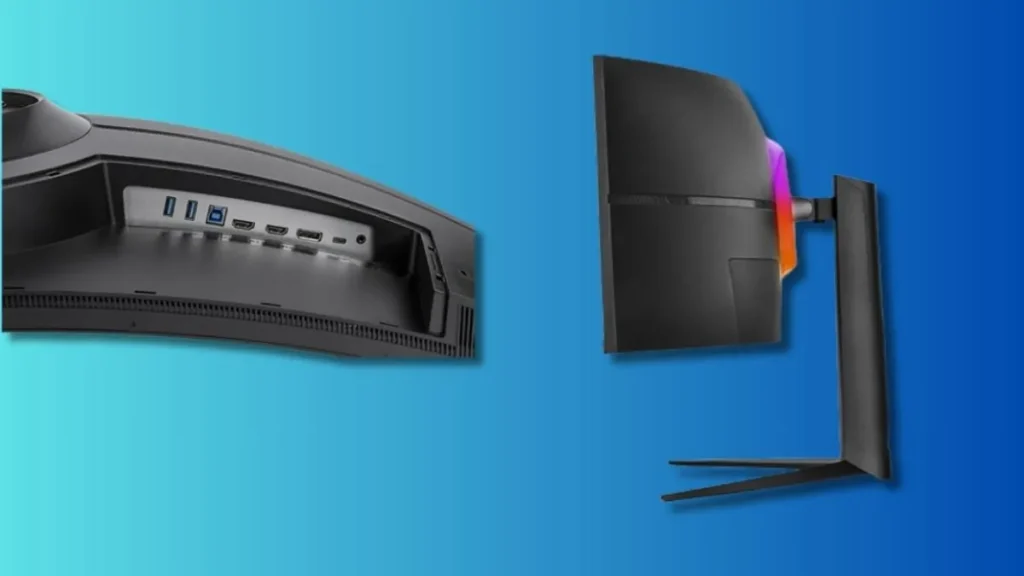
Connectivity stands out as one of the monitor’s strongest differentiators. Two HDMI 2.1 ports, one DisplayPort 1.4, and a USB-C port capable of delivering up to 90W of power allow the TGM-V49CDQ to function as both a high-refresh gaming monitor and a single-cable docking solution for laptops.
Ninety watts of USB-C power delivery is sufficient for most 14-inch and 16-inch performance notebooks, enabling hybrid users to power and connect their systems through one cable. The inclusion of a built-in KVM switch, along with Picture-in-Picture and Picture-by-Picture modes, further enhances its appeal to dual-PC streamers and professionals managing multiple systems.
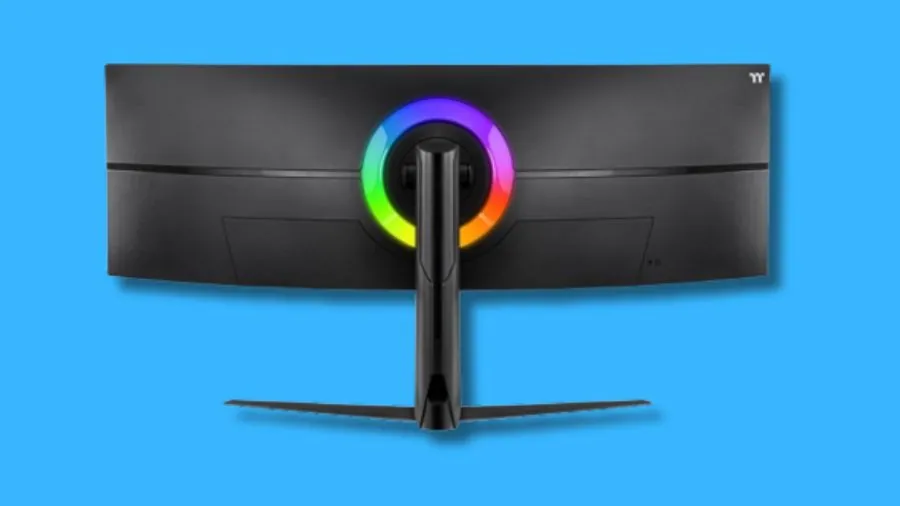
Ergonomic support includes up to 130mm of height adjustment, tilt from minus 5 to 20 degrees, swivel of plus or minus 20 degrees, and limited pivot functionality. The unit measures approximately 1150mm in width and weighs 9.6 kilograms, meaning users will require adequate desk space or a reinforced monitor arm. Maximum operational power consumption is rated at up to 240W, which reflects the size and refresh capabilities of the panel.
Within the broader 49-inch 240Hz ultrawide category, the TGM-V49CDQ positions itself as a high-refresh VA alternative that blends gaming performance with workstation functionality.
Competing models in this segment may offer IPS, mini-LED, or OLED technologies at higher price tiers, but Thermaltake appears to be focusing on delivering speed, USB-C docking convenience, and integrated KVM functionality within a more accessible performance bracket.
This monitor is particularly suited to sim racing enthusiasts seeking wraparound immersion, competitive PC gamers targeting high refresh responsiveness, streamers operating dual-system setups, and professionals looking to replace dual 27-inch QHD monitors with a seamless super ultrawide display. It is less suited for users prioritizing cinematic HDR depth or console-focused gaming.
Thermaltake has traditionally built its reputation in PC cases, cooling systems, and power supplies. The move into large-format high-refresh displays suggests a broader ecosystem strategy, targeting users who want cohesive desktop hardware across multiple categories. By combining 240Hz Dual QHD performance with USB-C 90W power delivery and integrated KVM support, the TGM-V49CDQ aims to bridge competitive gaming and productivity consolidation within a single 49-inch curved format.
Key Specifications
| Panel Size | 49-inch Fast VA (Curved 32:9) |
| Resolution | 5120 × 1440 (Dual QHD / DQHD) |
| Aspect Ratio | 32:9 Super Ultrawide |
| Refresh Rate | Up to 240Hz |
| Response Time | 1ms GTG |
| Brightness | 400 nits (Typical) |
| Color Gamut | DCI-P3 95% |
| Contrast Ratio | 1000:1 (Typical) |
| Color Depth | 1.07B colors, 10-bit |
| VRR Support | FreeSync Premium, G-SYNC Compatible |
| HDR | HDR10 |
| Ports | 2× HDMI 2.1, 1× DP 1.4, 1× USB-C (90W), 2× USB-A, Audio Out |
| KVM / PIP / PBP | Yes |
| Power Consumption | ≤240W (Typical) |
| VESA Mount | 100 × 100 mm |
| Model Number | GM-GCE-49CEUB-US |
Final retail pricing and broad availability have not yet been formally confirmed. If positioned competitively, the Thermaltake TGM-V49CDQ could emerge as a balanced option in the increasingly crowded 5120×1440 240Hz super ultrawide gaming monitor market.
Source: Thermaltake