
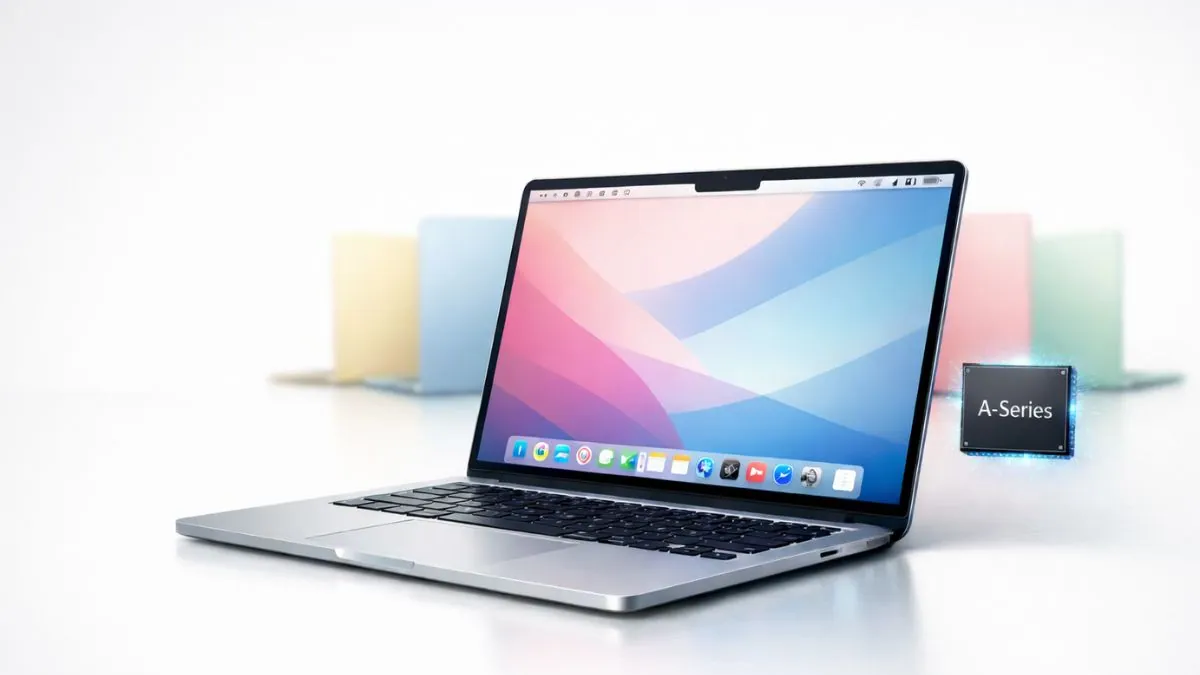
Apple is preparing one of the most aggressive entry-level Mac expansions in its history, with industry sources indicating that a new low-cost MacBook powered by an iPhone-class A-series chip could debut as early as March.
If the device launches in the rumored $699 to $799 range, it would mark a structural shift in Apple’s Mac pricing strategy and place the company in more direct competition with premium Chromebooks, entry-level Windows laptops, and Snapdragon-powered thin-and-light systems.
Unlike existing MacBook Air models that rely on M-series silicon, this upcoming machine is expected to use an A-series processor derived from Apple’s iPhone architecture. The decision is not merely cost-cutting. iPhone chips are produced at a massive scale with mature yields and optimized supply chains, giving Apple greater silicon flexibility while reducing wafer allocation pressure on higher-margin M-series production.
From a margin standpoint, leveraging an established mobile architecture allows Apple to protect profitability even at a lower retail price, particularly as memory and NAND storage markets remain volatile.
Performance will ultimately define perception. While this MacBook would not compete with M3 or M4 systems in sustained professional workloads, modern A-series chips deliver impressive efficiency and burst performance. For web browsing, document work, media consumption, cloud applications, light coding, and basic creative tasks, real-world performance differences may be less dramatic than synthetic benchmarks suggest.
Apple’s unified memory architecture, aggressive memory compression, and fast SSD swap behavior should help macOS operate smoothly within a lower power envelope.
According to Bloomberg, the base configuration may include 8GB of unified memory. The specification has already sparked discussion among enthusiasts, particularly as memory expectations continue to rise in entry-level systems.
Within Apple’s tightly integrated architecture, however, 8GB has historically delivered adequate performance for everyday productivity, web-based workflows, and student use. Users handling sustained video editing, virtualization, or large datasets would likely remain better suited to higher-tier Mac models, reinforcing this device’s positioning as an entry-level system rather than a professional workstation.
Feature compromises are expected as part of the pricing strategy. Industry watchers anticipate USB 3.2 Gen 2 connectivity instead of Thunderbolt support, likely limiting high-bandwidth external workflows. The display may sit just under 13 inches, aligning it below the current MacBook Air positioning.
A haptic trackpad is expected to remain, but some reports indicate the possibility of a non-backlit keyboard in the base configuration. These trade-offs signal clear segmentation without undermining everyday usability. Base storage could start at 256GB SSD, though Apple may retain upgrade tiers to maintain the average selling price.
The enclosure itself is rumored to adopt a refined aluminum manufacturing process designed to reduce internal structural complexity while improving thermal efficiency. Apple has consistently emphasized recycled aluminum alloys across its Mac lineup, and this model may align closely with the company’s 2030 carbon neutrality roadmap.
If graphite layers or redesigned heat spreaders are integrated, similar to thermal strategies used in high-end iPhones, Apple could offset the sustained performance limitations of a lower-power chip without significantly increasing cost.
Color may be a central differentiator. Sources suggest brighter finishes such as yellow, green, blue, and pink alongside classic silver and gray. That broader palette mirrors Apple’s approach with certain iPad and iMac lines and signals clear targeting of students and younger consumers. In the sub-$800 segment, design appeal can be as influential as raw performance.

Education appears central to the strategy. Chromebooks have dominated U.S. K-12 markets for more than a decade, largely due to price accessibility. A $699 Mac powered by Apple silicon could meaningfully narrow that gap, especially if Apple introduces education-specific incentives or volume discounts.
In emerging markets such as India and Southeast Asia, where price sensitivity remains high, a lower-cost Mac could substantially expand Apple’s installed base.
That installed base expansion carries long-term strategic implications. Industry estimates suggest Apple could target annual shipments between five and eight million units for this model. Beyond hardware revenue, each new Mac user increases the likelihood of subscriptions to iCloud, Apple Music, Apple TV+, and other digital services. For investors, installed base growth often generates stronger lifetime value than short-term hardware margins alone.
From a software perspective, the use of an A-series chip in a Mac introduces intriguing macOS optimization considerations. Apple already shares architectural foundations across iPhone, iPad, and Mac silicon, but scaling macOS for a more efficiency-weighted processor could encourage further operating system refinements.
Battery life may prove a hidden advantage, as A-series chips are engineered for extreme power efficiency. Developers may also benefit from improved cross-device performance parity between iPadOS and macOS applications, particularly as Apple continues to unify frameworks.
Rosetta translation performance will be closely watched. While Apple’s ARM transition has matured significantly, sustained translation workloads on an A-series chip may differ from M-series systems optimized for heavier desktop tasks. However, given Apple’s vertical integration and control over both silicon and software stacks, compatibility concerns are unlikely to be severe for mainstream users.
The timing aligns with Apple’s traditional spring product cadence, which often emphasizes consumer and education hardware ahead of its fiscal second quarter. If unveiled alongside updates to MacBook Pro or MacBook Air models, the new device would complete a tiered Mac lineup spanning entry-level to professional systems and eliminate reliance on older-generation hardware to fill lower price tiers.
This MacBook is not expected to replace the MacBook Air outright. Instead, it appears designed to coexist beneath it as a purpose-built gateway device engineered specifically for scale. Rather than discounting aging models, Apple seems prepared to redefine what entry-level means within its ecosystem.
If the reports hold, Apple’s low-cost MacBook will represent more than an affordable laptop. It signals a broader strategic recalibration, optimizing silicon allocation, expanding global market reach, strengthening ecosystem lock-in, and competing directly in segments historically left to rivals. At $699, powered by an iPhone-class chip and wrapped in a newly engineered aluminum design, this could become one of the most consequential Mac launches in years.
Source: Bloomberg