
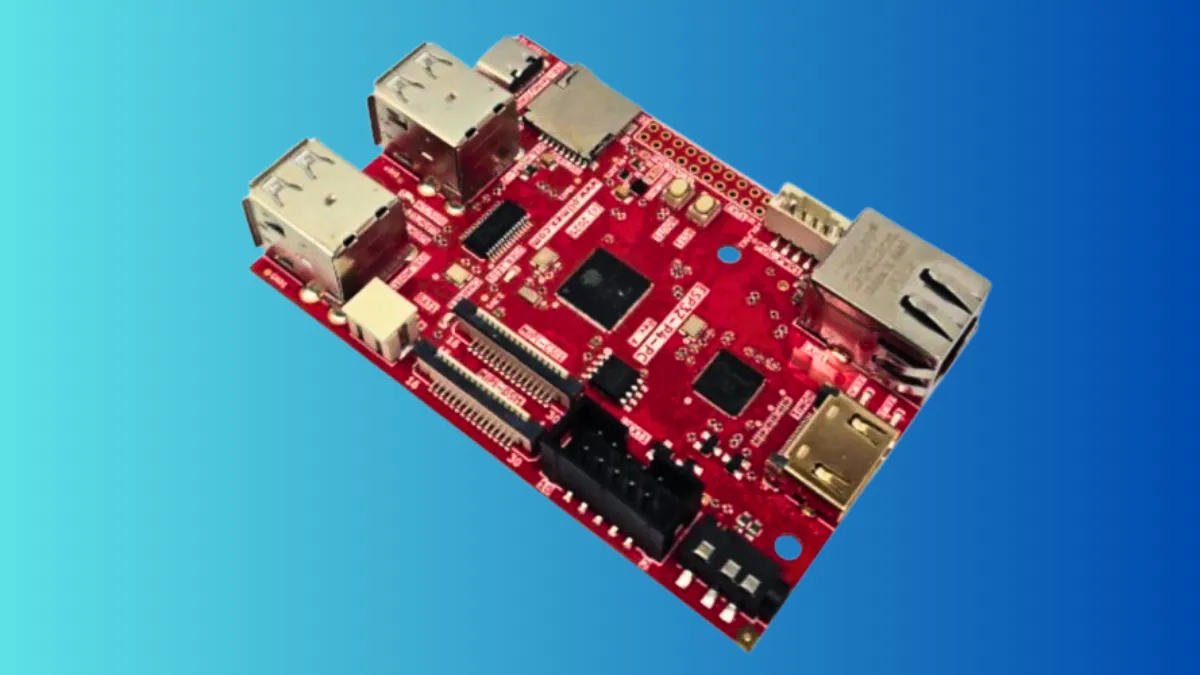
Olimex has released the ESP32-P4-PC, an open-source development board built around Espressif’s ESP32-P4NRW32 chip. Measuring 90 × 60 mm, the board combines HDMI output, 10/100 Ethernet, four USB 2.0 ports, and battery-backed power support on a compact RISC-V microcontroller platform.
The board is priced at €24.95, with shipments expected to begin February 23, 2026. It targets embedded systems that need display output and wired connectivity without stepping up to a full Linux single-board computer.
The ESP32-P4NRW32 features a dual-core 32-bit RISC-V processor running up to 400 MHz. A separate low-power RISC-V core, clocked up to 40 MHz, handles background tasks and energy-sensitive operations. The chip includes an AI instruction extension, a floating-point unit, and a 2D Pixel Processing Accelerator. Hardware support for H.264 and JPEG is also integrated.
This hardware mix is designed for real-time graphics, embedded interfaces, and multimedia handling where stable timing is more important than multitasking.
The memory configuration includes 768 KB of internal L2 memory and 32 MB of external PSRAM. Storage comes from 16 MB of onboard NOR flash, with expansion through a microSD slot. Compared to earlier ESP32 boards, the additional RAM allows smoother graphical user interfaces and improved video buffering.
HDMI output is implemented using an LT8912B MIPI-to-HDMI bridge. Developers can connect the board directly to standard monitors without adding external display controllers. For industrial control panels, kiosks, smart dashboards, or digital signage, this simplifies system design.
MIPI DSI and MIPI CSI interfaces are also available. This allows display panels and camera modules to operate from the same microcontroller. With built-in video acceleration and 2D graphics support, the board can function as an embedded display controller, camera viewer, or compact vision system.
Networking is handled through a 10/100 Mbps Fast Ethernet port. Power over Ethernet is supported through an optional add-on module. Although limited to Fast Ethernet speeds, the wired-first design favors stable and predictable connectivity in commercial and industrial environments.
Wireless networking is not included by default. Expansion is possible through the UEXT connector for add-on modules.
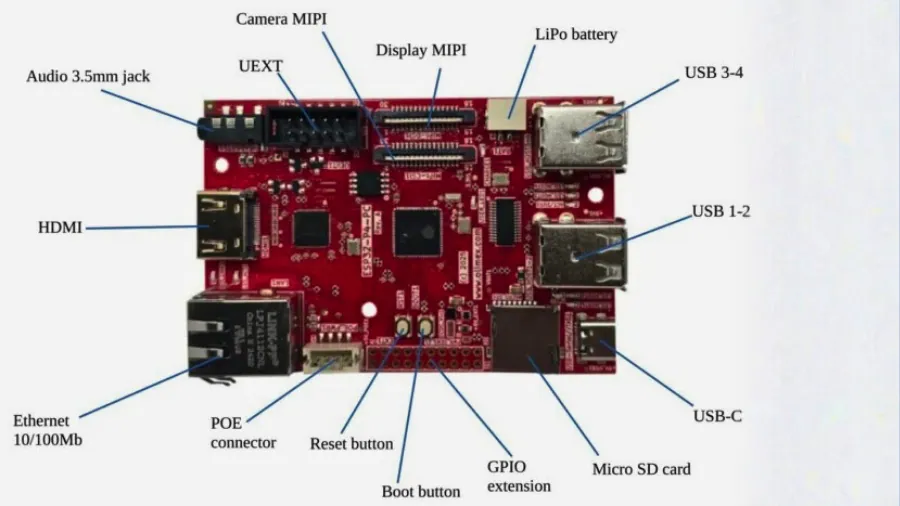
Four USB 2.0 Type-A ports are integrated directly on the board. This allows keyboards, storage devices, barcode scanners, and other USB peripherals to connect without external hubs. USB-JTAG support simplifies programming and debugging under the ESP-IDF framework. A 20-pin GPIO header provides additional I/O for custom integrations.
Power options include USB Type-C input, LiPo battery operation, and optional PoE. The board integrates battery charging, power sensing, and a step-up converter. In applications such as access control systems or industrial terminals, it can continue operating during short power interruptions.
The ESP32-P4-PC does not run Linux and is not intended to replace Raspberry Pi-class systems. Instead, it sits between traditional microcontroller boards and entry-level ARM SBCs, offering richer I/O while maintaining fast boot times and real-time behavior.
Also Read: DShanPi-A1 RK3576 SBC Launches With HDMI Input, Dual GbE and 6 TOPS AI
All hardware design files are open source, including KiCad schematics and layout files. Developers and OEMs can adapt the design for custom products while using Espressif’s existing ESP-IDF development ecosystem.
For display-driven embedded projects that require wired networking, HDMI output, and flexible power options, the ESP32-P4-PC delivers an unusually integrated feature set in a compact and affordable format.
Key Technical Specifications
| SoC | ESP32-P4NRW32 |
| CPU | Dual-core 32-bit RISC-V up to 400 MHz |
| Low-Power Core | RISC-V LP core up to 40 MHz |
| AI & Graphics | AI instruction extension, single-precision FPU, 2D Pixel Processing Accelerator |
| Memory | 768 KB internal L2 + 32 MB external PSRAM |
| Storage | 16 MB NOR Flash + microSD card slot |
| HDMI | Via LT8912B MIPI-to-HDMI bridge |
| Display Interface | MIPI DSI |
| Camera Interface | MIPI CSI |
| Video Acceleration | H.264 and JPEG hardware support |
| Ethernet | 10/100 Mbps Fast Ethernet |
| PoE | Optional add-on module |
| USB | 4 × USB 2.0 Type-A |
| Debugging | USB-JTAG |
| Power Input | USB-C, LiPo battery, optional PoE |
| Battery Features | Integrated charger, step-up converter, power sensing |
| Dimensions | 90 × 60 mm |
| Hardware Design | Fully open source (KiCad files and schematics available) |
Sources: Olimex, CNX Software