
NVIDIA is preparing to enter the consumer laptop CPU market in 2026 with its long-rumored N1X Arm-based processor. According to a recent report from The Wall Street Journal, early laptops powered by the chip are expected to come from Dell and Lenovo.
The move would mark NVIDIA’s first major step into building a dedicated NVIDIA Arm CPU for Windows laptops, expanding beyond its well-known discrete GPUs and AI accelerators into a fully integrated NVIDIA laptop SoC platform for the Windows-on-Arm ecosystem.
The N1X is believed to be a consumer-focused variant of NVIDIA’s GB10 Grace Blackwell architecture, currently used in the company’s DGX Spark AI systems. While the enterprise GB10 chip is designed for heavy AI workloads and data center acceleration, the N1X AI PC processor is expected to bring similar Grace Blackwell DNA to thin-and-light Windows laptops and high-performance notebooks aimed at everyday users, developers, and creative professionals.
Earlier leaks suggested the NVIDIA Arm laptop processor was originally planned for release in 2025 but was delayed due to software and platform-related issues. A previous report detailed how persistent driver bugs and Windows-on-Arm optimization challenges pushed the launch timeline into mid-2026.
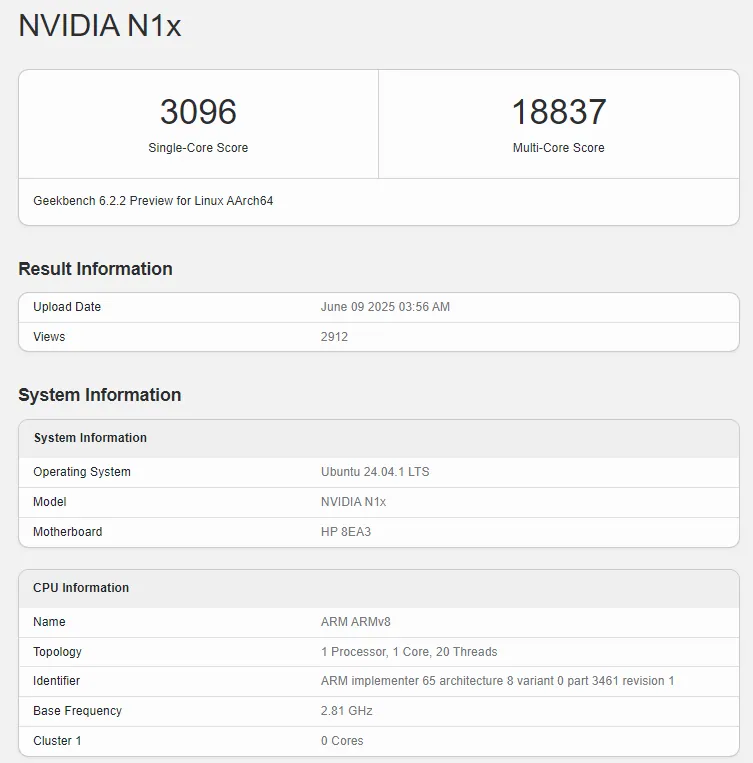
Reports citing internal development challenges point to driver maturity, Windows-on-Arm optimization, and broader ecosystem readiness as key reasons for the postponement. The chip has previously appeared in Geekbench and FurMark listings, indicating active internal testing of the NVIDIA Windows laptop SoC ahead of its revised 2026 launch window, possibly around Q2 2026.
Dell and Lenovo are expected to be among the first OEMs to ship laptops powered by the new NVIDIA N1X processor. Lenovo may introduce the chip in select Legion gaming laptops, alongside refreshed Yoga, Yoga Pro, and IdeaPad models.
Dell could bring the silicon to premium consumer systems and potentially future Alienware gaming laptops. Early backing from two of the world’s largest PC manufacturers suggests this is a strategic Windows-on-Arm AI PC push rather than a limited pilot program.
Another processor, reportedly called N1V, has also surfaced in leaks, though its exact positioning in NVIDIA’s consumer CPU lineup remains unclear.
Both N1X and N1V are believed to combine an Arm-based CPU core design developed in collaboration with MediaTek and NVIDIA-designed integrated graphics. This hybrid approach would allow NVIDIA to embed its GPU expertise directly into the system-on-chip while leveraging MediaTek’s experience with power-efficient Arm architectures, creating a competitive NVIDIA integrated GPU laptop platform.
NVIDIA dominates the discrete GPU and AI accelerator markets but has historically relied on Intel and AMD CPUs in laptops and desktops. By launching its own Arm-based Windows laptop processor, NVIDIA is moving toward full platform integration, similar to Apple’s transition to its in-house M-series silicon. Integrating CPU, GPU, and AI engines into a unified Arm SoC could enable tighter power management, improved thermals, stronger integrated graphics performance, and more efficient on-device AI processing, all key requirements for next-generation AI PC processors launching in 2026.
The Windows-on-Arm ecosystem is expanding, largely driven by Qualcomm’s Snapdragon X series. While Intel and AMD continue to lead the broader x86 laptop market, energy-efficient Arm designs are gaining traction in premium ultrabooks and AI-focused notebooks. If NVIDIA delivers superior integrated GPU performance and AI acceleration, the N1X could emerge as a direct Snapdragon X competitor and position itself as an Apple M-series rival in certain productivity, creative, and AI workloads.
Most current Windows-on-Arm laptops prioritize battery life and office productivity. If NVIDIA integrates a more powerful low-power GPU based on its existing architecture, thin gaming laptops and creator-focused systems could operate without relying on discrete graphics. That would offer OEMs new flexibility in system design while maintaining strong graphical performance in a compact form factor, reinforcing NVIDIA’s identity as a graphics-first laptop SoC provider.
NVIDIA’s CUDA platform and AI software tools are widely used in professional and enterprise environments. If similar AI capabilities are brought to Windows-on-Arm laptops powered by the N1X chip, developers and creators could see stronger on-device performance. This could allow faster local AI processing, smoother generative AI applications, and improved machine learning workloads without depending heavily on cloud services. As Microsoft and its partners expand the Copilot+ PC program toward 2026, NVIDIA’s move into laptop processors may influence the direction of the AI PC market.
Windows-on-Arm compatibility continues to improve, but some legacy x86 applications and certain PC games still rely on emulation, which can reduce performance. Driver maturity, battery efficiency, thermal management, and independent benchmark results will ultimately show how competitive N1X laptops are against Intel and AMD systems, as well as Apple’s Arm-based MacBooks and Qualcomm Snapdragon X devices.
For manufacturers such as Dell and Lenovo, adopting NVIDIA silicon would provide an additional platform option beyond traditional CPU vendors. For NVIDIA, the N1X marks a clear expansion from discrete graphics into the Windows laptop processor space.
If the expected 2026 launch moves forward, the N1X could represent a meaningful shift in Windows-on-Arm development. Its long-term impact will depend on measurable performance, software stability, and how effectively it competes in a crowded laptop market that includes both Arm-based and x86 systems.
Source: Wall Street Journal