
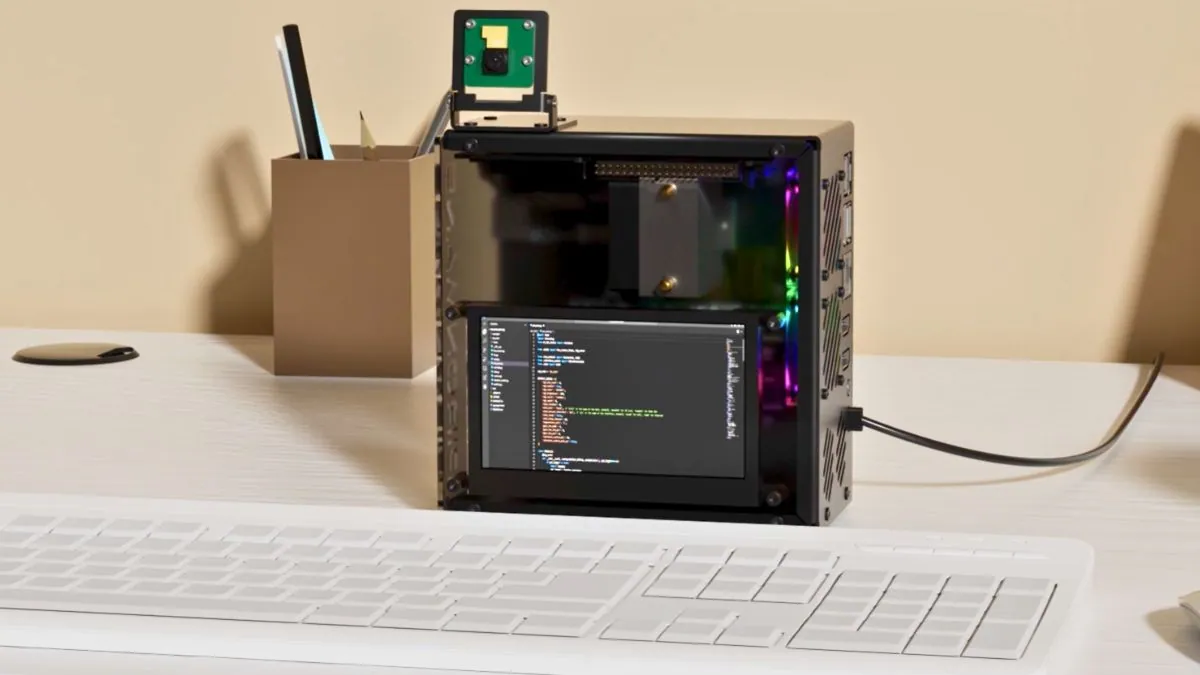
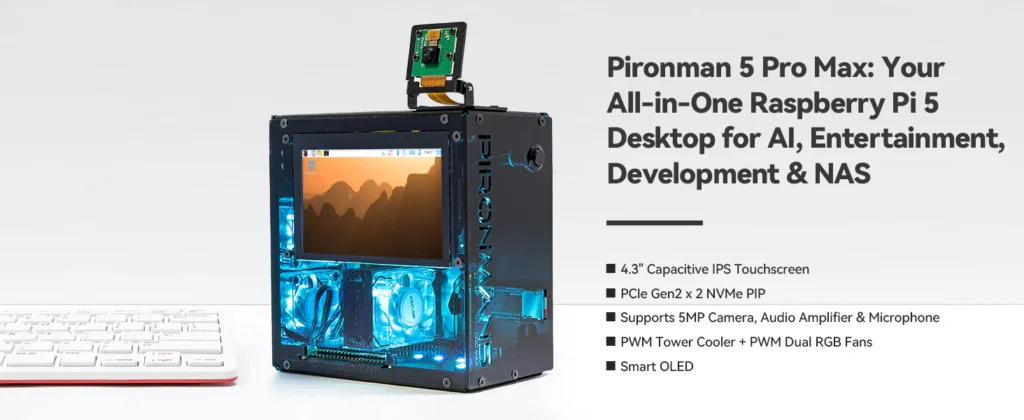
SunFounder has introduced the Pironman 5 Pro Max, a tower-style enclosure built around the Raspberry Pi 5. The new version expands on earlier Pironman models with a 4.3-inch touchscreen, dual NVMe support with RAID capability, upgraded cooling, and optional AI acceleration.
The case is listed at $145.99 without the Raspberry Pi board and is currently marked as coming soon. Buyers can configure storage, AI modules, and accessories directly through the company’s store.
The Pironman series has gradually shifted from decorative RGB cases toward more functional desktop-style builds. Earlier versions supported a single NVMe drive. The 5-MAX introduced dual NVMe with RAID support. The Pro Max keeps that storage flexibility and adds a side-mounted 4.3-inch capacitive IPS display with 800 × 480 resolution.
The touchscreen can be used as a system monitor, NAS status panel, or Home Assistant dashboard. It is not designed to replace a primary monitor, but it provides persistent system visibility for always-on setups.
The enclosure supports two M.2 NVMe drives in sizes ranging from 2230 to 2280 and enables RAID 0 or RAID 1 configurations. A built-in PCIe Gen2 switch enables both NVMe drives to operate through the Pi 5’s PCIe interface. Both drives operate through the Raspberry Pi 5’s PCIe interface, but it still represents a significant improvement over microSD-based systems or single-drive adapters.
AI acceleration is also supported through compatible M.2 modules such as the Hailo-8L, rated at 13 TOPS. This allows inference workloads to run separately from the CPU, which is useful for local object detection, lightweight machine learning tasks, or edge deployments. Similar trends are visible across newer single-board computers such as the DshanPi A1 with RK3576 and HDMI input, which also targets AI-focused edge use cases.
The Pro Max uses a PWM tower cooler and multiple RGB PWM fans. Stress testing shown in coverage indicates lower temperatures compared to the official Raspberry Pi active cooler. This is particularly relevant for users running dual NVMe drives or AI modules, where thermal throttling can become an issue.
The enclosure measures 140.9 × 77.0 × 138.7 mm and requires a 5V/5A USB-C input. SunFounder recommends the official 27W Raspberry Pi power supply to maintain stability.
Additional hardware includes a camera mount compatible with the Raspberry Pi Camera Module V2 and the Raspberry Pi AI camera. The case integrates dual 3W stereo speakers, a 3.5 mm audio jack, and a USB microphone dongle. Core Raspberry Pi 5 I/O remains accessible, including dual full-size HDMI, Ethernet, dual USB 3.0 ports, and one USB 2.0 port.
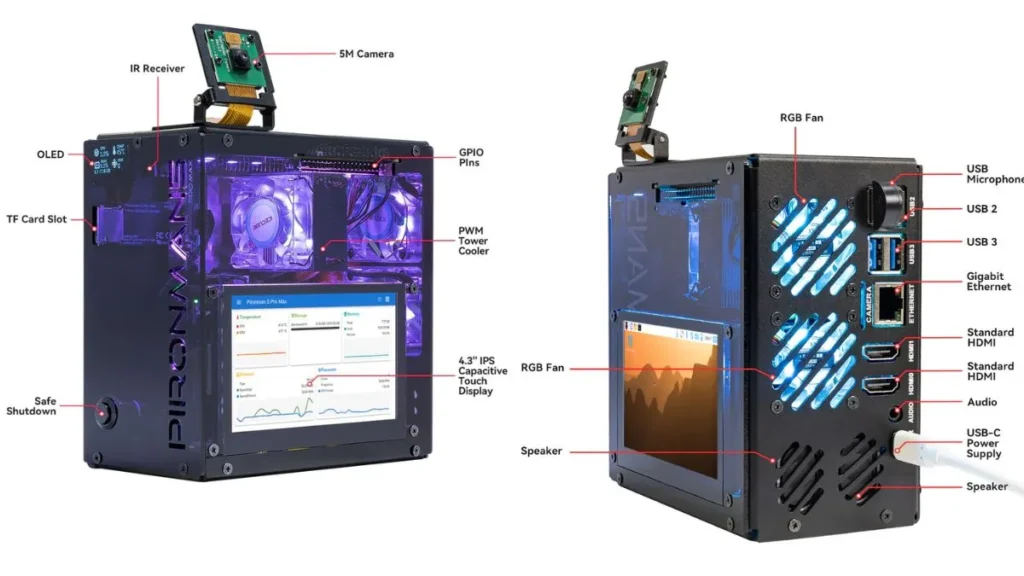
A 0.96-inch OLED display on the front shows system information such as CPU usage and temperature, with vibration-based wake functionality. The design also includes RTC battery support, GPIO access, and a dedicated power button.
Also Read: Akasa Euler CMX: 4L Fanless Mini-ITX Case with 220W DC-to-DC Power
Key Specifications
| Base Platform | Designed for Raspberry Pi 5 (2GB / 4GB / 8GB / 16GB) |
| Touchscreen | 4.3-inch IPS, 800 × 480 resolution |
| Secondary Display | 0.96-inch OLED system monitor with vibration wake |
| Storage Support | Dual M.2 NVMe (2230–2280) |
| RAID Modes | RAID 0 / RAID 1 |
| PCIe | PCIe Gen2 switch for dual NVMe support |
| AI Acceleration | Hailo-8L M.2 compatible (13 TOPS) |
| Cooling | PWM tower cooler + RGB PWM fans |
| Audio | Dual 3W stereo speakers + 3.5 mm audio jack |
| Camera Support | Raspberry Pi Camera Module V2 / Raspberry Pi AI Camera |
| Power Input | USB-C 5V/5A (27W recommended) |
| Dimensions | 140.9 × 77.0 × 138.7 mm |
| Price | $145.99 (case only) |
Even with expanded storage and cooling, overall performance is still defined by the Raspberry Pi 5’s underlying hardware. The enclosure is well suited for NAS deployments, Home Assistant setups, media serving, retro gaming, and edge AI tasks, but it does not alter the Pi’s CPU capabilities or position it for demanding compute workloads.
The enclosure alone is $145.99. Adding a Raspberry Pi 5, NVMe drives, and optional AI hardware can significantly increase total system price. For users invested in the Raspberry Pi ecosystem and its GPIO flexibility, the integration may justify the expense. For others, entry-level x86 mini PCs may offer higher raw performance at similar cost.
Independent benchmarks for RAID throughput, sustained thermal performance under dual NVMe load, and AI inference results have not yet been published. Those figures will better clarify how the enclosure performs beyond the specification sheet.
The Pironman 5 Pro Max continues SunFounder’s move toward more appliance-style Raspberry Pi builds, combining storage expansion, cooling, and embedded display hardware in a single chassis.
Source: Sunfounder