
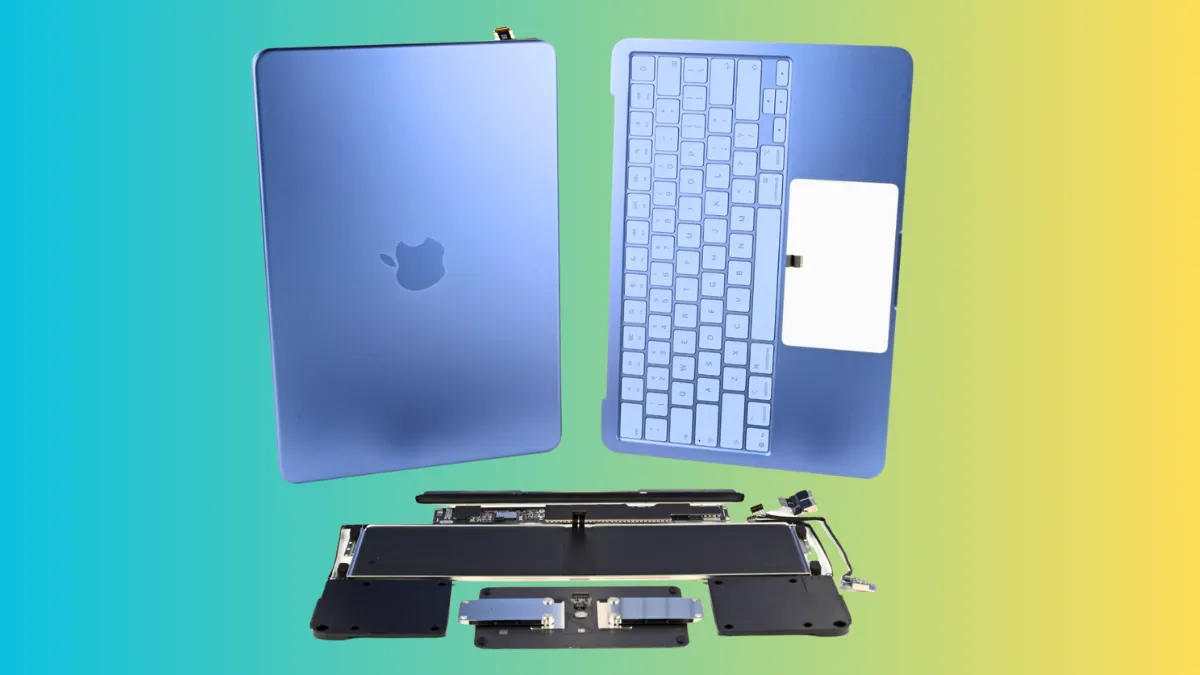
Apple’s newly introduced MacBook Neo is attracting attention from experts after a teardown showed the laptop is far easier to repair than most recent MacBooks. iFixit’s analysis suggests the MacBook Neo could be the most repairable MacBook Apple has released in more than a decade, showing a simpler internal layout than recent MacBook models.
The teardown reviewed the internal layout, component accessibility, and overall repair difficulty of Apple’s newest entry-level laptop. Technicians who reviewed the device said the MacBook Neo’s internal structure is noticeably simpler than that of recent MacBook models. Several important components can be accessed with fewer disassembly steps, potentially making repairs easier for service centers, schools, and organizations that manage large numbers of laptops.
After removing the bottom cover, components such as the battery connector, speakers, USB-C ports, and trackpad can be accessed without removing multiple layers of hardware. This kind of layout is uncommon in many modern laptops, especially recent MacBook models, where repairs often require removing several assemblies before reaching essential components.
Instead of being glued directly into the chassis, the MacBook Neo battery sits on a dedicated tray and is secured with screws. The battery pack is secured with eighteen screws, allowing technicians to remove it with standard tools rather than dealing with strong adhesives that previously made MacBook battery replacements more difficult and time-consuming. Repair experts say this change alone could simplify one of the most common laptop repairs.
The screw-mounted battery design also aligns with upcoming repair regulations in regions such as the European Union. These rules are expected to require portable electronics to include batteries that can be removed and replaced by technicians or users without specialized tools.
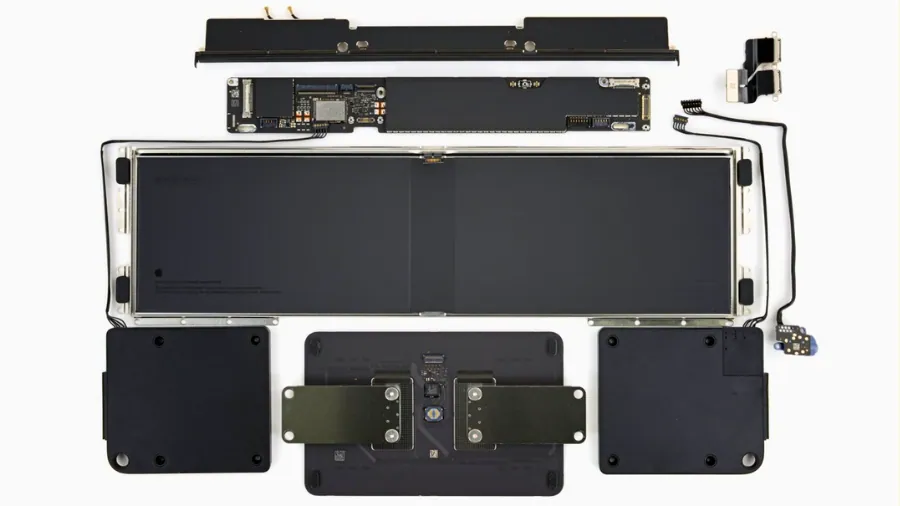
The teardown also showed that several other internal components follow a modular design. The USB-C charging ports are separate modules instead of being permanently attached to the logic board, meaning a damaged port can be replaced individually without replacing the entire motherboard. The headphone jack is also modular and can be removed independently with only a few screws. In addition, the display assembly is easier to detach because the antenna system no longer blocks the hinge screws, reducing the number of steps required to remove the screen.
Unlike the permanently integrated upper chassis used in several previous MacBook generations, the MacBook Neo keyboard can be replaced by removing a set of screws. The process still requires removing multiple fasteners, but it avoids the costly repair scenario in which the entire top case must be replaced to fix a faulty keyboard.
Despite these improvements, some components remain non-upgradeable. The teardown confirmed that both system memory and storage are soldered directly onto the logic board, meaning users cannot upgrade RAM or SSD capacity after purchase. Buyers therefore need to choose their preferred configuration at the time of purchase. The design is linked to Apple’s system architecture, where memory is integrated into the processor package to improve efficiency and overall performance.
The teardown also shows the MacBook Neo uses a mechanical clicking trackpad instead of Apple’s Force Touch haptic system, which has been standard in many MacBook models for years. The simpler mechanical design makes the trackpad easier to service and may also help reduce manufacturing costs while maintaining the familiar MacBook user experience.
Apple’s premium notebooks continue using more advanced hardware systems, including the MacBook Pro M5 Pro and M5 Max launch with upgraded performance architecture.
Repair technicians also reported fewer restrictions when swapping parts. In earlier Apple devices, replacing certain components could trigger software warnings or require calibration through Apple’s proprietary repair tools. In the MacBook Neo teardown, parts such as the battery and display were replaced without triggering system alerts, suggesting that Apple may be loosening some of the repair restrictions that previously complicated third-party repairs.
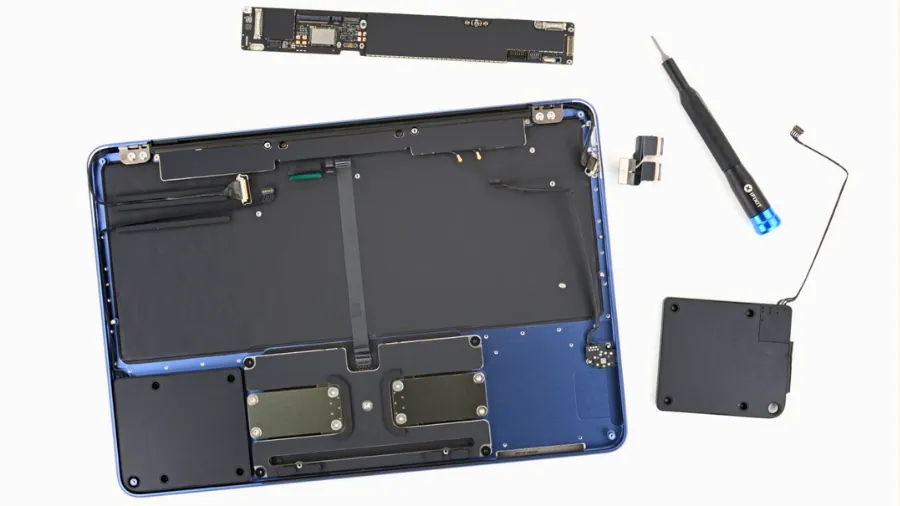
The teardown gave the MacBook Neo a repairability score of 6 out of 10. That score is higher than several recent MacBook models, reflecting a simpler internal layout and easier access to key components. However, memory and storage remain soldered to the logic board, which prevents post-purchase upgrades.
The MacBook Neo also seems to target the education market mainly at students and schools, where durability and easy repair are key factors when buying devices. Educational institutions usually prefer laptops that technicians can fix quickly instead of replacing them, especially when they have to maintain hundreds or even thousands of student machines.
The approach could also help Apple compete more directly with Chromebooks, which dominate many school environments around the world. Chromebooks have become popular in education partly because parts like batteries, keyboards, and displays are relatively easy to replace. If the MacBook Neo is easier to repair, Apple may be trying to position it as a more practical laptop for classrooms and budget-conscious buyers.
The teardown also hints that Apple may be experimenting with a different balance between performance, cost, and repairability. Although the MacBook Neo still relies on soldered RAM and storage, its simpler internal design and more modular components make it one of the most serviceable MacBooks released in recent years.
For repair technicians, schools, and everyday laptop owners, the MacBook Neo could mark a small but meaningful shift toward Macs that are easier to maintain and less expensive to repair over time.
Source: IFIXIT