
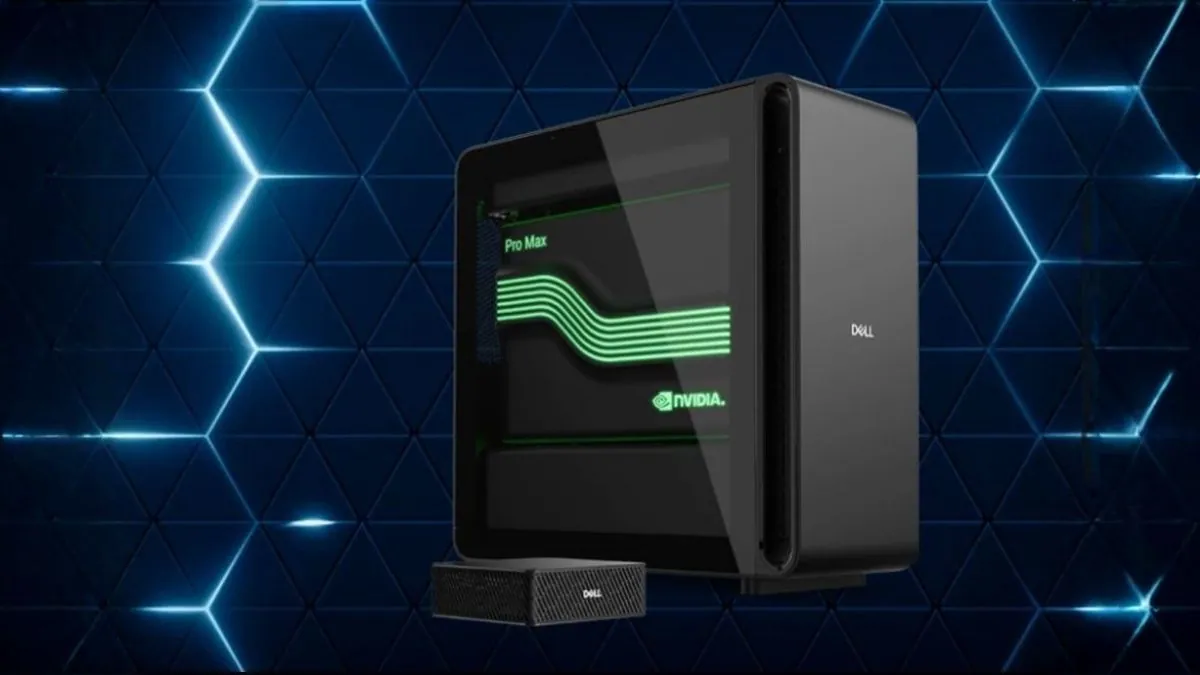
Dell has introduced a new Pro Max desktop built on NVIDIA’s GB300 platform, bringing up to 496GB of LPDDR5X memory into a workstation-class system designed specifically for local AI development and inference. Announced as part of Dell’s expanding on-prem AI portfolio, the system reflects a broader shift toward compact, integrated AI infrastructure that reduces reliance on cloud GPU deployments while keeping data local.
Unlike traditional workstations built around discrete CPUs and PCIe GPUs, Dell positions this system as an AI developer desktop powered by NVIDIA’s Grace Blackwell architecture. This design combines CPU and GPU resources with a unified high-bandwidth memory pool, enabling more efficient handling of large AI models that typically struggle with fragmented system RAM and VRAM.
| Key Specification | Details |
|---|---|
| Platform | NVIDIA GB300 (Grace + Blackwell architecture) |
| CPU | NVIDIA Grace-based ARM CPU (high core-count, server-class) |
| GPU | Blackwell-class integrated AI GPU |
| Memory | Up to 496GB LPDDR5X (unified, high-bandwidth) |
| Memory Architecture | Shared CPU-GPU memory pool |
| Storage | NVMe SSD support (enterprise-grade configurations expected) |
| Networking | High-speed enterprise networking (10–100GbE class, based on configuration) |
| Form Factor | AI developer desktop / workstation node |
| Target Workloads | AI inference, LLM fine-tuning, edge AI deployment |
| Software Stack | NVIDIA CUDA, TensorRT, NVIDIA AI Enterprise |
Dell has not disclosed full GPU core counts or exact AI TOPS performance figures, but based on NVIDIA’s GB300 platform direction, the system is expected to support modern precision formats such as FP4 and FP8, which are critical for efficient inference workloads. Compared to earlier architectures like Hopper (H100), Blackwell is designed to improve performance per watt and memory utilization, particularly for large language models and multimodal AI systems.
The defining feature of this system is the 496GB unified LPDDR5X memory pool. In practical terms, this shifts the bottleneck away from compute and toward memory capacity and bandwidth, which are now the primary constraints in many AI workflows. Large models often fail to run efficiently on traditional systems because they must be split across CPU memory and GPU VRAM, introducing latency and overhead. By keeping data in a single shared memory space, Dell’s configuration is designed to reduce data movement and improve inference efficiency.
This architecture enables real-world scenarios that are difficult on conventional workstations. Models in the 30B to 70B parameter range can potentially be loaded and executed locally without aggressive quantization or offloading, depending on optimization and precision settings. For enterprise teams, this means faster iteration, lower latency, and reduced dependency on cloud-based GPU clusters.
| Comparison Factor | Traditional AI Workstations | Dell Pro Max (GB300) |
|---|---|---|
| Compute Model | CPU + discrete GPU | Integrated Grace-Blackwell platform |
| Memory Layout | DDR5 + GPU VRAM split | Unified LPDDR5X pool |
| Data Movement | High overhead | Reduced |
| Upgradeability | Modular | Fixed configuration |
| Deployment | Complex (rack-scale) | Desk-side / edge deployment |
| Primary Limitation | VRAM capacity | Power and thermals |
Dell positions the system as an AI developer workstation rather than a general-purpose desktop. It targets enterprise AI teams, research labs, and organizations working with sensitive data or latency-critical applications, including finance, healthcare, and edge deployments. In these environments, running models locally is often preferable to cloud inference due to compliance, cost predictability, and data governance requirements.
Compared to NVIDIA’s DGX systems, including platforms like NVIDIA DGX Station, the Pro Max desktop occupies a lower tier in terms of raw compute scalability but significantly lowers deployment complexity. DGX platforms are designed for data center environments and large-scale training workloads, while Dell’s system is optimized for inference and development at the edge or within enterprise offices. It effectively bridges the gap between high-end AI workstations and full rack-scale infrastructure.
On the software side, the system is expected to integrate tightly with NVIDIA’s AI ecosystem, including CUDA for compute acceleration, TensorRT for inference optimization, and NVIDIA AI Enterprise for deployment and lifecycle management. This alignment is critical, as software optimization often determines real-world performance more than raw hardware specifications.
Dell has not published benchmark data or independent performance validation, and several details remain undisclosed. Pricing has not been announced, but the system is expected to target enterprise buyers rather than consumer markets. Availability timelines are also unclear, suggesting this may initially roll out through enterprise channels or as part of Dell’s AI infrastructure programs.
Thermal design and power consumption will be key factors in real-world deployment. Integrating a high-density memory subsystem with a Blackwell-class GPU in a desktop form factor presents engineering challenges, although Dell typically deploys advanced cooling solutions in its workstation lineup. The use of LPDDR5X memory also implies a fixed configuration, limiting post-purchase upgrades but enabling higher efficiency and bandwidth.
Also Read: Dell Launches SE2726HG Series 27-Inch IPS Gaming Monitors from $129
What distinguishes this launch is not just the headline memory capacity, but the direction it signals for AI hardware. Instead of scaling outward with more GPUs and larger clusters, vendors are increasingly focusing on scaling inward by integrating compute and memory into self-contained systems. This approach reduces infrastructure complexity while aligning with the growing demand for on-premise and edge AI solutions.
For organizations evaluating AI infrastructure, the key takeaway is practical rather than theoretical. Systems like this are designed to run larger models locally, minimize data movement, and simplify deployment without requiring full data center investment. While it will not replace multi-node clusters for large-scale training, it offers a viable alternative for inference-heavy workloads and development pipelines.
The Dell Pro Max with GB300 ultimately represents a transition point in enterprise AI computing, where memory capacity, integration, and deployment efficiency are becoming as important as raw compute power. Whether it delivers on that promise will depend on final performance disclosures, pricing, and software optimization, but its design direction is closely aligned with how AI workloads are evolving in real-world environments.
Source (s): Dell