

Razer introduced the 2026 Blade 18 with Intel’s Core Ultra 9 290HX Plus processor, up to Nvidia GeForce RTX 5090 laptop graphics running at 175W TGP, and an 18-inch dual-mode display capable of switching between UHD+ 240Hz and FHD+ 440Hz modes. The latest Blade 18 pushes even further into desktop replacement territory with higher sustained power targets, upgraded thermal hardware, Thunderbolt 5 connectivity, and stronger AI acceleration for local workloads.
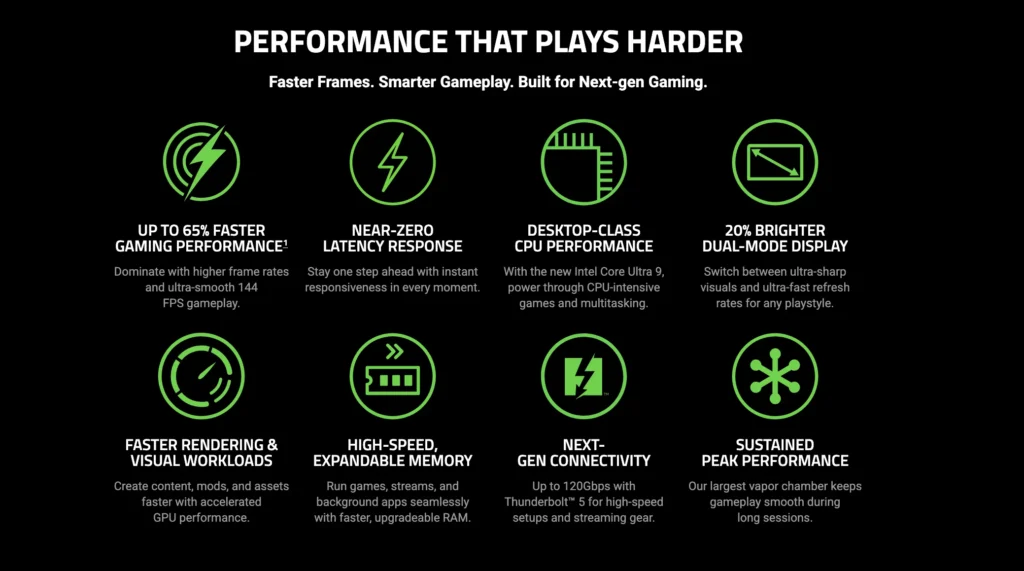
The Blade 18 remains one of the few gaming laptops combining ultra-high resolution and esports-level refresh rates on the same panel. Users can switch between 3840 × 2400 at 240Hz for content creation and visually demanding games or 1920 × 1200 at 440Hz for competitive gaming. The dual-mode panel remains unique in the 18-inch gaming laptop segment and removes the need to choose between image quality and maximum refresh rate.
Brightness reaches up to 600 nits, a 20% increase over the previous generation according to Razer. The 18-inch display carries a 16:10 aspect ratio, up to 100% DCI-P3 color coverage, Calman Verified color calibration, and a 3ms response time for fast-moving gameplay and creator workloads.
Performance hardware receives major upgrades this generation. Intel’s Core Ultra 9 290HX Plus features 24 cores with boost clocks reaching up to 5.5GHz, while the integrated NPU delivers up to 13 TOPS AI acceleration for background AI processing and inference tasks. Graphics scale up to Nvidia’s GeForce RTX 5090 Laptop GPU with 24GB VRAM alongside support for DLSS 4.5 Multi Frame Generation and Reflex 2 with Frame Warp.
Razer heavily emphasized local AI processing during the announcement. According to the company, the Blade 18 can deliver up to 37% faster large language model inference compared to competing laptop platforms. Razer reported up to 162 tokens per second in LM Studio testing while AI image generation performance can reach up to 2.2× faster speeds in certain rendering workloads.
Cooling hardware received a major redesign to sustain higher power levels during extended gaming and rendering sessions. The Blade 18 combines a large vapor chamber with triple-fan airflow, thermal hood routing, ultra-thin 0.05 mm cooling fins, and upgraded thermal interface materials. Razer claims the laptop can sustain up to 280W total package power under load.
Memory and storage capacities move well beyond traditional gaming notebook territory. The Blade 18 supports up to 128GB DDR5-6400 dual-channel memory alongside dual M.2 slots supporting up to 8TB PCIe Gen4 storage or 4TB Gen5 SSD configurations depending on setup.
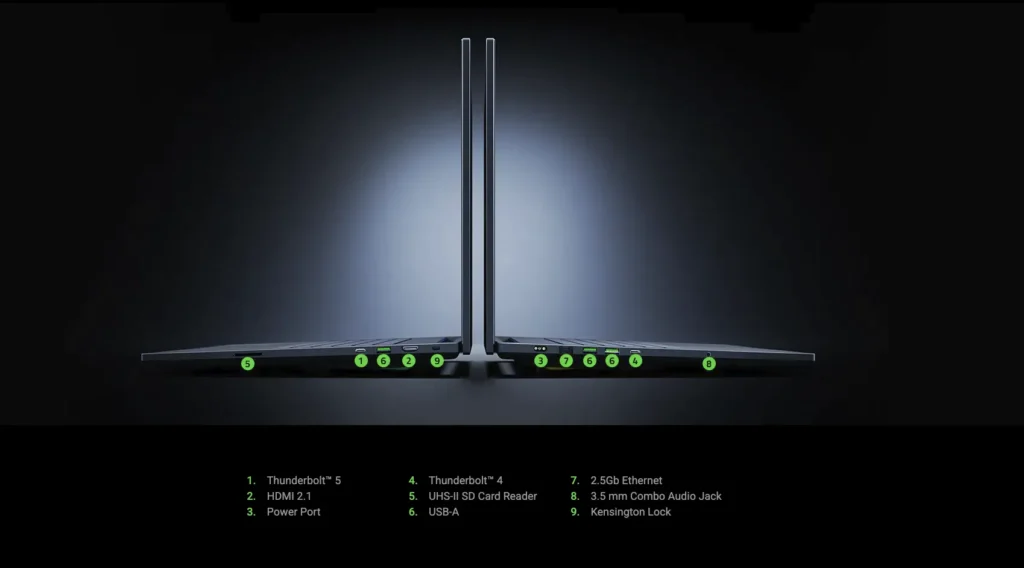
Connectivity becomes one of the strongest areas of the new Blade 18. Thunderbolt 5 support reaches up to 120Gbps bandwidth through Bandwidth Boost technology. The laptop carries Thunderbolt 4, HDMI 2.1, Wi-Fi 7, Bluetooth 5.4, 2.5Gb Ethernet, USB-A ports, a UHS-II SD card reader, and USB-C charging support up to 100W.
Razer continues using its CNC-milled aluminum unibody design, with each chassis carved from a single block of aluminum before receiving a sandblasted anodized finish. The Blade 18 weighs around 7.06 lbs (3.10 kg), making it noticeably heavier than thinner gaming notebooks but far better suited for sustained high-performance workloads.
Input hardware received upgrades as well. The Blade 18 features a full-size keyboard with per-key Razer Chroma RGB lighting, 1.5 mm key travel, and a large precision glass touchpad. Audio comes through a six-speaker arrangement tuned with THX Spatial Audio+ capable of virtual 7.1.4 surround sound.
For streaming and video calls, Razer upgraded the webcam to a 5MP IR sensor with Windows Hello facial recognition and a built-in privacy shutter. The laptop supports Linux alongside Windows 11, something Razer specifically highlights for developers working outside Microsoft’s ecosystem.
Razer has already started offering the Blade 18 through its official store and retail partners in select regions, though pricing varies depending on GPU and memory configuration.
Source: Razer Press