

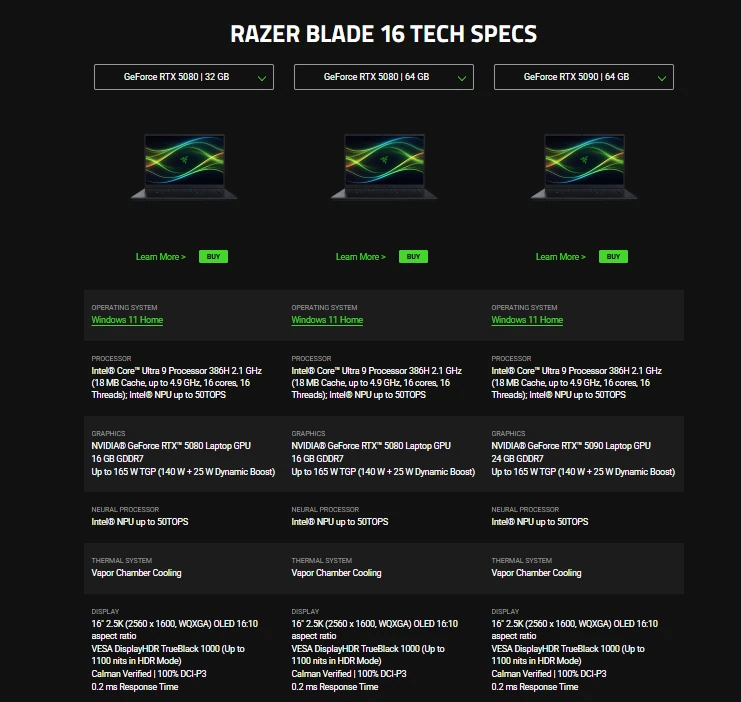
Thin gaming laptops usually cut GPU wattage heavily to keep temperatures under control. Razer is taking the opposite approach with the 2026 Blade 16. The laptop runs RTX 5080 and RTX 5090 configurations at up to 165W TGP while still keeping the chassis just 14.9 mm thick. Earlier Blade 16 configuration listings already pointed toward Razer pushing higher power targets inside the thinner chassis.
The RTX 5090 configuration carries 32GB of GDDR7 memory, while RTX 5080 models use 16GB. That puts the Blade 16 closer to larger desktop-replacement systems than most thin gaming laptops currently on the market.
Razer kept the same 16-inch OLED panel size and 2560 × 1600 resolution, but brightness has increased noticeably over the previous generation. The display now reaches VESA DisplayHDR TrueBlack 1000 certification with HDR brightness rated up to 1100 nits. Support for 100% DCI-P3 coverage, Calman verification, NVIDIA G-SYNC, and a 0.2 ms response time also remains intact, expanding on earlier Blade 16 OLED launch details.
HDR output is now roughly twice as bright as the earlier Blade 16 under supported HDR workloads.
Intel’s Core Ultra 9 386H handles processing duties with 16 cores, boost clocks up to 4.9 GHz, and an integrated NPU capable of up to 50 TOPS AI performance. Razer says the updated platform increases core count by roughly 33% over the earlier Blade 16 generation while improving efficiency during lighter workloads.
Configurations go up to 64GB of onboard LPDDR5X-9600 memory, which remains uncommon in this class of gaming laptops. Many competing RTX 5090 systems still rely on slower DDR5 or lower-speed LPDDR5X memory. Storage remains expandable through dual M.2 NVMe slots with support for capacities up to 8TB.
Razer is also putting more focus on efficiency this generation. The company claims up to 13 hours of productivity usage and as much as 15 hours of video playback under defined testing conditions, helped partly by Intel’s newer low-power cores and platform-level tuning.
Cooling comes from an updated vapor chamber layout paired with dual fans and thinner exhaust fins for sustained workloads. Razer also confirmed support for its HyperBoost feature when the laptop is paired with the optional Laptop Cooling Pad accessory, allowing select Blade 16 configurations to run at even higher graphics power levels.
The Blade 16 now includes both Thunderbolt 5 and Thunderbolt 4 alongside HDMI 2.1, three USB 3.2 Gen 2 Type-A ports, and a UHS-II SD card reader. Razer says Thunderbolt 5 can reach up to 120 Gbps bandwidth with Bandwidth Boost enabled. Wireless connectivity also moves to Wi-Fi 7 and Bluetooth 6.0.
Audio hardware now uses a revised six-speaker layout with four tweeters and two subwoofers. The updated THX Spatial Audio+ system also adds virtual 7.1.4 surround support for compatible headphones connected through the 3.5 mm jack.
The chassis still uses CNC-milled aluminum with a fingerprint-resistant coating, and Razer says the 2026 Blade lineup continues using recycled aluminum as part of the company’s broader sustainability plans.
Even with RTX 5090 graphics inside, the Blade 16 still weighs around 4.71 lbs (2.14 kg), keeping it among the lighter high-end gaming laptops currently available.
US pricing starts at $3,999.99 for RTX 5080 configurations with 32GB memory. Higher-end RTX 5090 versions with 64GB RAM and 2TB storage reach roughly $5,599.99 depending on configuration.
Source: ASUS Press