
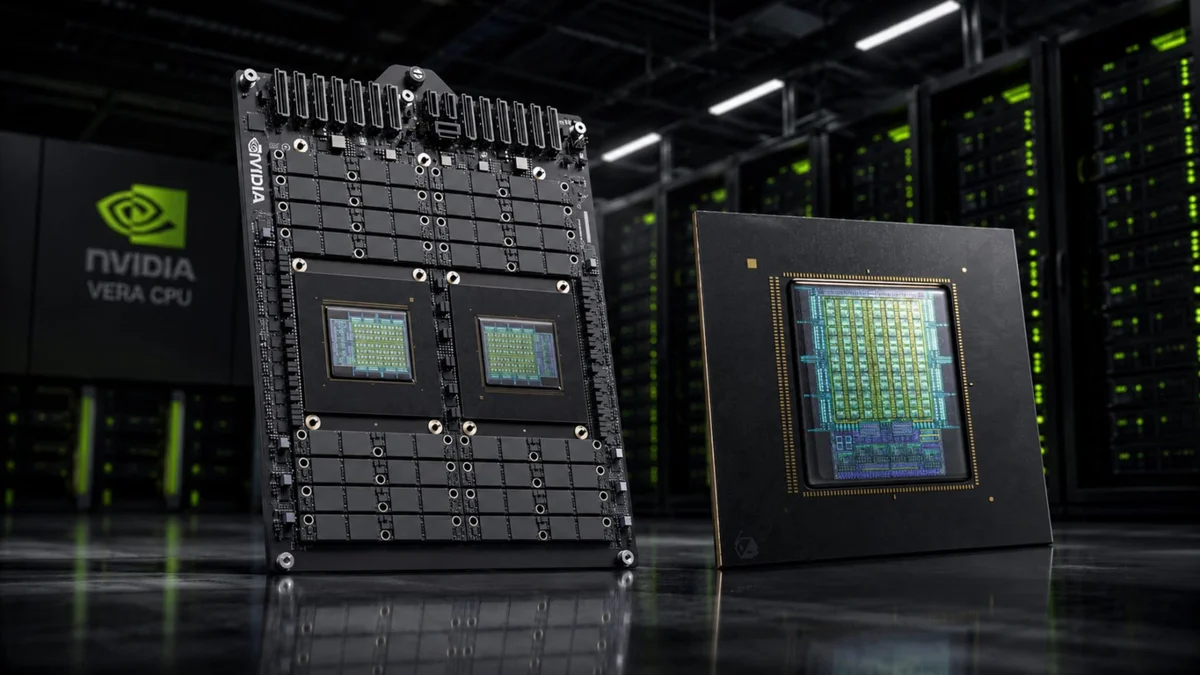
NVIDIA’s standalone server CPU, codenamed Vera, has emerged in public benchmarks for the first time, demonstrating a significant performance lead over current industry-standard x86 hardware. The standalone ARM-based processor is built around custom-designed cores, representing a major strategic shift for a company aiming to secure a large slice of the data center processor market.
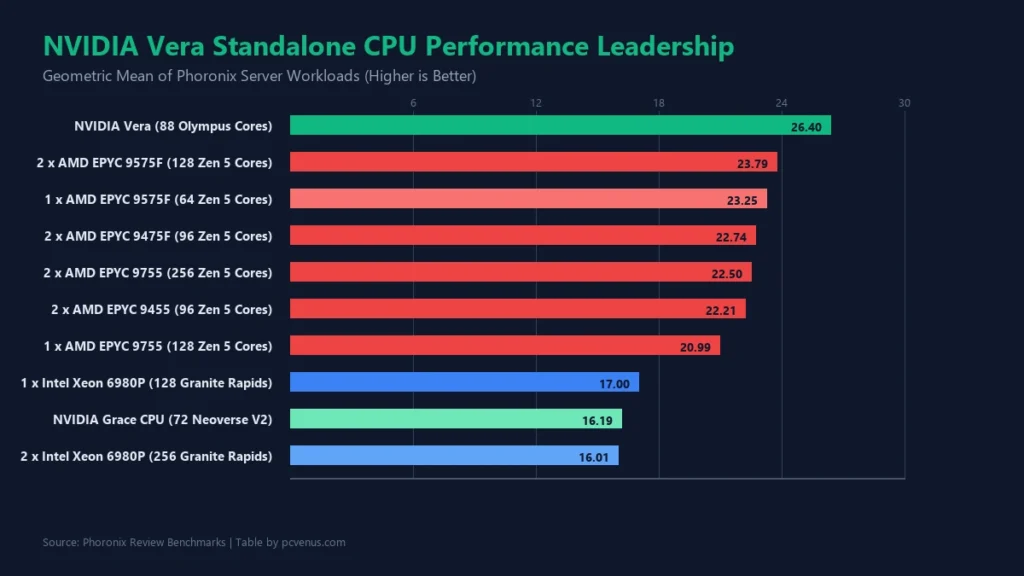
In independent testing published by Phoronix, the 88-core Vera CPU delivered a 63% geometric mean performance increase over its predecessor, the 72-core Grace chip. When tested against premium server silicon, NVIDIA’s new architecture outpaced AMD’s 64-core EPYC 9575F high-frequency chip by 10% and outperformed Intel’s 128-core flagship Xeon 6980P by 55% in standard compilation and database workloads.
Also read: Dell Deskside Agentic AI Series Enterprise Local AI
The Vera platform uses custom Olympus cores. These processors run on the Armv9.2 system. This new design helps the computer handle complex tasks smoothly. Unlike the standard ARM Neoverse cores used in the Grace CPU, Olympus is custom-engineered to handle sequential orchestration workloads, branch-heavy runtimes, and sandboxed execution environments typical of modern AI factories.
In addition to core performance, Vera integrates a second-generation LPDDR5X memory subsystem capable of delivering up to 1.2 TB/s of bandwidth. In STREAM TRIAD tests, the chip sustained 90% of its peak bandwidth while drawing less than 30 watts of memory power, representing a highly efficient alternative to standard DDR5 setups that frequently exceed 100 watts.
The low memory power footprint allows the platform to allocate more energy to active compute, maintaining high efficiency within the chip’s 450-watt socket thermal design power (TDP). These efficiency traits are becoming critical as enterprise environments evaluate next-generation data center options like the Intel Panther Lake architecture or standalone server designs.
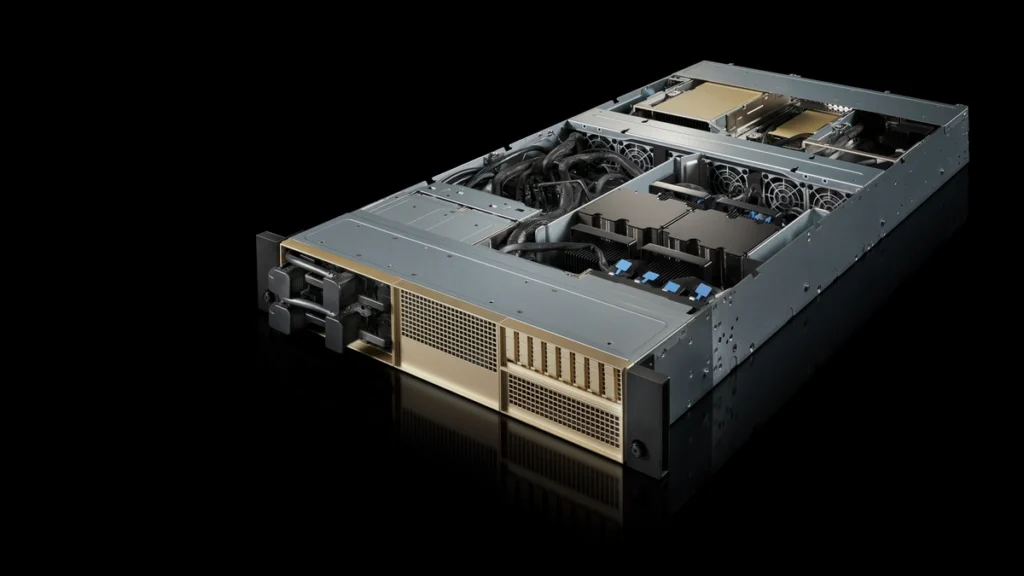
NVIDIA is not positioning Vera purely as a co-processor for its Rubin GPU platforms. Instead, standalone models will be available in both single- and dual-socket server configurations, supported by air- and liquid-cooled designs to fit standard enterprise infrastructure.
The company has already begun shipping early Vera CPU racks to select AI industry leaders, including Anthropic, OpenAI, SpaceX, and Oracle. With visible projections reaching nearly $20 billion in CPU revenue this year, NVIDIA is aggressively targeting a significant share of the broader data center market.
However, the competitive landscape is moving quickly. NVIDIA’s standalone silicon will soon face next-generation server competitors, including AMD’s upcoming Zen 6 Venice family and newer AMD Zen 6 Medusa Point architectures designed for consumer and edge servers. Standalone systems featuring the Vera CPU are scheduled to become widely available through hardware partners in the second half of the year.
Source: NVIDIA Blog